The JACO ElitePro Digital Tire Pressure Gauge is my best overall pick for drivers who want a dedicated digital gauge, while the AstroAI Digital Tire Pressure Gauge and Inflator stands out for people who want to check and add air with one tool. For a simple analog option, the TireTek 60 PSI avoids batteries and covers typical passenger-car pressures. The main choice is between easy-to-read digital displays, durable mechanical gauges, compact pencil designs, and tools with wider ranges for trucks or inflators. Range, valve access, and whether you need inflation built in matter more than headline PSI capacity alone. Read on for how all 15 options compare and which type best suits your needs.

Get furniture and decor delivered free with Prime
- Fast, free delivery on millions of items
- Prime Video, Amazon Music and more included
- Member-only deals all year
Complete the kit


Key Takeaways
- The JACO ElitePro Digital leads as a dedicated digital pick, while the AstroAI gauge-and-inflator combines pressure checks with air adjustment in one tool.
- Analog gauges split into distinct uses: TireTek’s 60 PSI range suits common car checks, while the ETENWOLF Glow Dial’s low-light display serves drivers checking tires after dark.
- High PSI capacity is not automatically an advantage: the 200–250 PSI digital models and 100–150 PSI options make more sense for broader vehicle or equipment needs than routine passenger-car checks.
- Multi-packs prioritize availability and coverage: ETENWOLF, Boao, AstroAI, and Builimeer bundles can supply spare gauges or valve caps, but buyers should weigh storage and matching the scale to their tires.
- Connection style changes usability: Builimeer’s dual-head design is aimed at reaching awkward valves, while compact pencil gauges trade display size and extra features for portability.
| TireTek 60 PSI Analog Tire Pressure Gauge |  | Best Analog Pick for Everyday Cars | Type: Analog tire pressure gauge | Maximum pressure: 60 PSI | Accuracy standard: ANSI B40.1 Grade B (2%) | VIEW ON AMAZON | See Our Full Breakdown |
| ETENWOLF T300 Digital Tire Pressure Gauge, 2-Pack, 3–200 PSI |  | Best Two-Pack for Wide Pressure Coverage | Model: T300 | Pack size: 2 gauges | Pressure range: 3–200 PSI | VIEW ON AMAZON | See Our Full Breakdown |
| ETENWOLF Tire Pressure Gauge, 0–75 PSI, Glow Dial | 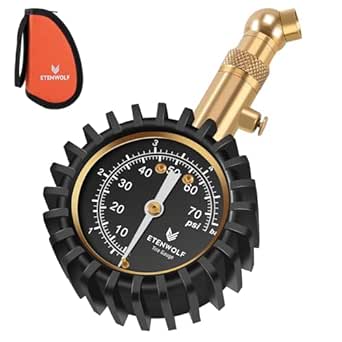 | Best Analog Choice for Low-Light Checks | Type: Analog tire pressure gauge | Pressure range: 0–75 PSI | Accuracy: ANSI B40.1 Grade A (±1% of span) | VIEW ON AMAZON | See Our Full Breakdown |
| ETENWOLF Pencil Tire Pressure Gauge 2-Pack, 10–50 PSI and 20–120 PSI |  | Best Two-Gauge Set for Mixed Pressure Needs | Pack size: 2 gauges | Pressure ranges: 10–50 PSI and 20–120 PSI | Accuracy: ANSI B40.1 Grade B; 2% of span in the middle 50% and 3% in the lower and upper 25% | VIEW ON AMAZON | See Our Full Breakdown |
| Boao Stainless Steel Pencil Tire Pressure Gauges with 20 Valve Stem Caps, 30 Pieces |  | Best Bulk Set for Glove Boxes and Shared Use | Quantity: 10 tire pressure gauges and 20 valve stem caps | Gauge material: Stainless steel | Gauge dimensions: 14.5 × 1 cm (5.7 × 0.4 inches) | VIEW ON AMAZON | See Our Full Breakdown |
| JACO ElitePro Tire Pressure Gauge, 100 PSI |  | Best Analog Gauge for Precise Adjustments | Type: Analog tire pressure gauge | Pressure range: Up to 100 PSI | Accuracy: Within ±1.5% | VIEW ON AMAZON | See Our Full Breakdown |
| Slime 20459 Brass Dial Tire Pressure Gauge, 5–60 psi |  | Best Compact Analog Pick | Type: Brass dial tire pressure gauge | Measurement range: 5–60 PSI | Units: PSI and bar | VIEW ON AMAZON | See Our Full Breakdown |
| AstroAI Heavy-Duty Digital Tire Pressure Gauge, 0–230 PSI |  | Best for High-Pressure and Multi-Vehicle Use | Pressure range: 0–230 PSI | Other measurement units: Bar, kg/cm², and kPa | Accuracy: ANSI B40.7 Grade 2A (0.5%) | VIEW ON AMAZON | See Our Full Breakdown |
| AstroAI Digital Tire Pressure Gauge and Inflator, 3–250 PSI |  | Best for Inflating and Deflating at the Tire | Pressure range: 3–250 PSI | Pressure units: PSI, bar, kPa, and kg/cm² | Resolution: 0.1 PSI | VIEW ON AMAZON | See Our Full Breakdown |
| AstroAI Digital Tire Pressure Gauge, 150 PSI |  | Best Everyday Digital Gauge | Maximum pressure: 150 PSI | Accuracy: ±1 PSI | Measurement units: PSI, bar, kgf/cm², and kPa | VIEW ON AMAZON | See Our Full Breakdown |
| Builimeer 2-Pack Dual-Head Tire Pressure Gauges, 10–150 PSI |  | Best for Shared Garage Use | Quantity: 2 gauges | Pressure range: 10–150 PSI | Increments: 2 PSI | VIEW ON AMAZON | See Our Full Breakdown |
| JACO ElitePro Digital Tire Pressure Gauge |  | Best for Precision Readings | Maximum pressure: 100 PSI | Accuracy: ±0.50% FS (0.50 PSI) | Resolution: 0.10 PSI | VIEW ON AMAZON | See Our Full Breakdown |
| AstroAI Digital Tire Pressure Gauge, 150 PSI |  | Best for Everyday Digital Checks | Pressure range: 0–150 PSI | Accuracy: ±1 PSI | Measurement units: PSI, Bar, Kgf/cm², KPA | VIEW ON AMAZON | See Our Full Breakdown |
| ETENWOLF T300 Digital Tire Pressure Gauge, 3–200 PSI |  | Best for Wide Pressure Range | Pressure range: 3–200 PSI | Accuracy: ±1 PSI | Operating temperature: -4°F to 130°F (-20°C to 54°C) | VIEW ON AMAZON | See Our Full Breakdown |
| AstroAI Pencil Tire Pressure Gauge, 2-Pack, 10–75 PSI |  | Best Battery-Free Pocket Pair | Quantity: 2 gauges | Pressure range: 10–75 PSI; 70–550 kPa; 0.7–5.5 bar | Accuracy: ±2% of span | VIEW ON AMAZON | See Our Full Breakdown |
| tire pressure gauge | Accuracy | Pressure range | Weight |
|---|---|---|---|
| TireTek 60 PSI Analog Tire Pre | — | — | 5.6 ounces |
| ETENWOLF T300 Digital Tire Pre | ±0.5% | 3–200 PSI | 110 g |
| ETENWOLF Tire Pressure Gauge | ANSI B40.1 Grade A (±1% of span) | 0–75 PSI | 285 g |
| ETENWOLF Pencil Tire Pressure | ANSI B40.1 Grade B; 2% of span in the middle 50% and 3% in the lower and upper 25% | — | — |
| Boao Stainless Steel Pencil Ti | — | — | — |
| JACO ElitePro Tire Pressure Ga | Within ±1.5% | Up to 100 PSI | 5.6 ounces |
| Slime 20459 Brass Dial Tire Pr | — | — | — |
| AstroAI Heavy-Duty Digital Tir | ANSI B40.7 Grade 2A (0.5%) | 0–230 PSI | 8 ounces |
| AstroAI Digital Tire Pressure | ±0.5% full scale | 3–250 PSI | 10.56 ounces |
| AstroAI Digital Tire Pressure | ±1 PSI | — | 2.4 ounces |
| Builimeer 2-Pack Dual-Head Tir | — | 10–150 PSI | — |
| JACO ElitePro Digital Tire Pre | ±0.50% FS (0.50 PSI) | — | — |
| AstroAI Digital Tire Pressure | ±1 PSI | 0–150 PSI | 50 g |
| ETENWOLF T300 Digital Tire Pre | ±1 PSI | 3–200 PSI | — |
| AstroAI Pencil Tire Pressure G | ±2% of span | 10–75 PSI; 70–550 kPa; 0.7–5.5 bar | — |
More Details on Our Top Picks
TireTek 60 PSI Analog Tire Pressure Gauge
The TireTek suits drivers who want a straightforward, battery-free gauge for ordinary vehicle tires. Its 0–60 PSI range fits many car, motorcycle, and bike checks, while the ANSI B40.1 Grade B calibration gives a stated accuracy standard to compare against the ETENWOLF 0–75 PSI Glow Dial’s Grade A calibration. The tradeoff is that TireTek is rated to a lower accuracy grade, but its built-in relief valve lets you bleed off excess air without removing the chuck, a practical advantage when fine-tuning pressure. A swiveling 45-degree chuck can make awkward valve access easier, and the glow-in-the-dark dial helps in dim conditions. I’d choose it over a digital model when I prefer a simple mechanical tool; I’d skip it if I need a brightly lit numeric display or readings above 60 PSI.
Pros:- ANSI B40.1 Grade B calibration with stated 2% accuracy
- Built-in relief valve allows pressure adjustments while connected
- Glow-in-the-dark dial and swiveling 45-degree chuck support low-light and awkward-angle checks
- Rubber cover helps with grip and impact protection
Cons:- Analog scale can take longer to read than a digital display
- 60 PSI maximum excludes some higher-pressure applications
- Grade B accuracy is less precise than the ETENWOLF 0–75 PSI gauge’s stated Grade A calibration
Best for: Drivers of cars and motorcycles who want a durable, battery-free gauge with a pressure-release valve for small adjustments.
Not ideal for: Owners of vehicles needing readings above 60 PSI or shoppers who prefer a digital readout that is easier to scan quickly.
- Type:Analog tire pressure gauge
- Maximum pressure:60 PSI
- Accuracy standard:ANSI B40.1 Grade B (2%)
- Chuck:5 mm tip, 45-degree angled, swiveling
- Materials:Alloy steel, brass, and rubber
- Features:Glow-in-the-dark dial, built-in relief valve, no batteries required
- Dimensions:1.25 × 2.75 × 5 inches
- Weight:5.6 ounces
Our verdict“Choose the TireTek for routine car and motorcycle checks if you want a battery-free analog gauge with a built-in bleed valve.”
ETENWOLF T300 Digital Tire Pressure Gauge, 2-Pack, 3–200 PSI
This T300 set is the most adaptable choice here for households with more than one vehicle type: the 3–200 PSI range stretches well beyond the TireTek’s 60 PSI ceiling and the ETENWOLF analog gauge’s 75 PSI limit. Each unit has a stated ±0.5% accuracy and Grade 2A calibration, giving buyers a digital option with a defined precision claim. The LED light helps locate a valve in dim conditions, while thermal compensation is specified for operation from -4°F to 130°F. Two gauges also make it easier to keep one in separate vehicles or share the set. The tradeoff is battery dependence: unlike the mechanical TireTek, these need replaceable AAA batteries, and the plastic construction may not appeal to buyers seeking an all-metal tool.
Pros:- Wide 3–200 PSI range covers more applications than the lineup’s lower-range analog gauges
- Stated ±0.5% accuracy and ANSI B40.7 Grade 2A calibration
- Two gauges can be kept in different vehicles or shared
- LED light and specified -4°F to 130°F operating range support varied checking conditions
Cons:- Requires replaceable AAA batteries
- Plastic construction is less suited to buyers seeking a metal-bodied gauge
- Broader pressure capacity may be unnecessary for drivers checking only standard car tires
Best for: Households that check cars alongside higher-pressure tires and want two digital gauges with broad range and stated accuracy.
Not ideal for: Drivers seeking a battery-free, all-metal gauge or anyone who only needs a basic low-pressure car-tire checker.
- Model:T300
- Pack size:2 gauges
- Pressure range:3–200 PSI
- Accuracy:±0.5%
- Calibration:ANSI B40.7 Grade 2A
- Operating temperature:-4°F to 130°F (-20°C to 54°C)
- Power:Replaceable AAA batteries
- Material:Plastic
- Weight:110 g
Our verdict“Pick this two-pack if your vehicles need a broad pressure range and you want digital readings from a pair of gauges.”
ETENWOLF Tire Pressure Gauge, 0–75 PSI, Glow Dial
Among the analog choices in this group, this ETENWOLF pairs a Grade A calibration with a 360-degree swivel chuck, making it a stronger fit than the TireTek when stated measurement accuracy and valve access take priority. Its 0–75 PSI range also gives a little more headroom than TireTek’s 60 PSI ceiling, though it cannot match the 200 PSI reach of the T300 digital pair. The glow dial is useful when checking tires in a dim garage or outdoors after dark, and the included bag, valve caps, and Schrader cores add practical spares for basic tire maintenance. Its main limitation is scope: a 75 PSI maximum rules out higher-pressure needs, and an analog display may be slower to read than the T300’s digital format.
Pros:- ANSI B40.1 Grade A calibration with ±1% of span accuracy
- 360-degree swivel chuck helps reach valves from different angles
- Glow dial supports reading in low-light conditions
- Includes a storage bag, four valve caps, and four Schrader valve cores
Cons:- 75 PSI maximum is far below the ETENWOLF T300’s 200 PSI range
- Analog scale may be slower to read than a digital gauge
- At 285 g, it is heavier than a compact pencil-style gauge
Best for: Drivers who prefer a mechanical gauge, want a higher stated accuracy grade, and often check valves at awkward angles or in low light.
Not ideal for: Owners of high-pressure tires above 75 PSI or buyers who want a digital display and broad measurement range.
- Type:Analog tire pressure gauge
- Pressure range:0–75 PSI
- Accuracy:ANSI B40.1 Grade A (±1% of span)
- Chuck:360-degree swivel
- Materials:Brass and rubber
- Thread style:Schrader
- Included components:Gauge, 4 valve caps, 4 Schrader valve cores, storage bag
- Dimensions:4.76 × 2.83 × 1.38 inches
- Weight:285 g
Our verdict“Choose this ETENWOLF if you want a higher-grade analog gauge with a swiveling chuck and low-light dial for tires below 75 PSI.”
ETENWOLF Pencil Tire Pressure Gauge 2-Pack, 10–50 PSI and 20–120 PSI
This set handles a useful split that a single-range pencil gauge cannot: one unit covers 10–50 PSI, while the other reaches 20–120 PSI. That makes it a more flexible mechanical alternative to the Boao 10-pack, whose pressure range is not specified, and a battery-free counterpart to the digital ETENWOLF T300 pair. Both gauges use ANSI B40.1 Grade B calibration and stainless steel bodies with zinc alloy heads. They can also release air from overinflated tires, so they are more than simple read-only tools. The compromise is having to select and carry the right gauge for the tire; the two ranges overlap, but neither unit covers the full span alone. Their pencil format also lacks the swivel chuck and illuminated dial found on the analog ETENWOLF 0–75 PSI gauge.
Pros:- Two separate ranges cover 10–50 PSI and 20–120 PSI
- ANSI B40.1 Grade B calibration
- Stainless steel bodies and zinc alloy heads provide an all-metal construction
- Can deflate overinflated tires and includes storage cases and valve caps
Cons:- Users must choose between two gauges rather than read the full range on one tool
- Grade B accuracy is less precise than the ETENWOLF analog gauge’s Grade A calibration
- Pencil-style readings lack the glow dial and swivel chuck of the ETENWOLF 0–75 PSI model
Best for: Drivers or small fleets with both standard-pressure and higher-pressure tires who want a battery-free pair of metal pencil gauges.
Not ideal for: Buyers who want one gauge for every tire or prefer an illuminated, easy-to-read dial with a swiveling chuck.
- Pack size:2 gauges
- Pressure ranges:10–50 PSI and 20–120 PSI
- Accuracy:ANSI B40.1 Grade B; 2% of span in the middle 50% and 3% in the lower and upper 25%
- Materials:Zinc alloy heads and stainless steel bodies
- Included components:2 gauges, 2 storage cases, 16 valve caps
- Item weight:117 g
- Dimensions:5.8 × 2.9 × 0.7 inches
- Part number:G101
Our verdict“Choose this set if you want two durable, battery-free gauges to cover both everyday and higher-pressure tires.”
Boao Stainless Steel Pencil Tire Pressure Gauges with 20 Valve Stem Caps, 30 Pieces
Boao is the practical pick when the priority is having spare gauges available, not getting the most precise or feature-rich single instrument. The set includes 10 compact pencil gauges and 20 valve stem caps, so it suits a garage, workshop, or group where tools can be kept in several vehicles. Its stainless steel bodies and dual-sided black and red scales offer a simple, battery-free format; compared with the two-gauge ETENWOLF pencil set, Boao supplies more units but does not provide published pressure ranges or accuracy figures. That missing range information makes it harder to confirm whether these gauges suit a specific tire, and the small scale markings may frustrate anyone who wants quick, clear readings. I’d treat the caps as a useful extra, not as a substitute for verified gauge specifications.
Pros:- Includes 10 gauges and 20 valve stem caps for distributing across vehicles
- Compact pencil format is easy to store in a glove box
- Stainless steel bodies and dual-sided black and red scales
- Valve caps help protect stems from dirt and corrosion
Cons:- No pressure measurement range is specified
- No accuracy or calibration standard is provided
- Small scale readings may be difficult to scan quickly
Best for: Families, shared garages, or vehicle groups that want compact gauges to keep in several glove boxes and value having spare valve caps.
Not ideal for: Buyers who need a specified pressure range, published accuracy, or large markings that are easy to read at a glance.
- Quantity:10 tire pressure gauges and 20 valve stem caps
- Gauge material:Stainless steel
- Gauge dimensions:14.5 × 1 cm (5.7 × 0.4 inches)
- Scale design:Dual-sided, with black and red scales
- Compatible vehicles:Cars, trucks, motorcycles, bikes, buses, SUVs, and ATVs
- Measurement range:Not specified in product data
Our verdict“Choose Boao for bulk distribution across vehicles, but pick the ETENWOLF pencil set if specified pressure ranges matter to you.”
JACO ElitePro Tire Pressure Gauge, 100 PSI
The JACO ElitePro suits drivers who want an analog reading they can check and adjust without batteries. Its pressure-hold dial keeps the result visible until reset, while the bleeder valve lets you lower an overinflated tire without switching tools. Compared with the compact Slime 20459, the JACO adds a flexible hose and a 360-degree swivel chuck, which can make awkward valve angles easier to reach. The brass body and protective guard favor durability, though this design is heavier and bulkier than a basic pencil gauge. Its 100 PSI ceiling works for many passenger-vehicle checks but falls short of the AstroAI Heavy-Duty Digital Gauge’s 230 PSI range. The dial also depends on ambient light despite its glow feature.
Pros:- Pressure-hold dial keeps the measurement visible until reset
- Bleeder valve supports controlled pressure release
- Flexible hose and swivel chuck help with difficult valve angles
- Brass construction and shock-resistant guard add protection
Cons:- 100 PSI maximum is lower than the AstroAI Heavy-Duty Digital Gauge’s range
- Analog dial can be harder to read than a backlit digital display
- Heavier and less pocketable than simple pencil-style gauges
Best for: Drivers who prefer a battery-free analog gauge and want to make small pressure corrections at the tire.
Not ideal for: Owners of vehicles or equipment that need readings above 100 PSI, or buyers who want a compact digital display.
- Type:Analog tire pressure gauge
- Pressure range:Up to 100 PSI
- Accuracy:Within ±1.5%
- Dial size:2 inches
- Material:Brass
- Hose:HybridFlex leak-proof air hose
- Chuck:360-degree swivel
- Weight:5.6 ounces
- Warranty:Lifetime
Our verdict“Choose the JACO if you want a durable analog gauge with a hose and bleeder valve, but skip it for high-pressure applications.”
Slime 20459 Brass Dial Tire Pressure Gauge, 5–60 psi
The Slime 20459 keeps the setup simple: a compact brass dial gauge, a push-on Schrader connection, and a bleeder valve for quick corrections. Its 5–60 PSI range is well suited to routine passenger-car checks, but it gives up the broader coverage of the JACO ElitePro’s 100 PSI capacity and the AstroAI digital gauges’ selectable units and lit displays. Reading in both PSI and bar is useful for drivers who follow pressure guidance in either unit, while its tire-sensor-safe design adds reassurance around modern valve hardware. The tradeoff is limited valve compatibility: it is made for Schrader stems, so it will not serve every setup. Its analog face also lacks the backlighting offered by digital alternatives.
Pros:- Compact brass construction is easy to store
- Displays readings in both PSI and bar
- Bleeder valve allows quick pressure reduction
- Designed to be tire sensor safe
Cons:- Schrader-only compatibility limits use with other valve types
- 60 PSI maximum is below the JACO ElitePro’s 100 PSI limit
- Analog dial has no backlight for dim conditions
Best for: Drivers with Schrader-valve passenger vehicles who want a compact analog gauge with a bleeder for routine pressure checks.
Not ideal for: Drivers with non-Schrader valves, or those who need readings above 60 PSI or a backlit display.
- Type:Brass dial tire pressure gauge
- Measurement range:5–60 PSI
- Units:PSI and bar
- Valve compatibility:Schrader
- Connection style:Push-on
- Material:Brass
- Dimensions:6 × 3.5 × 1.29 inches
- Additional feature:Bleeder valve
Our verdict“Pick the Slime for straightforward Schrader-valve checks in its 5–60 PSI range, not for broad vehicle compatibility.”
AstroAI Heavy-Duty Digital Tire Pressure Gauge, 0–230 PSI
For buyers checking a mix of vehicles or higher-pressure tires, the AstroAI Heavy-Duty stands apart with a 0–230 PSI range and four selectable units. Its dual-head chuck is designed to reach valve stems from different angles, while the backlit LCD and integrated flashlight help when checking tires in a dark garage or roadside setting. Compared with the AstroAI 150 PSI digital gauge in this roundup, this model covers a wider pressure range and adds a stainless steel dual-head chuck, but it is larger and heavier. The stated 0.5% accuracy and 0.1 increments support fine readings; however, its 30–40-second auto shutoff can interrupt work if you pause between tires. It also relies on a digital display rather than a simple battery-free analog face.
Pros:- Measures up to 230 PSI in four units
- Backlit LCD and integrated flashlight improve visibility in dim areas
- Dual-head chuck helps reach differently positioned valve stems
- Stainless steel construction suits frequent use
Cons:- Larger and heavier than the AstroAI 150 PSI digital gauge
- Auto shutoff after 30–40 seconds may interrupt slower checks
- Digital operation depends on batteries
Best for: Drivers, RV owners, and shop users who need one digital gauge for varied vehicles and pressure ranges, including applications above 150 PSI.
Not ideal for: Buyers who want a small pocket gauge, prefer battery-free operation, or only need routine passenger-car readings.
- Pressure range:0–230 PSI
- Other measurement units:Bar, kg/cm², and kPa
- Accuracy:ANSI B40.7 Grade 2A (0.5%)
- Chuck type:Stainless steel dual head
- Display:Backlit LCD
- Additional feature:Integrated flashlight
- Auto shutoff:30–40 seconds
- Weight:8 ounces
- Warranty:1 year
Our verdict“Choose this AstroAI when high-pressure coverage and a dual-head chuck matter more than compact size.”
AstroAI Digital Tire Pressure Gauge and Inflator, 3–250 PSI
This AstroAI is more than a checking tool: it combines pressure measurement, inflation, and deflation in one device. That makes it a better fit than the standalone AstroAI Heavy-Duty Digital Gauge for someone who already has an air compressor and wants to adjust pressure without changing tools. Its 0.1 PSI resolution, four units, backlit LCD, and built-in flashlight support close adjustments across a wide 3–250 PSI range. The main catch is that the inflation function depends on an air compressor, so it cannot add air on its own. Its 1/4-inch NPT connection also needs to match the user’s air setup. Compared with the smaller AstroAI 150 PSI gauge, it is a more capable workshop tool but less suitable as a simple pocket-ready checker.
Pros:- Combines pressure checking, inflation, and deflation
- 0.1 PSI resolution supports fine adjustments
- Four pressure units and a 3–250 PSI range cover varied needs
- Backlit LCD and LED flashlight aid use in dim conditions
Cons:- Inflation requires an air compressor
- 1/4-inch NPT connection must fit the user’s air setup
- More specialized and less compact for simple roadside checks than a standalone gauge
Best for: Home-garage users with an air compressor who want to check, inflate, and bleed tires without switching devices.
Not ideal for: Drivers without a compatible air compressor, or anyone seeking a basic standalone gauge for glove-box storage.
- Pressure range:3–250 PSI
- Pressure units:PSI, bar, kPa, and kg/cm²
- Resolution:0.1 PSI
- Accuracy:±0.5% full scale
- Connection:1/4-inch NPT
- Display:Backlit LCD
- Features:Inflation, deflation, automatic shutoff, and LED flashlight
- Weight:10.56 ounces
- Warranty:3 years
Our verdict“Buy this model if you have a compatible compressor and want pressure checks and adjustments in one tool.”
AstroAI Digital Tire Pressure Gauge, 150 PSI
The AstroAI 150 PSI is the straightforward digital choice for everyday checks: it offers a backlit LCD, four pressure units, and an illuminated nozzle in a lightweight body. The included AAA batteries let buyers start without sourcing power separately, and its automatic shutoff helps limit battery drain between uses. Compared with the AstroAI Heavy-Duty Digital Gauge, this model is lighter and simpler, but its 150 PSI ceiling is lower and it lacks the heavy-duty model’s dual-head chuck and integrated flashlight. Stated accuracy is ±1 PSI, a different specification from the 0.5% figure on that larger gauge, so buyers focused on fine measurement claims may prefer the latter. The ABS construction keeps the unit light, though it offers less of a metal-bodied feel than the JACO ElitePro.
Pros:- Backlit display and illuminated nozzle assist in dim areas
- Reads in PSI, bar, kgf/cm², and kPa
- Lightweight body is easy to handle and store
- Two AAA batteries are included and it shuts off automatically
Cons:- 150 PSI maximum is below the AstroAI Heavy-Duty Digital Gauge’s 230 PSI range
- Requires AAA batteries
- ABS construction lacks the metal-bodied feel of the JACO ElitePro
Best for: Drivers who want a light, battery-powered digital gauge for regular passenger-car checks and occasional low-light use.
Not ideal for: Owners needing readings above 150 PSI, a dual-head chuck, or inflation and deflation from the gauge itself.
- Maximum pressure:150 PSI
- Accuracy:±1 PSI
- Measurement units:PSI, bar, kgf/cm², and kPa
- Display:Backlit LCD
- Additional feature:Illuminated nozzle
- Automatic shutoff:After 30 seconds
- Batteries:2 AAA included
- Weight:2.4 ounces
- Warranty:1 year
Our verdict“Choose this AstroAI for convenient, everyday digital checks if its 150 PSI limit covers your tires.”
Builimeer 2-Pack Dual-Head Tire Pressure Gauges, 10–150 PSI
Two gauges make this set practical for a household that keeps one in the car and another in the garage, while the 12.2-inch dual-head chuck helps reach inner and outer valves on vehicles with paired rear wheels. Its 10–150 PSI range covers many car, truck, SUV, RV, and bike checks, and the battery-free design avoids display batteries or electronics. Compared with the compact AstroAI Pencil Tire Pressure Gauge 2-Pack, Builimeer offers a longer chuck and a much higher upper limit, but its readings use 2 PSI increments rather than a finer digital display. The air release valve lets me reduce an overfilled tire, though the scale’s 10 PSI floor rules out very low-pressure applications. Choose it for reach and a spare gauge, not for fine adjustments.
Pros:- Two gauges and eight valve stem caps provide a ready spare and replacement caps.
- Long dual-head chuck can reach inner and outer valves on dual-wheel setups.
- 2 PSI scale increments suit routine checks across a broad range of vehicles.
- Battery-free construction includes an air release valve for letting out excess air.
Cons:- The 10 PSI minimum excludes low-pressure tire applications.
- 2 PSI increments offer less precision for small pressure adjustments than digital gauges.
- The long dual-head design is less compact to store than a pencil gauge.
Best for: Households or small garages checking cars, trucks, and RVs that benefit from having two gauges and access to inner dual-wheel valves.
Not ideal for: Cyclists or owners of low-pressure tires who need readings below 10 PSI or finer than 2 PSI increments.
- Quantity:2 gauges
- Pressure range:10–150 PSI
- Increments:2 PSI
- Chuck length:12.2 in (30.9 cm)
- Materials:Stainless steel, zinc alloy, plated brass, ABS
- Included accessories:8 valve stem caps
- Item weight:3.2 oz
Our verdict“Choose this set for a garage that needs two battery-free gauges and a long reach, but skip it for low-pressure tires or fine-tuned readings.”
JACO ElitePro Digital Tire Pressure Gauge
For drivers who value small, readable increments, the JACO ElitePro Digital pairs 0.10 PSI resolution with a stated ±0.50 PSI accuracy and ANSI 2A certification. Its 2.5-inch backlit LCD is easier to read in a dim garage than the analog scale on the Builimeer dual-head gauges, while the alloy steel and brass construction with a shock-resistant guard is aimed at regular shop use. The 10-inch hybrid air hose adds flexibility at the valve, though it makes this a different kind of tool from a compact pencil gauge. It tops out at 100 PSI, so the ETENWOLF T300 is a better fit for users who need readings up to 200 PSI. JACO’s tradeoffs are dependence on AAA batteries and a digital interface for buyers who prefer a simple mechanical scale.
Pros:- 0.10 PSI resolution and stated ±0.50 PSI accuracy support fine pressure adjustments.
- ANSI 2A certification and dual pressure sensors are specified for measurement performance.
- Large backlit LCD is easy to read in low-light work areas.
- Brass and steel construction, shock-resistant guard, and leak-proof hybrid hose suit regular use.
Cons:- 100 PSI maximum is below the ETENWOLF T300’s 200 PSI range.
- Requires two AAA batteries, unlike the battery-free Builimeer gauges.
- Digital controls may not suit buyers who favor an uncomplicated analog gauge.
Best for: Drivers and home mechanics who want fine digital increments, a backlit readout, and a flexible hose for routine vehicle checks.
Not ideal for: Users who need pressure readings above 100 PSI, want a battery-free gauge, or prefer a simple analog display.
- Maximum pressure:100 PSI
- Accuracy:±0.50% FS (0.50 PSI)
- Resolution:0.10 PSI
- Display:2.5-inch LCD with LED backlight
- Hose length:10 in
- Materials:Alloy steel, brass
- Power:2 AAA batteries, included
- Warranty:100% lifetime warranty
Our verdict“Pick the JACO for fine, clearly displayed readings and a hose-equipped build, provided 100 PSI is enough and batteries are acceptable.”
AstroAI Digital Tire Pressure Gauge, 150 PSI
The AstroAI GL-0801A keeps digital tire checks straightforward: a 0–150 PSI range, one-button unit selection, and a backlit screen paired with an illuminated nozzle. That lighting helps when the valve is hard to see, while support for PSI, Bar, Kgf/cm², and KPA is useful for drivers following different measurement conventions. Against the JACO ElitePro, AstroAI reaches 50 PSI higher, but its stated ±1 PSI accuracy and plastic body are less focused on fine measurement and heavy-duty construction. It is also simpler than the ETENWOLF T300, which extends to 200 PSI and includes thermal compensation. This AstroAI makes sense as a compact everyday gauge for standard Schrader valves; it is not a choice for Presta-equipped bicycles or buyers seeking a rugged metal body.
Pros:- 0–150 PSI range covers routine checks across many passenger vehicles and bikes with Schrader valves.
- Backlit display and illuminated nozzle help with nighttime or poorly lit checks.
- One-button controls switch among four measurement units.
- Compact body includes two AAA batteries and an automatic shutoff.
Cons:- Compatible only with standard Schrader valves.
- ±1 PSI accuracy is less fine than the JACO ElitePro’s stated 0.50 PSI accuracy.
- ABS construction is less suited to buyers seeking a metal-bodied gauge.
Best for: Drivers who want a compact digital gauge for standard Schrader valves, with a lit display and several selectable measurement units.
Not ideal for: Cyclists using Presta valves or buyers who need a metal-bodied gauge, temperature compensation, or a range above 150 PSI.
- Pressure range:0–150 PSI
- Accuracy:±1 PSI
- Measurement units:PSI, Bar, Kgf/cm², KPA
- Valve compatibility:Standard Schrader
- Power:2 AAA batteries
- Auto-off:30 seconds of inactivity
- Material:ABS
- Weight:50 g
Our verdict“Choose this AstroAI for convenient, illuminated checks on Schrader valves, but look elsewhere for Presta compatibility or a more rugged build.”
ETENWOLF T300 Digital Tire Pressure Gauge, 3–200 PSI
The T300 is the range specialist in this group: its 3–200 PSI span reaches well below the Builimeer gauges’ 10 PSI floor and above the AstroAI 150 PSI model’s ceiling. That breadth makes it a flexible choice for people who check varied tires, while ±1 PSI accuracy and ANSI B40.7 Grade 2A calibration offer a clear reference point. Thermal compensation from -4°F to 130°F also addresses changing conditions, and the LED helps illuminate the valve. ETENWOLF says the plastic gauge is designed to withstand being run over, but it still differs from the JACO ElitePro’s brass-and-steel construction. The Schrader chuck is included; a Presta adapter is not, so bicycle owners with Presta valves need to obtain one separately.
Pros:- 3–200 PSI range covers lower readings and higher pressures than the AstroAI 150 PSI gauge.
- ±1 PSI accuracy and ANSI B40.7 Grade 2A calibration are specified.
- Thermal compensation supports operation from -4°F to 130°F.
- Built-in LED, replaceable AAA batteries, and 30-second auto shutoff add practical convenience.
Cons:- Presta adapter is not included.
- Plastic construction may not appeal to buyers seeking the JACO’s brass-and-steel build.
- Requires two AAA batteries.
Best for: Drivers and mechanics checking a mix of standard vehicle tires and higher-pressure applications who need a broad range and cold- or heat-tolerant operation.
Not ideal for: Presta-valve bicycle owners who need an adapter in the box, or buyers who prefer brass-and-steel construction over plastic.
- Pressure range:3–200 PSI
- Accuracy:±1 PSI
- Operating temperature:-4°F to 130°F (-20°C to 54°C)
- Valve compatibility:Schrader; Presta adapter not included
- Power:2 AAA batteries
- Features:LED light, 30-second auto shutoff
- Material:Plastic
- Warranty:3 years
Our verdict“Choose the T300 when broad pressure coverage and temperature compensation matter more than an included Presta adapter or metal construction.”
AstroAI Pencil Tire Pressure Gauge, 2-Pack, 10–75 PSI
These AstroAI pencil gauges suit buyers who want a small, mechanical tool they can keep in a glove box or pocket without worrying about batteries. The two-gauge set includes four valve stem caps, and each stainless steel gauge has a pocket clip, chuck, and deflator valve. Compared with the Builimeer two-pack, this pair is more compact and offers PSI, kPa, and bar readings, but its 75 PSI ceiling is much lower and it lacks Builimeer’s long dual-head chuck for inner rear valves. Its ±2% of span accuracy and pencil-style scale also make it less suited to fine adjustments than the digital JACO ElitePro. The limited range is the main boundary: exceeding 75 PSI can damage the gauge, so this is best kept to compatible lower-pressure tires.
Pros:- Two compact gauges make it easy to keep one in a vehicle and another as a spare.
- Stainless steel construction resists rust and corrosion.
- PSI, kPa, and bar scales support different measurement preferences.
- Battery-free design includes a deflator valve and pocket clip.
Cons:- 75 PSI maximum excludes many higher-pressure applications and exceeding it can damage the gauge.
- 10 PSI minimum rules out lower-pressure readings.
- ±2% of span accuracy and a pencil scale are less suited to fine adjustments than the JACO ElitePro digital gauge.
Best for: Drivers or cyclists who want two compact, battery-free gauges for routine checks within the 10–75 PSI range.
Not ideal for: Owners of high-pressure tires, users who need readings below 10 PSI, or anyone who wants a backlit display or dual-head reach.
- Quantity:2 gauges
- Pressure range:10–75 PSI; 70–550 kPa; 0.7–5.5 bar
- Accuracy:±2% of span
- Material:Stainless steel
- Certification:ANSI B40.1 Grade B
- Features:Deflator valve, chuck, pocket clip, battery-free
- Dimensions:6.89 × 1.18 × 0.71 in
- Included components:2 pencil gauges; 4 valve stem caps
Our verdict“Choose this pair for compact, battery-free checks on tires within its 10–75 PSI range, but avoid it for higher pressures or fine digital readings.”

How We Picked
I compared the 15 listed gauges by the job they appear best equipped to do: routine passenger-car checks, low-light use, broader pressure ranges, reaching difficult valves, or checking and inflating with one tool. I gave weight to readability, range fit, handling, and practical versatility, rather than treating the highest PSI limit or longest feature list as an automatic advantage. Analog, digital, pencil, dual-head, and inflator-style tools each serve different habits, so I judged them against their intended use.
The order favors gauges that offer a useful balance for regular drivers, then separates specialist picks by their advantages and tradeoffs. I also considered whether bundled items add meaningful utility and whether the design may suit a buyer’s vehicle or storage needs. Product names and specifications identify the models being compared; this ranking does not claim hands-on testing or independent accuracy measurements.
Factors to Consider When Choosing Tire Pressure Gauges
Before choosing a gauge, match the tool to your vehicle, checking routine, and storage habits. A large pressure range, a digital display, or a multi-piece bundle can sound like an upgrade, but each only helps when it solves a real need.
Match the pressure range to your vehicle
Start with the pressure range you actually need, using the vehicle’s tire-pressure placard or owner’s manual rather than the maximum printed on the tire sidewall. A gauge with a very high ceiling can cover more applications, but it may offer less useful reading resolution near ordinary passenger-car pressures. A compact range can be easier to interpret when it is centered on the pressures you check most. Buyers with multiple vehicles, trailers, or equipment may benefit from a broader range, provided the scale remains legible at the low end. Avoid choosing by maximum PSI alone: the relevant question is whether the gauge suits your normal operating pressure and vehicle mix.
Choose a display you can read accurately
Digital screens are often easier to read quickly, especially for drivers who find small analog markings difficult. Analog dials avoid battery dependence, but their scale and pointer need enough light and a clear viewing angle. Pencil gauges are slim and easy to stash, though their narrow scales can be harder to read than a large dial or screen. Low-light features can help with roadside or early-morning checks, but they do not replace a readable scale. Think about where you check tires and how easily you can hold the gauge steady before prioritizing a display type.
Think about valve access and the seal
A gauge is only useful when its chuck can reach the valve stem and seat well enough to give a repeatable reading. Wheels with tight openings, dual rear wheels, or awkward valve angles can make a dual-head or angled connection more practical than a straight pencil design. A poor connection may release air or produce inconsistent readings, which can tempt drivers to keep retrying and lose pressure. Check the valve locations on your own wheels before buying a specialty head. Keep valve caps in place between checks, and avoid assuming that a bundle of caps will fit every valve setup without checking compatibility.
Decide whether you need a gauge or an inflator tool
A dedicated gauge is usually simpler to carry when your main task is checking pressure. A gauge-and-inflator can reduce tool changes if you regularly top up tires using an air hose, but it takes more space and adds connections to manage. If you already have a compressor with its own pressure display, a separate gauge can provide an independent check rather than duplicating the same function. Buyers who rarely add air may gain little from an inflator attachment. Choose the combined format when the workflow matters more than keeping the tool compact.
Balance portability against handling
Pencil gauges and compact digital models fit easily in a glove box, making them convenient for occasional checks or a spare kit. Larger dial gauges may be easier to hold and read, but they take up more room and can be less convenient to carry. If a gauge will live in a home garage, portability may matter less than a comfortable grip and a display you can see while crouching by a wheel. Multi-packs are useful for keeping a spare in another vehicle, yet they can be wasteful if you only need one dependable tool. Choose based on where the gauge will live and who needs to use it.
Set a repeatable checking routine
Even a well-chosen gauge can mislead if you check tires inconsistently. Measure when tires are cold, use the vehicle’s recommended pressure, and check all tires under similar conditions; recent driving can raise readings. Press the gauge squarely onto the valve and repeat a reading if the connection was uncertain. For a digital model, keep suitable batteries available and follow its instructions for units and shutoff. For an analog gauge, inspect the scale and pointer for damage. A consistent method often matters more than adding features you will rarely use.
Frequently Asked Questions
Should I choose a digital or analog tire pressure gauge?
Choose digital if a clear numerical display is your main priority or you find dial markings difficult to read. Analog models suit drivers who prefer a mechanical tool without batteries, though the scale still needs to be legible and the gauge must be held at a useful angle. Neither format alone proves that a reading is accurate, so a trustworthy scale, sound valve connection, and consistent technique matter with both. For routine checks, pick the display you can read reliably in your garage or usual checking conditions. If you are unsure, compare display size and pressure range rather than relying on the label “digital” or “analog.”
Do I need a gauge that reads above 100 PSI?
Many passenger-car owners do not need a range that extends far beyond their vehicle’s recommended tire pressure. A higher-capacity gauge makes more sense if you also check tires on trucks, trailers, or other equipment that calls for higher pressures. Do not treat the maximum reading as a mark of better performance for your car; the useful range and readability around your normal pressure are more relevant. Check the vehicle placard and any other equipment you plan to measure before choosing. If one gauge must serve several vehicles, a broader range can be practical, but check that its scale remains clear where you will use it most.
Is a gauge-and-inflator worth choosing over a separate gauge?
A combined gauge-and-inflator is useful when you regularly connect an air hose and want to check pressure while adding air. It can cut down on tool changes, especially in a home garage with a compatible compressor. A dedicated gauge is usually the simpler choice for glove-box storage or drivers who mainly check pressure and inflate elsewhere. The combined design may be bulkier and depends on the air-hose connection and operating setup. Decide based on how often you add air yourself, not just the convenience of having two functions in one tool.
Are multi-pack tire pressure gauges a good choice?
A multi-pack can make sense when you want a spare for another vehicle, a shared household kit, or gauges with different ranges for different applications. The ETENWOLF pencil set, for example, pairs two ranges, while other listed bundles add multiple gauges or valve caps. More pieces do not automatically mean better value if the gauges will sit unused or are difficult to read. Check that each gauge’s range matches a vehicle you own and that you have a sensible place to store the extras. For a single car and one user, one well-matched gauge may be the more practical choice.
How should I compare two gauges with the same stated pressure range?
Look beyond the upper limit and compare the scale layout, display visibility, connection style, and intended use. Two gauges rated to the same pressure may differ in how easily you can read them, reach a recessed valve, or use them with an inflator. Consider whether one relies on batteries, comes in a pack, or has a design that suits your storage needs. The listed range does not by itself tell you how precise a reading will be, so do not infer accuracy from capacity alone. Match the design to your tires and checking habits, then use the same careful technique each time.
Conclusion
For most drivers seeking a dedicated digital tool, I recommend the JACO ElitePro Digital Tire Pressure Gauge as the best overall fit in this lineup. The TireTek 60 PSI is my best-value direction for routine car checks if you prefer a straightforward analog gauge, while the AstroAI Digital Tire Pressure Gauge and Inflator is the best premium-style choice for buyers who regularly add air with a hose. Beginners who want a simple, familiar format can start with the TireTek; those who prefer a digital readout can choose a dedicated AstroAI digital model. For specific needs, consider the ETENWOLF Glow Dial for low-light checks, Builimeer’s dual-head gauge for awkward valve access, or a high-range digital model for mixed vehicle use. Match the gauge to your tire pressures and routine, rather than paying for capacity or accessories you will not use.
Fall Picks
fall essentials
As an affiliate, we earn on qualifying purchases.