
TL;DR
Gubi has brought Carlo Nason’s Lotus table lamp, first introduced as the LT305 in 1969, back into production after working with his son, Alberto. The reissue keeps its four-layer, mouth-blown glass design and adds a more stable steel base that can be disassembled more easily for cleaning and bulb replacement.
Gubi has returned Carlo Nason’s Lotus table lamp to production, reviving a sculptural design first introduced in 1969 as the LT305. Developed with Nason’s son, Alberto, the reissue preserves the lamp’s four nested, mouth-blown glass shades while updating its steel base for greater stability and easier disassembly.

Get furniture and decor delivered free with Prime
- Fast, free delivery on millions of items
- Prime Video, Amazon Music and more included
- Member-only deals all year
The lamp’s familiar “Lotus” name began with collectors rather than the original product designation. Gubi adopted it for the reissue, with CEO Marie Kristine Schmidt saying the name had become part of the design’s identity. The company describes the revival as faithful to Nason’s original specifications, with changes focused on the base rather than the lamp’s appearance.
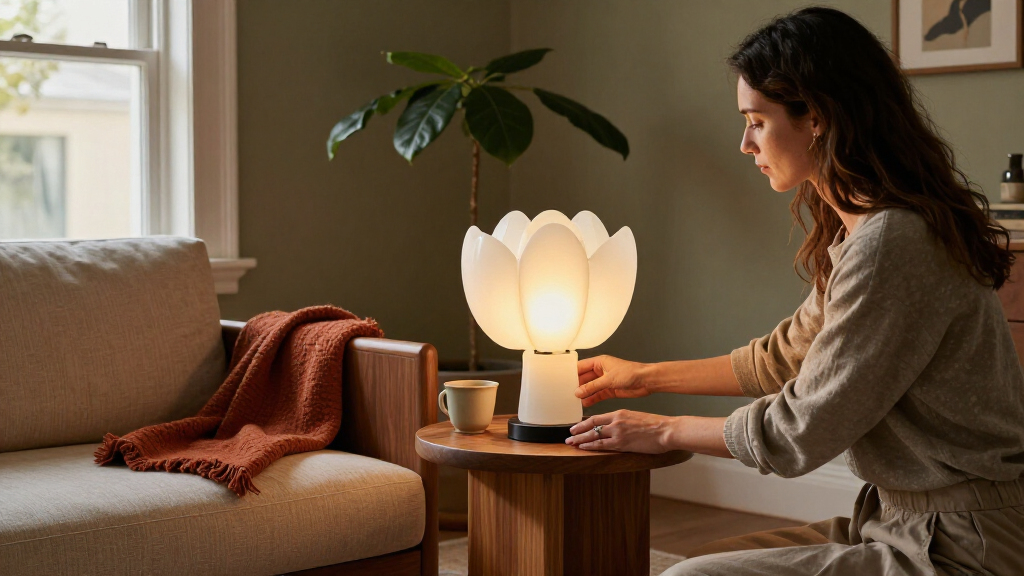
Four shades of mouth-blown glass nest together to form the flower-like silhouette. Each is made using the Murano technique known as “pulegoso,” which introduces small air bubbles into the glass, giving it a textured, semi-opaque appearance. The overlapping glass conceals the bulb at the center, while single-layer sections along the outer curves allow light through. Schmidt said the construction produces a glow without glare or harsh shadows.
The redesigned steel base houses the bulb socket and holds the shades in place. Gubi says the updated construction improves stability and makes the lamp easier to take apart for cleaning and bulb replacement. The company says the reissue was developed in close collaboration with Alberto Nason. The Lotus Table Lamp is available through Gubi’s website and select retailers, according to the source report.
A Collector Design Returns to Production
The relaunch brings a design associated with collectors into current production, giving customers a chance to buy the lamp new rather than seek out examples from its short original run. That matters in practical terms: the updated base is intended to make routine care and bulb replacement easier, while the glass construction and overall silhouette remain close to the original.
The timing also gives the reissue a connection to Nason’s legacy. The source report says Nason died earlier this year. His son’s involvement links the production return to the family’s account of the design, while Gubi’s relaunch gives a wider audience access to a work that had been out of production for decades. The report does not provide sales figures or pricing, so the size of expected demand is unknown.
Products Worth Considering

Shark Matrix Plus 2-in-1 Robot Vacuum and Mop with 60-Day Self-Emptying Base

Hisense 40-Inch QD4SR Series Hi-QLED FHD Roku Smart TV

Levoit Vital 100S-P Air Purifier with Washable Pre-Filter
As an affiliate, we earn on qualifying purchases.
From LT305 to the Lotus Name
Carlo Nason introduced the lamp in 1969 under the designation LT305. It remained in production for only a few years, but the design later developed a following among collectors, who called it the Lotus lamp. Gubi retained that name for its revival rather than returning to the original model code as the product’s public identity.
Nason grew up in a family of Murano glassmakers and drew on the region’s glassblowing traditions. The source report connects the lamp’s streamlined, bulbous form to the influence of industrial product design and the Space Age styles popular in the 1960s. Its layered glass construction combines that contemporary profile with a labor-intensive making process.
Gubi says it worked with Alberto Nason during development and aimed to preserve the original intention while making discreet practical changes. The report identifies the base as the only stated construction refinement; it does not specify changes to the glass shades or provide a side-by-side technical comparison with the 1969 version.
““Collectors had already given the lamp a name that captures the design beautifully. The name had become part of the design’s identity and history, and we wanted to respect that.””
— Marie Kristine Schmidt, Gubi CEO
Price and Production Details Unspecified
The source report does not state the lamp’s price, production volume, dimensions, available finishes, or whether the reissue is being made in Murano. It also does not give a launch date beyond reporting that the lamp is available through Gubi and select retailers. Gubi’s statements about stability and ease of maintenance are company descriptions; the report includes no independent testing or detailed specifications for those changes.
The report says Nason died earlier this year but does not specify a date. It also does not quantify the size of the lamp’s collector following or provide sales expectations for the reissue.
Availability Through Gubi Retailers
The immediate next step for buyers is checking Gubi’s website or a select retailer for current availability and product details. The source report does not identify a later launch event, further production schedule, or planned additions to the Lotus line. Any information about price, regional availability, or stock levels will need to come from Gubi or individual retailers.
Key Questions
What is Gubi bringing back?
Gubi has returned Carlo Nason’s Lotus table lamp to production. Nason first introduced the design in 1969 as the LT305.
What does the Lotus lamp look like?
It has a bulbous, flower-like form made from four nested mouth-blown glass shades. Small air bubbles created with the Murano “pulegoso” technique give the glass a textured, semi-opaque appearance.
What changed in the reissue?
Gubi says it re-engineered the steel base for greater stability and easier disassembly for cleaning and bulb replacement. The company says it kept the design’s expression and original specifications otherwise intact.
Why is it called the Lotus lamp?
Collectors gave the lamp the Lotus name after its original release. Gubi adopted that name for the revival, saying it had become part of the design’s identity and history.
Where can the reissued lamp be bought?
The source report says the Lotus Table Lamp is available through gubi.com and select retailers. It does not list a price or provide details on stock by location.
Source: rss