TL;DR

Get furniture and decor delivered free with Prime
- Fast, free delivery on millions of items
- Prime Video, Amazon Music and more included
- Member-only deals all year
Livingetc reports that furniture and interiors incorporating flowers preserved in resin are appearing in a range of recent design projects, including a Paris herbal infusion house and work by botanical artist Marcin Rusak. Designers interviewed for the report connect the material’s appeal to nostalgia and the desire to preserve a moment, while the trend’s wider scale and commercial impact remain unmeasured.
The report identifies Apoticari’s La Tisanerie, a herbal infusion house that opened in September in Paris’s Haut-Marais, as one example. Its floral-enriched resin bar counter serves as a focal point for a venue built around botanical infusions. Livingetc describes the establishment as Paris’s first dedicated herbal infusion house; that characterization comes from the publication, not from independent verification provided in the source material.
The feature also highlights designers using resin in furniture and lighting. Romain Casella, founder and director of the London- and Geneva-based agency MAY, told Livingetc he had observed resin appearing in client platforms, including tables, consoles and lighting. He singled out the Gelo side tables by Monologue and Paraforma, which are hand-cast in resin, and Austrian designer Laurids Gallée’s Node 01 light. The report also references Dutch designer Sabine Marcelis’s work with resin and light.
Botanical artist and designer Marcin Rusak is presenting his Flora Herbarium Clear Amber 152 at Salon Art + Design in New York, according to the feature. The fair is scheduled for November 4–8 at the Park Avenue Armory. Rusak’s work treats flowers as more than decoration: he has described them as carriers of knowledge, memory and emotion, and said he hopes a piece may serve as a record of the era in which it was made.
Why Designers Are Preserving Flowers
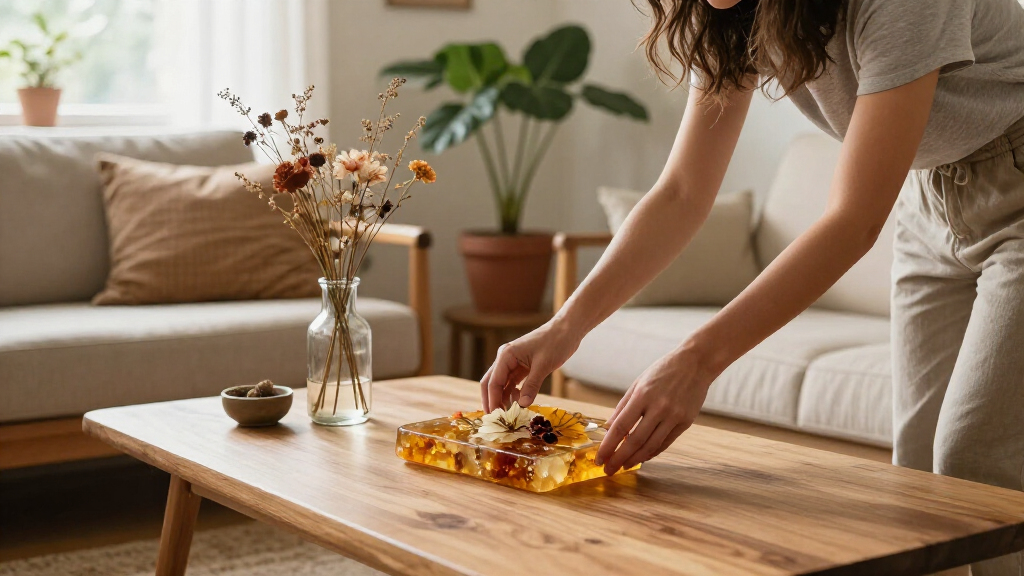
Resin allows designers to hold flowers in a fixed form, making the material both a surface and a way of presenting natural objects as part of an interior. The examples in the report range from a hospitality counter to collectible furniture and lighting, suggesting that the technique is being used across different settings rather than in a single product category.
Casella linked resin’s appeal to nostalgia and the idea of freezing time. He told Livingetc that keeping an object still can feel reassuring during unstable periods. That is an interpretation from a design-industry source, not a measured explanation for consumer demand. Still, it helps explain why preserved blooms may appeal to people seeking interiors with visible references to nature, memory and craft.
For readers, the trend matters as a signal of what is appearing in contemporary design projects, not proof that floral resin has become a mass-market staple. The report offers examples and expert observations but does not provide sales figures, market research or data measuring how widely consumers are buying such pieces.
Products Worth Considering

Philips Hue Festavia Globe Outdoor String Lights, 32 Bulbs, 91 ft

Philips Hue Secure Wired Video Doorbell, 2K Resolution, Wide Angle View, Integrated Hue Lights, Two-Way Audio, Infrared Night Visibility, Bl

Philips Hue Festavia 130-Foot Indoor/Outdoor Smart String Lights, 500 LEDs
As an affiliate, we earn on qualifying purchases.
From Midcentury Technique to New Projects
Livingetc says floral epoxy resin design originated in the 1940s and was revived in the 1980s, before returning to view alongside interest in amber-toned interiors. The feature frames the current attention as a resurgence of an existing technique, rather than the invention of a new material or process.
The article situates the examples within a wider design moment it calls “One Decorative Gesture,” which its Style Pulse S/S27 report names as a trend expected to influence interiors in the year ahead. That forecast is Livingetc’s editorial assessment. The source also points to recent design events and social-media discovery as reasons the author encountered more floral resin projects, but it does not establish a quantified rise over a defined period.
““Like the mosquito in amber in Jurassic Park, we’re deliberately choosing to freeze time — and there’s something reassuring in that in such unstable times: it doesn’t move; it’s there, still.””
— Romain Casella, founder and director of MAY, speaking to Livingetc
How Broad Is the Resurgence?
The source material does not establish how widespread the trend is beyond the selected venues, designers and events it discusses. It provides no sales data, consumer survey, production figures or comparison with earlier periods. The author’s observation that floral resin seemed to be appearing frequently is personal reporting, not a market-wide measurement.
Details about the material’s composition, durability, maintenance and environmental effects are also not supplied. The report does not say whether the flowers used in the cited projects are dried, treated or sourced in a particular way, nor does it assess how resin pieces age. Those factors may differ from one maker or product to another.
Upcoming Fair Puts Rusak’s Work on View
The next dated event identified in the report is Salon Art + Design, scheduled for November 4–8, 2026, at New York’s Park Avenue Armory, where Rusak plans to present Flora Herbarium Clear Amber 152. The fair may offer a further opportunity to see how botanical materials are being used in collectible design, but the source does not say whether additional floral resin launches or exhibitions are planned.
For now, the evidence points to a visible set of projects and a renewed design conversation, rather than a confirmed industry-wide shift. Further information on market demand, new commissions and how these pieces perform over time would help clarify whether the resurgence extends beyond the examples in the feature.
Key Questions
What is floral resin?
Floral resin refers to resin designs that incorporate flowers or other botanical material. In the projects described by Livingetc, the material appears in furniture, lighting and a Paris bar counter.
Where is floral resin being used in the report?
Examples include the floral-enriched counter at Apoticari’s La Tisanerie in Paris, the Gelo side tables by Monologue and Paraforma, and lighting by designers including Laurids Gallée and Sabine Marcelis.
Is floral resin a new design technique?
No. Livingetc says floral epoxy resin design dates to the 1940s and was revived in the 1980s. The current report describes renewed attention to the technique.
Does the report show that floral resin is a major market trend?
No market-wide figures are included. The feature documents selected projects and quotes a design consultant, but provides no sales data or consumer research to measure the trend’s scale.
When can visitors see Marcin Rusak’s cited work?
Rusak is scheduled to present Flora Herbarium Clear Amber 152 at Salon Art + Design, running November 4–8, 2026, at the Park Avenue Armory in New York, according to Livingetc.
Source: livingetc.com