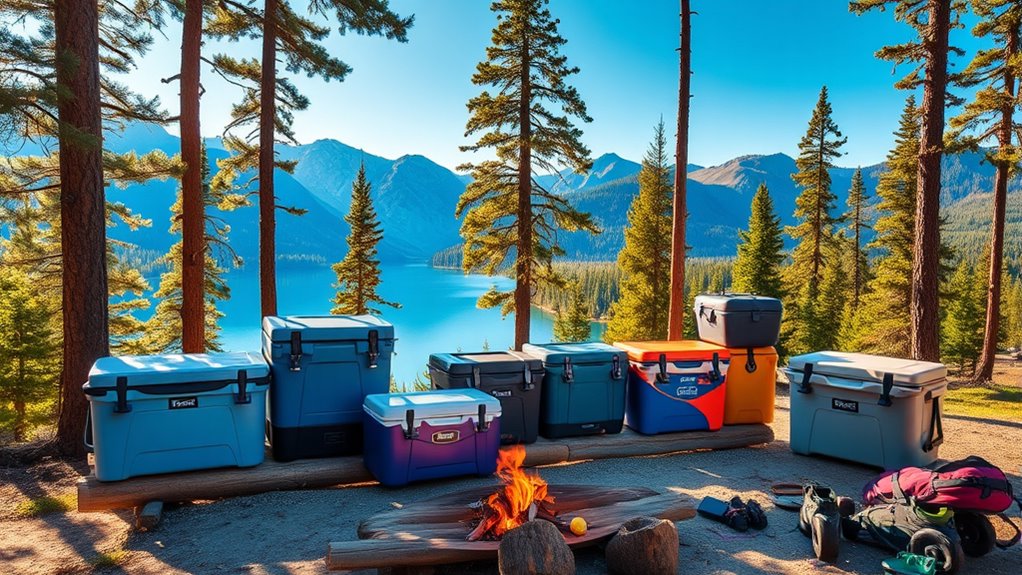
Among these high-end camping coolers, I name the YETI Tundra 65 best overall for its balance of useful capacity and rugged hard-cooler design. The ICECO VL60 stands apart for powered cooling and separate temperature zones, while the Ninja FrostVault 50qt adds a dry storage drawer for food that should stay out of meltwater. The main tradeoff is between passive coolers, which are simpler and need no power, and powered or feature-rich options that call for more planning, space, or upkeep. Capacity and wheels matter too: a large cooler can serve a group, but it is harder to load and move. Read on for the full comparison and guidance by camping style.

Get furniture and decor delivered free with Prime
- Fast, free delivery on millions of items
- Prime Video, Amazon Music and more included
- Member-only deals all year
Complete the kit


Key Takeaways
- The YETI Tundra 65 is the best all-around hard cooler here: it pairs substantial capacity with a straightforward, non-powered format, while the wheeled Roadie models favor mobility over maximum volume.
- Powered cooling changes the trip plan: the ICECO VL60 can actively refrigerate and separate zones, but it depends on an electrical supply rather than ice alone.
- Wheels solve some, not all, transport problems: wheeled picks such as the YETI Roadie 48 and Coleman 100-quart are easier to roll than lift, yet their size can still be awkward in a packed vehicle or at camp.
- Capacity is not the same as usable space: the Ninja FrostVault’s dry drawer separates items from the main compartment, while the RTIC 20-can soft cooler suits a compact load instead of group provisions.
- The roundup spans very different levels of complexity: the Coleman and Lifetime models offer large-capacity passive cooling, while the Blue Coolers Ice Vault and ENGEL target buyers prioritizing insulated construction and longer outings.
| YETI Roadie 48 Wheeled Cooler with Retractable Periscope Handle |  | Best Premium Wheeled Cooler | Capacity: 48 quarts | Weight: 11.7 kg | Insulation: PermaFrost polyurethane | VIEW ON AMAZON | See Our Full Breakdown |
| Coleman Classic Series 100-Quart Insulated Wheeled Cooler |  | Best for Large Groups | Capacity: 100 quarts | Can capacity: Up to 167 cans without ice; 80 cans with 50 lb of ice | Ice retention: Up to 5 days in temperatures up to 90°F | VIEW ON AMAZON | See Our Full Breakdown |
| Blue Coolers Ice Vault – 60 Quart Roto-Molded Ice Cooler with Wheels |  | Best for Extended Ice Storage | Capacity: 60 quarts | Weight: 36.5 pounds | Dimensions: 18 x 26.75 x 17.5 inches | VIEW ON AMAZON | See Our Full Breakdown |
| Ninja FrostVault 50qt Hard Cooler with Dry Storage Drawer, Spanish Moss |  | Best for Separate Food Storage | Capacity: 50 quarts | Can capacity: Up to 80 cans without ice; 45 cans with ice | Dimensions: 17.07 x 32.2 x 18.78 inches | VIEW ON AMAZON | See Our Full Breakdown |
| ICECO VL60 Dual Zone Portable Refrigerator with SECOP Compressor |  | Best Powered Cooler Alternative | Capacity: 60 liters | Freezer capacity: 63 quarts, as listed in product data | Weight: 64 pounds | VIEW ON AMAZON | See Our Full Breakdown |
| YETI Tundra 65 Cooler |  | Best for Rugged, Group Camping | Construction: Rotomolded | Insulation: Pressure-injected polyurethane foam | Capacity: Fits 54 cans or 16.8 kg of ice | VIEW ON AMAZON | See Our Full Breakdown |
| YETI Roadie 32 Wheeled Cooler |  | Best for Rolling Short-Trip Convenience | Model listed in title: Roadie 32 | Model listed in details: Roadie 48 Wheeled Cooler | Capacity: 1078.5 cubic inches | VIEW ON AMAZON | See Our Full Breakdown |
| YETI Tundra 45 Cooler |  | Best Mid-Size Rotomolded Pick | Construction: Rotomolded | Capacity: Up to 26 cans | Capacity packing ratio: 2:1 ice-to-contents ratio | VIEW ON AMAZON | See Our Full Breakdown |
| ENGEL 60-Quart Ultra-Light Injection-Molded Cooler |  | Best Lightweight Large-Capacity Pick | Capacity: 60 quarts | Dimensions: 29.5 × 18 × 17 inches (W × D × H) | Weight: 21.5 pounds | VIEW ON AMAZON | See Our Full Breakdown |
| Lifetime 115-Quart High Performance Cooler |  | Best for Large, Bear-Country Camps | Capacity: 115 quarts | Weight: 42.5 pounds | Chamber depth: 15 inches | VIEW ON AMAZON | See Our Full Breakdown |
| Coleman Xtreme 50-Quart Rolling Cooler |  | Best for Wheeled Value | Capacity: 50 quarts | Can capacity: Up to 84 cans | Ice retention: Up to 5 days at temperatures up to 90°F | VIEW ON AMAZON | See Our Full Breakdown |
| MAXSA 40QT Floating Cooler for River Lake Beach Kayak Camping, Cool Gray |  | Best for Water-Based Camping | Capacity: 40 quarts | Can capacity: 60+ cans | Insulation: Double-wall construction | VIEW ON AMAZON | See Our Full Breakdown |
| RTIC Ultra-Tough 20-Can Soft Cooler |  | Best Compact Soft Cooler | Capacity: 6.7 quarts | Can capacity: Up to 20 cans | Cooling duration: Up to 2 days when used according to RTIC’s cooling tips | VIEW ON AMAZON | See Our Full Breakdown |
| highend camping cooler | Capacity | Weight | Dimensions | Insulation |
|---|---|---|---|---|
| YETI Roadie 48 Wheeled Cooler | 48 quarts | 11.7 kg | — | PermaFrost polyurethane |
| Coleman Classic Series 100-Qua | 100 quarts | 18 pounds | 36.9 x 17.3 x 18 inches | — |
| Blue Coolers Ice Vault | 60 quarts | 36.5 pounds | 18 x 26.75 x 17.5 inches | Up to 2.25 inches |
| Ninja FrostVault 50qt Hard Coo | 50 quarts | 29 pounds | 17.07 x 32.2 x 18.78 inches | Up to 3 inches |
| ICECO VL60 Dual Zone Portable | 60 liters | 64 pounds | 19.5 x 31.2 x 18.9 inches | — |
| YETI Tundra 65 Cooler | Fits 54 cans or 16.8 kg of ice | — | — | Pressure-injected polyurethane foam |
| YETI Roadie 32 Wheeled Cooler | 1078.5 cubic inches | — | 8.6 in D × 15.7 in W × 13.5 in H | — |
| YETI Tundra 45 Cooler | Up to 26 cans | — | 25.5 × 16 × 15.5 inches | Up to 3 inches |
| ENGEL 60-Quart Ultra-Light Inj | 60 quarts | 21.5 pounds | 29.5 × 18 × 17 inches (W × D × H) | 2 inches of closed-cell foam |
| Lifetime 115-Quart High Perfor | 115 quarts | 42.5 pounds | — | — |
| Coleman Xtreme 50-Quart Rollin | 50 quarts | 12.7 pounds | 22.6 x 17.6 x 17.5 inches | — |
| MAXSA 40QT Floating Cooler for | 40 quarts | 42.3 pounds | 37.8 x 23.62 x 10.16 inches | Double-wall construction |
| RTIC Ultra-Tough 20-Can Soft C | 6.7 quarts | 3.5 pounds | 9.49 x 13.71 x 13.67 inches | Closed-cell foam, up to 1.5 inches |
More Details on Our Top Picks
YETI Roadie 48 Wheeled Cooler with Retractable Periscope Handle
The Roadie 48 suits campers who want a premium hard cooler that can roll between the vehicle, campsite, and picnic spot. Its puncture-resistant wheels and retractable handle make a heavy load easier to move than a comparable cooler without wheels, while non-slip feet help keep it planted once parked. At 48 quarts, it is more manageable than the Coleman Classic 100-Quart, but gives up the Coleman’s group-scale capacity. A dry goods basket keeps some food above the ice, though it is not the separate, enclosed food compartment offered by the Ninja FrostVault. The tradeoff is weight: at 11.7 kg, it is still a substantial lift into a vehicle, and the supplied details do not state a specific ice-retention duration.
Pros:- Impact- and puncture-resistant wheels suit repeated outdoor transport.
- Retractable handle makes rolling the loaded cooler easier.
- Dry goods basket separates selected items from ice.
- Non-slip feet help prevent unwanted movement when parked.
Cons:- At 11.7 kg, it is heavy to lift even before loading.
- Its 48-quart capacity is limited for large groups.
- No specific ice-retention duration is provided in the product details.
Best for: Campers who want a durable, mid-capacity cooler with wheels for moving food and drinks around established campsites or tailgates.
Not ideal for: Solo campers prioritizing low carry weight, or large groups that need the 100-quart capacity of the Coleman Classic.
- Capacity:48 quarts
- Weight:11.7 kg
- Insulation:PermaFrost polyurethane
- Wheels:Solid, impact- and puncture-resistant
- Item highlight:Fits 76 cans or 24.5 kg of ice
- Included components:Casters and dry goods basket
- Color:Charcoal
Our verdict“Choose the Roadie 48 for premium rolling convenience and a practical mid-size load, not for lightweight carrying or maximum group capacity.”
Coleman Classic Series 100-Quart Insulated Wheeled Cooler
When a camping trip involves a crowd, the 100-quart capacity is the Coleman Classic’s clearest advantage: it holds up to 167 cans without ice, or 80 cans with 50 pounds of ice. Its six-inch all-terrain wheels and tow and swing-up handles help move that volume, while the lid’s 250-pound capacity gives it a useful second role as a seat or step. The stated ice retention is up to five days at temperatures up to 90°F, though actual results depend on packing, opening frequency, and conditions. Compared with the more compact YETI Roadie 48, this Coleman is built around group provisioning rather than easy storage or a smaller footprint. Its plastic construction and broad 36.9-inch length make it a less refined choice for tight vehicle space or small campsites.
Pros:- 100-quart capacity supports group-sized food and drink loads.
- Six-inch all-terrain wheels and dual handles aid transport.
- Lid supports up to 250 pounds and can serve as a seat or step.
- Includes four cup holders and a leak-resistant drain plug.
Cons:- Its 36.9-inch length and large capacity can make storage difficult.
- Ice retention varies with use and outdoor conditions.
- Plastic construction is less suited to buyers seeking a premium roto-molded build.
Best for: Families, large camping groups, and tailgaters who need to store substantial food and drinks in one wheeled cooler.
Not ideal for: Solo campers or people with limited vehicle and garage space; its large footprint can be awkward to store and maneuver.
- Capacity:100 quarts
- Can capacity:Up to 167 cans without ice; 80 cans with 50 lb of ice
- Ice retention:Up to 5 days in temperatures up to 90°F
- Dimensions:36.9 x 17.3 x 18 inches
- Weight:18 pounds
- Wheels:6-inch all-terrain wheels
- Lid weight capacity:250 lb
- Cup holders:4, fit drinks up to 30 oz
- Warranty:1-year limited warranty
Our verdict“Pick the Coleman Classic when group capacity matters more than compact storage or premium construction.”
Blue Coolers Ice Vault – 60 Quart Roto-Molded Ice Cooler with Wheels
The Ice Vault is the pick here for campers who value thick insulation and a rugged roto-molded shell over a lighter, simpler cooler. Its product description claims ice retention of up to 10 days when packed using best practices; that is a stated maximum, not a guarantee for every trip. The 60-quart capacity sits between the YETI Roadie 48 and the much larger Coleman Classic, making it a useful middle ground for multi-day outings. A freezer-style gasket, lockable lid, non-skid feet, and rapid drain system add practical details for outdoor use. Unlike the wheeled Coleman and Roadie, however, the supplied details do not specify wheel construction or a transport handle, and its 36.5-pound weight is a significant carry burden. It makes more sense for car camping than for frequent hand-carrying.
Pros:- Roto-molded construction is designed for rugged outdoor use.
- Up to 2.25 inches of insulation and a freezer-style gasket support extended cooling.
- 60-quart capacity offers more room than the YETI Roadie 48.
- Lockable lid, non-skid feet, and rapid drain system add practical utility.
Cons:- At 36.5 pounds, it is heavy to lift and carry.
- The up-to-10-day ice claim depends on packing practices and conditions.
- Product details do not specify wheel construction or a retractable transport handle.
Best for: Car campers and outdoor groups who want a rugged 60-quart cooler with substantial insulation for multi-day trips.
Not ideal for: Campers who must carry their cooler far from the vehicle or want clearly specified, easy-rolling transport features.
- Capacity:60 quarts
- Weight:36.5 pounds
- Dimensions:18 x 26.75 x 17.5 inches
- Insulation:Up to 2.25 inches
- Ice retention:Up to 10 days, following best practices
- Construction:Roto-molded
- Features:Lockable lid, freezer-style gasket, non-skid feet, rapid drain system
- Color:Charcoal gray with wheels
Our verdict“Choose the Ice Vault for a rugged, insulated car-camping cooler when long claimed ice life matters more than low weight.”
Ninja FrostVault 50qt Hard Cooler with Dry Storage Drawer, Spanish Moss
The FrostVault’s main distinction is its refrigerated dry-storage drawer, which lets campers keep food separate from melting ice without moving it into another container. Ninja says the Dry Zone stays under 40°F for days and up to 20°F cooler than a YETI dry basket under laboratory testing; that makes the drawer more useful for temperature-sensitive provisions than the open basket included with the YETI Roadie 48. Its 50-quart body also holds up to 80 cans without ice, or 45 cans with ice, and the stated insulation reaches three inches. The added compartment improves access, but it also creates a different packing layout than a simple open ice chest. Choose this over the Blue Coolers Ice Vault for separated food storage, not for a longer stated maximum ice-retention claim.
Pros:- DryZone drawer keeps food separate from ice and easier to reach.
- Ninja states the compartment stays under 40°F for days.
- Up to three inches of insulation and a lockable lid support outdoor use.
- One-handed latch is designed for easier opening and closing.
Cons:- The drawer takes up space and changes how the cooler can be packed.
- At 32.2 inches wide, it may be awkward in compact vehicle storage.
- The supplied details do not give a specific ice-retention duration for the main compartment.
Best for: Campers carrying fresh food who want a dedicated, dry compartment that stays cool without placing provisions directly on ice.
Not ideal for: Buyers who want a straightforward open cooler, need a stated multi-day ice-retention figure, or prefer a smaller footprint.
- Capacity:50 quarts
- Can capacity:Up to 80 cans without ice; 45 cans with ice
- Dimensions:17.07 x 32.2 x 18.78 inches
- Weight:29 pounds
- Insulation:Up to 3 inches
- Dry storage:FrostVault Dry Zone drawer; stated to stay under 40°F for days
- Color:Spanish Moss
Our verdict“Choose the FrostVault if separate, cool food storage is more useful to you than a simple open interior or a longer stated ice-retention claim.”
ICECO VL60 Dual Zone Portable Refrigerator with SECOP Compressor
The ICECO VL60 is not a conventional ice chest: its SECOP compressor and dual-zone controls let you set one compartment to freeze and the other to refrigerate, or switch off a zone to save energy. That makes it the most temperature-controlled option in this group, especially for campers carrying frozen provisions or traveling for longer stretches with a reliable power source. It can run from 12/24V DC or 110–240V AC, giving it more flexibility between a vehicle and home than the passive Blue Coolers Ice Vault. The tradeoff is dependence on power and a 64-pound weight, before considering the space required for its 31.2-inch width. It also has less stated storage volume than the 100-quart Coleman. Choose it for controlled refrigeration, not for a lightweight cooler you can carry to a remote site.
Pros:- Independent zones allow simultaneous freezing and refrigeration.
- Temperature range runs from 0°F to 50°F.
- Accepts 12/24V DC and 110–240V AC power.
- Includes two removable wire baskets and an insulated cover.
Cons:- At 64 pounds, it is substantially heavier than the passive coolers here.
- Requires a power source for active cooling.
- Its 60-liter capacity is smaller than the Coleman Classic’s 100 quarts.
Best for: Vehicle campers and overlanders with dependable DC or AC power who need separate freezer and refrigerator zones.
Not ideal for: Backpackers, remote campers without power, and buyers who want a light, simple ice chest for occasional outings.
- Capacity:60 liters
- Freezer capacity:63 quarts, as listed in product data
- Weight:64 pounds
- Dimensions:19.5 x 31.2 x 18.9 inches
- Cooling range:0°F to 50°F
- Compressor:SECOP
- Power input:12/24V DC and 110–240V AC
- Zones:Dual zone with independent controls
- Included components:Insulated cover and two removable wire baskets
Our verdict“Choose the ICECO VL60 when powered, separately controlled freezer and refrigerator storage matters more than portability or power independence.”
YETI Tundra 65 Cooler
The Tundra 65 is the strongest fit here for campers who want a substantial, hard-sided cooler built around rugged construction and ice retention. Its rotomolded shell, pressure-injected foam, and ColdLock gasket are designed to hold cold, while the dry goods basket keeps food above ice and meltwater. Compared with the smaller YETI Tundra 45, it offers more room for group provisions, but that extra capacity makes a full load harder to carry. The Vortex Drain System and non-slip feet add practical campsite convenience; they do not solve the bulk problem. I’d choose it over the wheeled YETI Roadie 32 when rugged storage matters more than rolling transport. The listed information omits dimensions and loaded weight, so buyers should plan for a two-person lift when packed.
Pros:- Rotomolded construction and insulated walls are suited to demanding outdoor use.
- ColdLock gasket and interlocking lid are designed to reduce cold loss.
- Dry goods basket separates items from ice and meltwater.
- Drain system and non-slip feet support practical campsite use.
Cons:- Large capacity can make it cumbersome to carry when full.
- Dimensions and loaded weight are not provided in the product information.
Best for: Car campers and fishing groups who need a large, rugged cooler and can move it with help.
Not ideal for: Solo campers or anyone regularly carrying a loaded cooler over distance; its size and unspecified loaded weight make transport harder to judge.
- Construction:Rotomolded
- Insulation:Pressure-injected polyurethane foam
- Capacity:Fits 54 cans or 16.8 kg of ice
- Included component:Dry goods basket
- Hinge system:NeverFail Hinge System
- Lid latches:T-Rex Lid Latches
- Drain:Vortex Drain System
Our verdict“Choose the Tundra 65 for rugged group-camping storage if you have help moving it and do not need wheels.”
YETI Roadie 32 Wheeled Cooler
The Roadie 32 Wheeled Cooler suits campers who would rather roll their supplies than lift a conventional hard cooler. Its retractable handle and impact- and puncture-resistant wheels address the transport burden that comes with models such as the YETI Tundra 45, while non-slip feet help steady it once parked. A dry goods basket keeps selected items apart from ice, and the hard polyethylene shell is built for outdoor use. Its main limitation is capacity: the supplied data describes a compact interior, so it is a weaker fit for large groups than the ENGEL 60-Quart or Tundra 65. There is also a product-information mismatch: the title says Roadie 32, while details identify a Roadie 48. I’d verify the exact model and capacity before buying, rather than assume the listed measurements resolve the discrepancy.
Pros:- Retractable handle and wheels make transport easier than lifting a hard cooler.
- Wheels are described as impact- and puncture-resistant.
- Non-slip feet help keep it from sliding when parked.
- Includes a dry goods basket.
Cons:- The title and product details list different Roadie model sizes.
- Compact capacity may not suit group camping or extended trips.
- The supplied capacity figure and dimensions should be checked against the intended model.
Best for: Small camping parties and tailgaters who need wheeled transport for a compact cooler and can confirm the exact model before purchase.
Not ideal for: Large groups or buyers who need a clearly documented capacity; the product details conflict on whether this is a Roadie 32 or Roadie 48.
- Model listed in title:Roadie 32
- Model listed in details:Roadie 48 Wheeled Cooler
- Capacity:1078.5 cubic inches
- Dimensions:8.6 in D × 15.7 in W × 13.5 in H
- Chamber depth:13 inches
- Shell material:Polyethylene (PE)
- Insulation material:Polyurethane foam
- Included component:Dry goods basket
Our verdict“Pick the Roadie if rolling convenience matters more than group-sized storage, but confirm the model details first.”
YETI Tundra 45 Cooler
The Tundra 45 offers a more manageable footprint than the Tundra 65 while keeping the rotomolded build and thick insulation associated with this YETI line. Its stated capacity is up to 26 cans when packed with a 2:1 ice-to-contents ratio, a useful planning detail that also shows how quickly usable food space can shrink when ice retention is the priority. At 23 pounds empty, it is not a light carry, but it is less of a group-hauling commitment than the larger Tundra 65. Compared with the wheeled Roadie 32, this model trades rolling convenience for a straightforward hard-sided design. The dry goods basket helps keep selected items out of meltwater; buyers should still account for the empty weight and the ice-heavy packing ratio before choosing it for frequent carries.
Pros:- Rotomolded construction is suited to repeated outdoor use.
- Up to 3 inches of insulation and a freezer-quality gasket are designed to retain cold.
- Dry goods basket helps separate stored items from ice.
- More compact capacity than the Tundra 65.
Cons:- The empty cooler weighs 23 pounds before adding ice and contents.
- The stated 26-can capacity assumes a 2:1 ice-to-contents ratio.
- No wheels are listed for moving it across a campsite.
Best for: Couples or small camping groups who want a durable, mid-size rotomolded cooler for car-based trips.
Not ideal for: Hikers, solo campers carrying gear far from the vehicle, or groups needing substantial food space without a large ice share.
- Construction:Rotomolded
- Capacity:Up to 26 cans
- Capacity packing ratio:2:1 ice-to-contents ratio
- Dimensions:25.5 × 16 × 15.5 inches
- Empty weight:23 pounds
- Insulation:Up to 3 inches
- Included component:Dry goods basket
Our verdict“Choose the Tundra 45 if you want a sturdy mid-size cooler and can manage its weight and ice-heavy packing needs.”
ENGEL 60-Quart Ultra-Light Injection-Molded Cooler
The ENGEL 60-Quart stands out for buyers who want ample cooler space without the heavier feel of many large hard-sided options. At 21.5 pounds, it is lighter than the 42.5-pound Lifetime 115-Quart, though the Lifetime provides far more room and a stated ice-retention period of up to 10 days. ENGEL’s two inches of closed-cell foam insulation are designed to keep ice for up to seven days, making this a plausible fit for multi-day car camping rather than a lightweight backpacking choice. Its removable basket, divider, drain plug, and tie-down slots give it useful campsite flexibility. The tradeoff is its 29.5-inch width and hand-wash care: it still takes up substantial vehicle and storage space, and cleanup is less convenient than a quick rinse.
Pros:- 21.5-pound weight is modest for a 60-quart hard cooler.
- Two inches of closed-cell foam are designed for ice retention up to seven days.
- Removable basket, divider, and drain plug support flexible storage and cleanup.
- Tie-down slots and integrated handles help with securing and carrying.
Cons:- Large dimensions can make it awkward to store or carry.
- Hand-wash care requires more cleanup effort.
- Its stated ice retention is shorter than the Lifetime 115-Quart’s up-to-10-day claim.
Best for: Car campers and anglers who want 60-quart capacity with a relatively low empty weight and useful organization features.
Not ideal for: Backpackers, campers with limited vehicle storage, or buyers who want a cooler that can be cleaned in a dishwasher.
- Capacity:60 quarts
- Dimensions:29.5 × 18 × 17 inches (W × D × H)
- Weight:21.5 pounds
- Insulation:2 inches of closed-cell foam
- Ice retention:Up to 7 days
- Material:Polypropylene (PP)
- Included features:Removable wire basket, divider, drain plug, built-in bottle opener
- Warranty:Limited 5 years
Our verdict“Choose the ENGEL if you need substantial camping capacity but want to keep empty weight lower than a much larger cooler.”
Lifetime 115-Quart High Performance Cooler
The Lifetime 115-Quart is the lineup’s capacity pick for camps that need to store provisions for a large group. Its stated ice retention of up to 10 days and IGBC-certified bear resistance when locked make it a more specialized choice than the ENGEL 60-Quart, which is lighter and easier to accommodate but holds much less. The divider doubles as a cutting board, adding a practical food-prep surface, and the garden-hose-compatible drain can make emptying a large cooler less messy. That capacity comes with a real handling cost: the cooler weighs 42.5 pounds empty, before ice or food. Bear resistance also depends on locking it, so it is not a substitute for following campsite food-storage rules. I’d reserve it for vehicle-based group camping where space and help with moving it are available.
Pros:- 115-quart capacity suits large groups and extended camp provisions.
- Ice retention is stated as up to 10 days.
- IGBC-certified bear resistance applies when the cooler is locked.
- Garden-hose-compatible drain and cutting-board divider add campsite utility.
Cons:- 42.5-pound empty weight makes loading and transport demanding.
- Bear resistance depends on locking the cooler.
- Its large capacity can take up substantial vehicle and campsite space.
Best for: Large car-camping groups in bear country who need substantial food storage and can lock the cooler at camp.
Not ideal for: Solo campers, smaller campsites, and anyone who must carry a cooler far; it weighs 42.5 pounds empty and needs a lock for its stated bear resistance.
- Capacity:115 quarts
- Weight:42.5 pounds
- Chamber depth:15 inches
- Ice retention:Up to 10 days
- Bear resistance:IGBC-certified; withstands a bear for up to an hour when locked
- Material:High-density polyethylene (HDPE), plastic
- Drain:Easy-to-drain spout compatible with a garden hose
- Warranty:5-year limited warranty
Our verdict“Choose the Lifetime for locked, high-capacity group camping in bear country if you can handle its size and weight.”
Coleman Xtreme 50-Quart Rolling Cooler
The Coleman Xtreme 50-Quart suits campers who want substantial capacity and rolling convenience without moving up to the more specialized builds in this roundup. Its 50-quart interior holds up to 84 cans, and the stated ice retention of up to five days makes it a practical choice for longer trips, though actual performance depends on conditions. All-terrain wheels and a telescoping handle help move a loaded cooler, while the lid can serve as a seat rated for 250 pounds. Compared with the YETI Roadie 48, this Coleman emphasizes straightforward capacity and transport rather than a premium feature set. The tradeoff is its bulky footprint, which can be awkward to store, and its ice-retention claim is not a guarantee in every camp setting.
Pros:- 50-quart capacity holds up to 84 cans
- All-terrain wheels and a retractable telescoping handle aid movement
- Stated ice retention is up to five days at temperatures up to 90°F
- Lid doubles as a seat with a 250-pound weight capacity
Cons:- Large dimensions can make storage and vehicle loading awkward
- Ice retention varies with conditions, use, and temperature
Best for: Car campers who want a large, wheeled cooler for group food and drinks and value simple transport over premium construction.
Not ideal for: Backpackers, solo campers, and drivers with limited cargo space; its 50-quart body is bulky, and it is not designed for compact carrying.
- Capacity:50 quarts
- Can capacity:Up to 84 cans
- Ice retention:Up to 5 days at temperatures up to 90°F
- Dimensions:22.6 x 17.6 x 17.5 inches
- Weight:12.7 pounds
- Wheels:All-terrain
- Lid weight capacity:250 pounds
- Warranty:1-year limited warranty
Our verdict“Choose this Coleman if you want high capacity and wheels for car camping without needing the premium positioning of the YETI Roadie 48.”
MAXSA 40QT Floating Cooler for River Lake Beach Kayak Camping, Cool Gray
The MAXSA 40QT Floating Cooler is the most specialized pick here: its selling point is taking supplies onto the water, not rolling a heavy load across a campground. The buoyant, sealed design is described as usable on rivers, lakes, and pools, while the double-wall insulation and 40-quart capacity target full-day outings with drinks and food. That sets it apart from the wheeled Coleman Xtreme 50-Quart, which offers greater stated capacity and more convenient land transport but is not presented as a floating cooler. MAXSA’s wheel-free construction also avoids wheel hardware, though a 42.3-pound listed weight means carrying it on land may still be demanding. Ice-retention duration is not specified, so buyers seeking a clearly stated multi-day cooling claim should compare it with the Coleman instead.
Pros:- Floating design is intended for use on water as well as land
- 40-quart capacity is listed to hold 60 or more cans
- Double-wall insulation supports cold storage for outdoor outings
- Wheel-free construction avoids wheel components that can require maintenance
Cons:- At a listed 42.3 pounds, carrying it on land may be strenuous
- No specific ice-retention duration is provided
- No wheels for moving a loaded cooler across camp or a beach
Best for: Kayakers, river floaters, and lakeside campers who want a hard-sided cooler designed to stay afloat and keep provisions close on the water.
Not ideal for: Campers who need to roll supplies over long distances or want a documented multi-day ice-retention duration; it has no wheels and no specific duration is provided.
- Capacity:40 quarts
- Can capacity:60+ cans
- Insulation:Double-wall construction
- Design:Amphibious floating design for water and land use
- Dimensions:37.8 x 23.62 x 10.16 inches
- Weight:42.3 pounds
- Material:Plastic
- Warranty:30 days
Our verdict“Pick the MAXSA for kayaking and river trips where floating access matters more than wheels or a stated multi-day ice-retention claim.”
RTIC Ultra-Tough 20-Can Soft Cooler
For short camping outings where a full-size hard cooler would take up too much room, the RTIC Ultra-Tough 20-Can offers a compact, portable alternative. At 3.5 pounds and 6.7 quarts, it is much easier to carry than the 40- and 50-quart hard-sided options, and its shoulder strap helps when hands are occupied. Closed-cell foam insulation is rated to keep contents cool for up to two days when used according to RTIC’s cooling tips; that makes it better suited to a day trip or overnight than extended group provisioning. Unlike the floating MAXSA 40QT, this soft cooler trades high capacity for easier handling. Its waterproof zipper and floatable design add flexibility, but hand washing and the need to follow cooling guidance limit convenience.
Pros:- Lightweight 3.5-pound design is easier to carry than the hard-sided options
- Holds up to 20 cans in a compact 6.7-quart format
- Waterproof zipper helps limit leaks and water intrusion
- Floatable design and included shoulder strap suit varied outdoor outings
Cons:- Up-to-two-day cooling duration depends on following RTIC’s cooling tips
- Hand wash only, which makes cleanup less convenient
- Small capacity is not suited to group or extended-trip provisioning
Best for: Solo campers, couples, and day-trippers who need a light cooler for a modest amount of food and drinks rather than a group’s full provisions.
Not ideal for: Families or multi-day campers who need large capacity or longer stated ice retention; its 20-can limit and up-to-two-day cooling claim are comparatively modest.
- Capacity:6.7 quarts
- Can capacity:Up to 20 cans
- Cooling duration:Up to 2 days when used according to RTIC’s cooling tips
- Dimensions:9.49 x 13.71 x 13.67 inches
- Weight:3.5 pounds
- Insulation:Closed-cell foam, up to 1.5 inches
- Exterior material:Heavy-duty nylon
- Features:Waterproof zipper, floatable design, shoulder strap
- Warranty:1 year
Our verdict“Choose the RTIC when portability for day trips or overnight camping matters more than the capacity and longer cooling claims of the Coleman Xtreme 50-Quart.”

How We Picked
I compared the 13 options against the jobs campers actually need a cooler to do: hold food and drinks, keep contents cold, travel to and from camp, and fit the trip’s available space. I considered stated capacity, passive insulation or powered refrigeration, handling features such as wheels and handles, construction type, and added features that change how contents can be stored. I also separated hard coolers, soft coolers, and compressor-powered units instead of treating them as direct substitutes.
The ranking favors versatility and practical tradeoffs over a single headline spec. That places the YETI Tundra 65 first as a capable passive all-rounder, with powered control, dry storage, compact carry, and high-volume wheeled options earning their own roles for more specific needs. Large capacity alone does not guarantee a higher position: bulk, dependence on power, and the effort of moving a loaded cooler all count against it. Since insulation results depend on packing, ambient conditions, and lid openings, I do not treat any stated ice-retention claim as a promise for every camping trip.
Factors to Consider When Choosing Highend Camping Coolers
Before choosing a cooler, I would start with the trip rather than the product’s biggest number. The right match depends on how many people you are feeding, how far the cooler travels from the vehicle, whether you can supply power, and how often you need access to its contents. These choices can matter more than adding capacity or paying for a feature you will rarely use.
Match Capacity to the Group and Trip Length
Capacity figures do not tell the whole story: food shape, drink containers, and the ice or cold packs you add all take up room. A large chest can suit a family camp, but it may be mostly empty on a short solo trip and still consume valuable vehicle space. I would plan the typical load first, then leave room for cold sources and access without packing everything tightly. For longer trips, think about whether you can replenish ice or prefer to bring more provisions in one load. Buying much more capacity than your usual need can make the cooler harder to lift and less convenient to place at camp.
Choose Passive Cooling or Powered Refrigeration
Passive coolers need no electricity, which keeps setup simple and makes them useful away from a power source. A compressor model such as the ICECO VL60 can control temperatures without relying on ice, but you need to plan for a compatible power supply and the energy it uses. Before choosing powered cooling, check how you will connect it in a vehicle or at camp and what happens when that supply is unavailable. Avoid assuming that a powered refrigerator is automatically easier: cables, ventilation, and a stable place to operate it become part of the setup. For most camps without reliable power, a passive cooler may be the more practical choice.
Account for the Whole Journey, Not Just Camp
Wheels can reduce lifting across a parking area or campground road, but they do not make a heavy, fully loaded cooler easy to handle over sand, rocks, or steps. Before buying a large rolling model, check the vehicle opening, storage footprint, and route from the car to the campsite. A non-wheeled chest may suit a vehicle-based site where it stays put, while a smaller wheeled cooler may work better for frequent moves. Soft-sided designs can be easier to carry and stow when empty, though they offer a different level of structure from hard chests. Consider who will move the cooler and where it must go, not only whether it has wheels.
Prioritize the Storage Layout You Will Actually Use
Separate compartments and dry storage can make camp food easier to organize, but added layout features only help when they match your packing habits. A dry drawer can keep selected items apart from the main compartment, while a basic chest leaves you to manage separation with containers or bags. Think about which foods must stay dry, which items you need to reach often, and whether separate zones justify a more involved design. A single large compartment is straightforward to load but may require more repacking to reach items underneath. Avoid paying for storage complexity if your usual load is mostly drinks and packaged food.
Balance Construction Against Weight and Maintenance
Rugged hard shells can suit repeated transport and rougher use, while lighter or soft-sided options can reduce carrying and storage demands. A sturdier build may also be heavier before it is filled, so check whether its handling matches your strength and vehicle setup. Whatever the construction, food residue and moisture need attention after a trip; a cooler that is awkward to open, drain, or store can become a chore. Keep the lid closed when possible and clean and dry the interior before putting the cooler away. Choose for the conditions you expect rather than assuming the heaviest construction is always the best fit.
Spend on Features That Solve a Real Problem
Higher-end designs can add rugged construction, wheels, dry storage, or active temperature control, but each feature should earn its place in your packing routine. Pay for a powered unit if precise cooling without ice suits your travel and power access; choose wheels if you routinely roll supplies across firm ground. If your main need is a compact drink cooler, a large premium chest may add bulk without helping the trip. For a first cooler, a simple passive model can make packing, cleaning, and cold management easier to learn. I would compare the feature’s practical benefit against its added size, setup, and care before choosing.
Frequently Asked Questions
Should I choose the ICECO VL60 or a passive cooler for a multi-day camping trip?
I would choose the ICECO VL60 when you can provide a dependable power source and want active temperature control or separate zones. A passive cooler is a simpler fit for sites without power and avoids adding a compressor and cables to camp setup. For a powered model, plan for where it will sit, how it will connect, and what you will do if power is interrupted. For a passive model, plan your ice or cold-pack supply and limit lid openings. The better choice depends less on the trip’s length than on whether power or ice is easier to manage.
Is a wheeled cooler worth choosing if I camp with a large group?
Wheels can help when you move a cooler over firm, relatively smooth ground, especially if it is loaded for a group. They do not remove the weight of the cooler or make it effortless to lift into a vehicle, carry up steps, or pull through loose ground. Compare a wheeled option such as the YETI Roadie 48 with a larger-capacity chest by considering both your route and your typical load. If the cooler stays beside your vehicle at camp, capacity may matter more than wheels. If you often move it across camp, handling features can justify choosing a smaller load.
Can I use a 20-can soft cooler as my main camping cooler?
The RTIC Ultra-Tough 20-Can Soft Cooler can suit a compact trip, a small group, or a secondary load, but its stated capacity points to a different job from a large hard chest. Food, cold sources, and drink containers compete for the same space, so actual packing room can be less than the can count suggests. I would use it as a main cooler only if your provisions are limited and its carry-and-store format fits your trip. For group meals or longer stays, a larger option is more practical. A small cooler can still be a useful companion for drinks or items you want close at hand.
Does the Ninja FrostVault drawer replace separate containers for keeping food dry?
The dry storage drawer gives selected items a separate place from the main cooler compartment, which can help with organization and reduce contact with meltwater. It does not mean every item in the cooler is protected from moisture, so packing still matters. Think about which foods you want to keep apart and whether the drawer’s layout fits their size and quantity. If you already use sealed containers and prefer one open compartment, a simpler cooler may meet your needs. The drawer is most useful when its separation solves a recurring packing problem.
Which cooler makes the most sense for a first-time camper?
I would start with a straightforward passive cooler that matches the group size, rather than choosing a powered unit or a very large chest just for extra features. The Coleman Classic Series 100-quart offers substantial capacity, but its size may be cumbersome for a small vehicle or a short trip. A smaller passive option is easier to load and manage, though it leaves less room for group provisions. Before choosing, check where it will ride in your vehicle and who will move it when full. A first cooler should suit your usual trip, not an imagined maximum-sized one.
Conclusion
For most campers who want one dependable passive hard cooler, I recommend the YETI Tundra 65 as best overall. For a large load with a more value-focused brief, the Coleman Classic Series 100-quart is my best-value pick, while the ICECO VL60 is best premium for campers who can supply power and want active cooling. Beginners should favor a simpler passive model sized to their typical trip rather than jumping straight to the biggest chest. For specific needs, choose the Ninja FrostVault for separated dry storage, a wheeled Roadie for easier rolling on suitable ground, or the RTIC 20-can soft cooler for a compact load. I would make the final call by matching capacity and cooling style to your campsite, vehicle, and usual group size.
Columbus Day / Indigenous Peoples' Day Picks
long weekend sales
As an affiliate, we earn on qualifying purchases.