The best baby walking toys support play and early movement, but they do not teach a baby to walk on their own. I rank the VTech Sit-to-Stand Learning Walker best overall for its removable activity panel and play options, while the Wooden 6-in-1 Puppy Push Walker stands out for varied activities and the woom Wow Baby & Toddler Balance Bike for families focused on riding practice. The main tradeoffs are push support versus floor-play features, plastic versus wooden construction, and a toy’s footprint and adjustability. A push walker is different from a balance bike, so the right choice depends on how your child will use it, not just the age on the label. Read on for the full comparison and help matching a toy to your space, supervision needs, and child’s stage.

Get furniture and decor delivered free with Prime
- Fast, free delivery on millions of items
- Prime Video, Amazon Music and more included
- Member-only deals all year
Complete the kit


Key Takeaways
- The VTech Sit-to-Stand Learning Walker ranks first for versatility: its removable activity panel supports seated play, making it less dependent on whether a child is ready to push.
- Color variants do not change the core buying decision: the blue, lavender, and pink VTech Sit-to-Stand models and the separately listed VTech walker share the same basic role, so compare the listing details rather than treating each color as a different type of toy.
- The wooden push walkers serve different play priorities: the 6-in-1 Puppy emphasizes activity variety, while the labebe Tool Bench and Bautia Montessori models suit buyers drawn to themed or simpler wooden play.
- Balance bikes are not push walkers: the SEREED, woom Wow, and Liberry models focus on seated scooting and balance practice, so they make more sense when that play style fits the child and available space.
- More features are not automatically better: sound panels and multi-activity designs add play choices, but a simpler toy can be easier to store, supervise, and keep engaging.
| VTech Sit-to-Stand Learning Walker, Blue |  | Best for Play Variety | Color: Blue | Activity panel: Detachable and reattachable | Piano keys: Five | VIEW ON AMAZON | See Our Full Breakdown |
| SEREED Baby Balance Bike for Toddlers, 12–24 Months |  | Best for Riding and Balance Practice | Recommended age: 12–24 months | Bike type: Balance bike | Frame material: Aluminum alloy | VIEW ON AMAZON | See Our Full Breakdown |
| VTech Sit-to-Stand Learning Walker, Lavender |  | Best for Seated-to-Standing Play | Color: Lavender | Removable activity panel: Yes | Piano keys: Five | VIEW ON AMAZON | See Our Full Breakdown |
| Wooden 6-in-1 Puppy Push Walker for Toddlers | 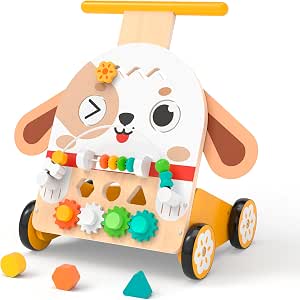 | Best Wooden Walker for New Walkers | Brand: Yuyctwg | Material: Natural wood | Age range: 12–36 months | VIEW ON AMAZON | See Our Full Breakdown |
| labebe Wooden Baby Walker with Tool Bench |  | Best for Older Toddlers Who Like Building Play | Material: Wood and MDF | Dimensions: 12.2 × 19.29 × 12.99 inches | Age range: 36 months to 5 years | VIEW ON AMAZON | See Our Full Breakdown |
| Fisher-Price Laugh & Learn Smart Stages Puppy Walker |  | Best for Learning Variety | Play modes: Sit and play; stand and walk | Learning levels: 3 Smart Stages levels | Audio content: 75+ songs, sounds, and phrases | VIEW ON AMAZON | See Our Full Breakdown |
| Bautia Wooden Montessori Baby Walker |  | Best Wooden Push Walker | Material: Wood | Color: Green | Dimensions: 14.4 × 12.6 × 18 in | VIEW ON AMAZON | See Our Full Breakdown |
| VTech Sit-to-Stand Learning Walker, Pink |  | Best for Removable Floor Play | Color: Pink | Age range: 9 months to 3 years | Activity features: 5 piano keys, 3 shape sorters, 3 rollers, 3 light-up buttons, and telephone handset | VIEW ON AMAZON | See Our Full Breakdown |
| woom Wow Baby & Toddler Balance Bike, No-Pedal, 9–36 Months |  | Best for Balance-Bike Practice | Bike type: No-pedal balance bike | Age range: 9–36 months | Recommended height: 27–39 inches | VIEW ON AMAZON | See Our Full Breakdown |
| VTech Sit-to-Stand Learning Walker |  | Best for Two-Speed Walking Practice | Model: 80-077001 | Age range: 9 months to 3 years | Number of wheels: 4 | VIEW ON AMAZON | See Our Full Breakdown |
| Liberry Baby Balance Bike for Ages 1–2, Adjustable Seat, Green |  | Best for Stable First Rides | Age range: 12–24 months | Bike type: Balance bike | Frame material: Steel | VIEW ON AMAZON | See Our Full Breakdown |
| baby walking toy | Age range |
|---|---|
| VTech Sit-to-Stand Learning Wa | — |
| SEREED Baby Balance Bike for T | — |
| VTech Sit-to-Stand Learning Wa | — |
| Wooden 6-in-1 Puppy Push Walke | 12–36 months |
| labebe Wooden Baby Walker with | 36 months to 5 years |
| Fisher-Price Laugh & Learn Sma | — |
| Bautia Wooden Montessori Baby | — |
| VTech Sit-to-Stand Learning Wa | 9 months to 3 years |
| woom Wow Baby & Toddler Balanc | 9–36 months |
| VTech Sit-to-Stand Learning Wa | 9 months to 3 years |
| Liberry Baby Balance Bike for | 12–24 months |
More Details on Our Top Picks
VTech Sit-to-Stand Learning Walker, Blue
The VTech Sit-to-Stand Learning Walker suits families who want one toy to serve both seated play and early supported walking. Its detachable activity panel brings the piano keys, shape sorters, handset, lights, and rollers down to floor level, then reattaches when a child is ready to push. Compared with the more walking-focused SEREED Baby Balance Bike, this VTech offers more stationary activities but less practice steering and riding. The two-speed control gives caregivers a way to adjust the walker as a child’s pace changes, and the product is described for carpet and bare floors. The tradeoff is that its many play features may matter less to buyers seeking a simple push aid, and dimensions and weight are not provided.
Pros:- Detachable panel supports play before a child is ready to push the walker
- Five piano keys and several hands-on activities offer varied play
- Two speed settings accommodate changing walking pace
- Described for use on carpet and bare floors
Cons:- Requires a child who is ready to sit, stand, or walk to use its activities or walker function
- Dimensions and product weight are not specified
- More activity features may be unnecessary for families who want a basic push walker
Best for: Families looking for a play-rich walker that can entertain a child while seated and support later push-walking practice
Not ideal for: Caregivers seeking a compact, low-feature walking aid or a riding toy that develops steering; the product data does not list its dimensions or weight
- Color:Blue
- Activity panel:Detachable and reattachable
- Piano keys:Five
- Other play features:Telephone handset, three shape sorters, light-up buttons, and spinning rollers
- Speed settings:Two
- Floor compatibility:Carpet and bare floors
Our verdict“Choose this VTech if you want a seated activity panel as well as a push walker, but pick the SEREED bike for more riding and steering practice.”
SEREED Baby Balance Bike for Toddlers, 12–24 Months
Unlike the push-and-play VTech Sit-to-Stand Learning Walker, Blue, the SEREED Baby Balance Bike is built around riding, steering, and balance practice. Its four-wheel layout, supportive seat, and 135° turning limit give a young rider a stable-feeling format, while non-slip EVA wheels are intended for indoor and outdoor use. At 3.5 pounds in the specs, it is easy to carry between play areas; the description lists 3.6 pounds, so the supplied weight information conflicts. This is a more focused choice than an activity walker, with no piano panel or shape-sorting play built in. It also has no brake, so caregivers need to supervise closely and choose an appropriate riding area. The recommended 12–24-month age range makes it less adaptable as a long-term walker.
Pros:- Four-wheel design and a 135° turning limit are intended to help limit tipping
- Lightweight construction makes it easy to carry
- Non-slip EVA wheels are designed for indoor and outdoor use
- Encourages balance, steering, and coordination practice
Cons:- No brake is listed
- Recommended age range is limited to 12–24 months
- Weight is listed as both 3.5 and 3.6 pounds in the supplied product data
Best for: Families with a 12–24-month-old who is ready to sit and practice steering and balance on indoor or outdoor surfaces
Not ideal for: Buyers who want stationary learning activities, brake-assisted stopping, or a toy intended to serve well beyond the listed age range
- Recommended age:12–24 months
- Bike type:Balance bike
- Frame material:Aluminum alloy
- Wheel material and size:EVA; 6.7 inches
- Number of wheels:Four
- Turning limit:135°
- Weight:3.5 pounds in specs; 3.6 pounds in description
- Maximum weight recommendation:55 pounds
- Brakes:None
Our verdict“Pick the SEREED for a lightweight first riding toy focused on balance and steering, rather than the VTech’s seated activities and push-walker format.”
VTech Sit-to-Stand Learning Walker, Lavender
The Lavender VTech Sit-to-Stand Learning Walker is a strong fit for households that want play to begin before a child is ready to push. Its removable activity panel includes five piano keys, a handset, shape sorters, lights, and spinning rollers, then attaches to the walker for standing play and early walking practice. That makes it more flexible for changing play stages than the Wooden 6-in-1 Puppy Push Walker, which centers on a fixed wooden activity panel and push-walking. The VTech’s two speed settings also let caregivers adjust the walker as a child’s pace changes. Its tradeoff is a feature-led design: families who prefer wooden materials and quiet, low-tech activities may favor the Puppy Walker. The supplied data does not specify floor compatibility, dimensions, or weight for this color listing.
Pros:- Detachable panel supports seated play
- Five piano keys and multiple tactile activities offer varied engagement
- Two speed settings can suit changing walking pace
- Activities can move from the panel to the walker format
Cons:- Electronic and interactive features may not suit buyers seeking a simpler wooden toy
- Dimensions and weight are not specified
- Floor compatibility is not stated in the supplied details
Best for: Families who want a detachable activity panel for a child who plays seated now and may push a walker later
Not ideal for: Buyers who prioritize a wooden, low-tech design or need listed dimensions, weight, and floor compatibility before choosing
- Color:Lavender
- Removable activity panel:Yes
- Piano keys:Five
- Other activity features:Telephone handset, three shape sorters, light-up buttons, and spinning rollers
- Speed settings:Two
- Panel use:Detachable for seated play and attachable to the walker
Our verdict“Choose the Lavender VTech for a removable activity panel and adjustable walking pace; choose the Wooden 6-in-1 Puppy Push Walker for a wooden, hands-on alternative.”
Wooden 6-in-1 Puppy Push Walker for Toddlers
The Wooden 6-in-1 Puppy Push Walker puts walking stability ahead of electronic play. Its weighted base is designed to slow rolling, while rubber-rimmed wheels aim for quieter movement and gentler contact with floors. That makes it a more walking-focused choice than the Lavender VTech Sit-to-Stand Learning Walker, whose detachable panel offers more kinds of play but whose supplied details do not describe a weighted base. Here, the fixed activity panel combines a shape sorter, bead maze, gears, sliding beads, tracking game, and flip board, giving a child reasons to stop and explore between pushes. The wood construction, rounded edges, and stated ASTM F963 and CPSIA compliance may appeal to buyers avoiding a plastic, feature-heavy design. Assembly is required, and no adjustable handle or height is listed.
Pros:- Weighted base is designed to slow rolling for early walking practice
- Six activities give children several hands-on ways to play
- Rubber-rimmed wheels are described as quiet and floor-friendly
- Rounded edges and water-based, non-toxic paint are specified
Cons:- Assembly is required
- No adjustable handle or height is mentioned
- Fixed wooden activity panel is less portable for seated play than the detachable VTech panels
Best for: Caregivers seeking a wooden push walker with a slower-rolling base and hands-on activities for a child aged 12–36 months
Not ideal for: Families who need an adjustable handle, a detachable activity panel, or a walker that requires no assembly
- Brand:Yuyctwg
- Material:Natural wood
- Age range:12–36 months
- Activities:Shape sorter, bead maze, spinning gears, sliding beads, tracking game, and flip-and-discover board
- Wheels:Four rubber-rimmed wheels
- Paint:Water-based, non-toxic
- Safety standards:ASTM F963 and CPSIA
- Assembly:Required
Our verdict“Choose this model for a wooden, slower-rolling push walker with varied tactile activities, but skip it if handle adjustment is a priority.”
labebe Wooden Baby Walker with Tool Bench
The labebe Wooden Baby Walker with Tool Bench stands apart from the other push walkers here because its listed age range is 36 months to 5 years, not an early-walker range. Its gears, number flippers, shape sorter, and building tools make it a better match for older toddlers who are drawn to pretend construction and hands-on tasks. The adjustable speed control is a useful distinction from the Wooden 6-in-1 Puppy Push Walker, whose details do not mention speed adjustment. But the age recommendation sharply narrows its fit for families shopping for a first walking aid. At 12.2 × 19.29 × 12.99 inches, it also has a defined footprint to plan around. Buyers should compare that age guidance with their child’s stage rather than assume the “baby walker” name means it suits a new walker.
Pros:- Building tools add a distinct pretend-play angle
- Includes gears, number flippers, and a shape sorter
- Adjustable speed control is specified
- Dimensions and safety standards are provided
Cons:- Listed age range of 36 months to 5 years excludes many early walkers
- Wood-and-MDF construction may not suit buyers seeking an all-solid-wood product
- The supplied details do not specify wheel material or number of wheels
Best for: Families with a child aged 36 months to 5 years who wants building-themed play alongside a push toy
Not ideal for: Caregivers shopping for a first walker for a baby or younger toddler, since the listed age range begins at 36 months
- Material:Wood and MDF
- Dimensions:12.2 × 19.29 × 12.99 inches
- Age range:36 months to 5 years
- Features:Adjustable speed, interactive gears, number flippers, shape sorter, and building tools
- Included components:Push walker and tool toy
- Safety standards:ASTM, CE, and EN71
- Color:Grey
Our verdict“Choose the labebe for an older toddler who enjoys tool-themed activities and can use its listed age range; younger new walkers should look to an age-matched push walker instead.”
Fisher-Price Laugh & Learn Smart Stages Puppy Walker
I’d pick the Laugh & Learn Smart Stages Puppy Walker for families who want one toy to work for seated play as well as early walking practice. Its three learning levels introduce concepts including letters, shapes, counting, and Spanish words, while more than 75 songs, sounds, and phrases give children several ways to engage. The sit-and-play mode also makes it more versatile before a child is ready to push a walker. Compared with the VTech Sit-to-Stand Learning Walker, this model emphasizes staged learning and bilingual content rather than a removable activity panel and two-speed switch. Its four-wheel base and easy-grasp handle support pushing, but the supplied details don’t specify wheel resistance or a speed adjustment. Buyers seeking precise control over rolling speed should look at a model with that feature.
Pros:- Sit-and-play and stand-and-walk modes suit different stages of readiness.
- Three learning levels cover letters, shapes, colors, counting, and Spanish words.
- More than 75 songs, sounds, and phrases provide varied audio play.
- Seven hands-on activities support fine-motor play alongside pushing practice.
Cons:- No speed-control setting is listed, so rolling resistance may not be adjustable.
- The activity panel is not described as removable for separate floor play.
Best for: Families who want a walker that also offers seated play and a range of early learning activities, including Spanish words.
Not ideal for: Caregivers who want a stated speed-control feature or a removable activity panel for separate floor play.
- Play modes:Sit and play; stand and walk
- Learning levels:3 Smart Stages levels
- Audio content:75+ songs, sounds, and phrases
- Activities:7, including light-up piano keys, roller, spinner, and flip page
- Handle:Easy-grasp handle
- Base:4-wheel base
- Recommended age:6–36 months
Our verdict“Choose this for staged learning and two play modes; choose the VTech Sit-to-Stand Learning Walker if adjustable speed or a removable panel matters more.”
Bautia Wooden Montessori Baby Walker
The Bautia Wooden Montessori Baby Walker suits buyers who prefer a wooden push toy with activities built into its panel rather than an electronic learning center. A letter wheel, xylophone, flip board, and tracking game give a child reasons to stop and play between attempts at walking. Its rubber wheels are described as quiet and floor-friendly, while adjustable speed is intended to help with stability. Compared with the Fisher-Price Laugh & Learn Smart Stages Puppy Walker, Bautia offers a more traditional wooden build, but it does not list staged songs, phrases, or a sit-and-play mode. The speed-adjustment details are also unclear, and assembly requires screws and nuts. I’d favor it for hands-on, low-tech play, but buyers who need clear setup instructions about wheel adjustment may prefer a more fully specified option.
Pros:- Wooden construction gives it a distinct alternative to plastic activity walkers.
- Activity panel includes a letter wheel, xylophone, flip board, and tracking game.
- Rubber wheels are described as quiet and floor-friendly.
- Adjustable speed is intended to support stability during early walking practice.
Cons:- The product details do not explain which parts or settings adjust the speed.
- Some assembly is required.
- No seated-play mode or electronic learning content is listed.
Best for: Families seeking a wooden push walker with quiet, floor-friendly wheels and several hands-on activities.
Not ideal for: Caregivers who want electronic songs, clearly documented speed settings, or a walker that arrives ready to use without assembly.
- Material:Wood
- Color:Green
- Dimensions:14.4 × 12.6 × 18 in
- Weight:3.5 kg
- Maximum height:45.7 cm
- Wheel feature:Rubber wheels; adjustable speed described
- Activity panel:Rolling letter wheel, xylophone, flip board, and tracking game
- Included components:Screws and nuts
Our verdict“Choose Bautia for a wooden, hands-on push walker, but skip it if you need clearly explained speed controls or electronic activities.”
VTech Sit-to-Stand Learning Walker, Pink
The pink VTech Sit-to-Stand Learning Walker stands out for a practical detail: its removable activity panel can be used on the floor before it is attached for walking play. That makes it a flexible choice for a child who enjoys the activities but is not yet ready to push a walker. Five piano keys, shape sorters, rollers, lights, and a telephone handset offer varied hands-on play; the two-speed switch adds a control that the Fisher-Price Laugh & Learn Smart Stages Puppy Walker does not list. The tradeoff is that this model relies on batteries for its electronic features and is specified for ages 9 months to 3 years, rather than the Fisher-Price model’s earlier starting age. I’d choose it for floor-to-walker versatility, but not for buyers seeking a wooden build or battery-free play.
Pros:- Removable panel supports floor play and can be reattached for walking use.
- Two-speed control offers an adjustment as a child’s walking pace changes.
- Combines music, lights, piano keys, shape sorters, rollers, and a handset.
- Two AA batteries are included.
Cons:- Electronic features require batteries.
- The stated age range begins at 9 months.
- The 90-day manufacturer-defect warranty is limited in duration.
Best for: Families who want a removable activity panel for floor play before their child is ready to use a push walker.
Not ideal for: Buyers who prefer battery-free toys, wooden construction, or a model specified for children younger than 9 months.
- Color:Pink
- Age range:9 months to 3 years
- Activity features:5 piano keys, 3 shape sorters, 3 rollers, 3 light-up buttons, and telephone handset
- Speed settings:2
- Removable activity panel:Yes
- Batteries:2 AA, included
- Dimensions:16.5 × 14.2 × 18.1 in
- Manufacturer warranty:90 days against manufacturer defects
Our verdict“Choose this pink VTech model if a removable floor-play panel and two speed settings matter more than battery-free or wooden construction.”
woom Wow Baby & Toddler Balance Bike, No-Pedal, 9–36 Months
The woom Wow Baby & Toddler Balance Bike is the outlier here: it is a ride-on balance bike, not a handle-led push walker. I’d include it for families whose child is ready to practice scooting, steering, and balancing under close supervision, rather than for buyers seeking a walker to steady early steps. Its 6 lb aluminum frame, low 10.5-inch saddle, and self-centering steering are designed for very young riders; the quiet, maintenance-free wheels keep upkeep simple. Compared with the four-wheel VTech Sit-to-Stand Learning Walker, it offers a different kind of movement practice and no activity panel or speed switch. It also has no brake, and its suggested height range is limited, so fit and supervision matter more than they do with a stationary activity walker.
Pros:- Lightweight 6 lb aluminum frame is easier to handle than a heavier ride-on.
- Low 10.5-inch saddle is designed for young riders.
- Self-centering steering supports controlled steering practice.
- Quiet, maintenance-free wheels and included Buddy soft toy add practical and play appeal.
Cons:- This is a balance bike, not a walker for supporting a child’s first steps.
- It has no brake.
- The recommended age and height ranges limit how long it may fit.
Best for: Families with a child who fits the stated height range and is ready for supervised, no-pedal balance-bike practice.
Not ideal for: Caregivers looking for a standing support walker, attached learning activities, or a bike with a brake.
- Bike type:No-pedal balance bike
- Age range:9–36 months
- Recommended height:27–39 inches
- Frame material:Aluminum
- Weight:6 lb
- Bike length:23 inches
- Saddle height:10.5 inches
- Brake:No brake
- Included component:Buddy soft toy
Our verdict“Pick the woom Wow for supervised balance-bike practice, not as a substitute for a four-wheel learning walker like the VTech Sit-to-Stand.”
VTech Sit-to-Stand Learning Walker
I’d choose this VTech Sit-to-Stand Learning Walker when adjustable rolling speed and a removable activity panel are the main priorities. The panel can provide floor play before a child is ready to push, then attach to the four-wheel walker for standing and walking practice. Its two-speed switch offers a way to adjust the pace, while piano keys, sorters, rollers, lights, a handset, and spinning gears keep the panel busy. Compared with the pink VTech version in this roundup, the supplied details list spinning gears but do not give dimensions or a color, so buyers who need those specifics should check the product listing. Like that pink model, this version requires two AA batteries; new batteries are recommended for regular use. It’s a practical activity-rich choice, but not a wooden or battery-free option.
Pros:- Removable activity panel supports play before walking practice begins.
- Two-speed switch allows a change in rolling pace.
- Four wheels provide a push-walker format for standing and walking practice.
- Activities include piano keys, sorters, rollers, lights, a handset, and spinning gears.
Cons:- Electronic play requires two AA batteries, and new batteries are recommended for regular use.
- No dimensions or color are provided in the product details.
- The listed warranty lasts 90 days against manufacturer defects.
Best for: Families who want an activity walker with a removable play panel and two speed settings for changing walking confidence.
Not ideal for: Buyers who want a wood walker, battery-free play, or detailed dimensions and color information in the provided specifications.
- Model:80-077001
- Age range:9 months to 3 years
- Number of wheels:4
- Activities:5 piano keys, 3 shape sorters, 3 rollers, 3 light-up buttons, telephone handset, and spinning gears
- Speed control:Two-speed switch
- Activity panel:Removable for floor play
- Batteries:2 AA, included; new batteries recommended for regular use
- Warranty:90 days against manufacturer defects
Our verdict“Choose this VTech model for a removable activity panel and two-speed walking practice, but look elsewhere for a wooden, battery-free walker.”
Liberry Baby Balance Bike for Ages 1–2, Adjustable Seat, Green
For toddlers ready to practice scooting, the Liberry Baby Balance Bike offers a more ride-focused option than the VTech Sit-to-Stand Learning Walker, which is built around standing play and activities. Its four-wheel base and closed wheels support steadier movement and help keep little feet away from the wheels, while the adjustable seat can accommodate growth from 9.7 to 11 inches. At 6.4 pounds, it is manageable to move between rooms or take outside on smooth paths. Soft EVA tires are intended to reduce noise and skidding, but this bike is not suited to gravel or other uneven ground. It also requires assembly, and unlike a push walker, it asks a child to sit and propel themselves rather than practice walking behind a handle.
Pros:- Four wheels provide a stable base for beginner riders.
- Closed wheel design helps protect feet from wheel contact.
- Seat adjusts from 9.7 to 11 inches to accommodate growth.
- Soft EVA tires are designed to reduce noise, shock, and skidding on smooth surfaces.
Cons:- Not recommended for uneven surfaces such as gravel.
- Requires assembly before use.
- A seated balance bike does not offer the handle-led walking practice of push walkers.
Best for: Caregivers of 12–24-month-olds who are ready to practice seated scooting on smooth indoor floors or paved paths and want a seat that adjusts as the child grows.
Not ideal for: Families looking for a toy to support standing and walking practice, or those who need a ride-on for gravel, rough paths, or other uneven surfaces.
- Age range:12–24 months
- Bike type:Balance bike
- Frame material:Steel
- Number of wheels:4
- Wheel size and material:6 inches; EVA
- Seat height:Adjustable from 9.7 to 11 inches
- Maximum weight capacity:55 lbs
- Weight:6.4 lbs
- Fit inseam:10–18 inches
Our verdict“Choose the Liberry for a toddler ready to scoot on smooth surfaces who needs a stable four-wheel starter bike, not a push walker for practicing steps.”

How We Picked
I compared these baby walking toys by the job they are designed to do: provide push-and-play support, encourage hands-on activity, or offer a seated balance-bike experience. I weighed usability across more than one play stage, the usefulness of the activity features, adjustability where specified, likely storage demands, and how clearly each option fits a buyer’s needs. A toy’s label or appearance alone did not determine its place; the key question was whether its design offers a practical reason to choose it over alternatives in this lineup.
The VTech Sit-to-Stand Learning Walker ranks highest because its activity panel can be used separately, giving it a wider play role than a toy used only for pushing. The wooden walkers follow, with the 6-in-1 Puppy distinguished by activity range and the labebe and Bautia options serving narrower preferences. Balance bikes rank as specialized choices rather than direct substitutes for push walkers: the woom Wow is the premium pick, while SEREED and Liberry provide alternatives for families prioritizing early scooting. Since several VTech entries are color or listing variants, I treat them as one basic design when explaining the comparison rather than implying that color changes performance.
Factors to Consider When Choosing Baby Walking Toys
Before choosing among these baby walking toys, decide what kind of play you want the toy to support. The most useful comparison starts with your child’s current abilities and your home setup, not the number of sounds, activities, or age labels on a box.
Choose the toy’s job before its features
A push walker and a balance bike support different kinds of play, so they should not be treated as interchangeable. A push walker offers something to hold while moving behind it, while a balance bike is ridden seated and moved with the feet. If your child is more interested in stationary buttons and textures, an activity panel may matter more than wheels. A common mistake is buying a bike because it says “walking” in the listing, then expecting it to provide the same support as a push toy. Match the product to the movement your child can already attempt with adult supervision. If you are unsure, choose a toy with more than one play mode rather than relying on a single use.
Check readiness and supervision needs
Age ranges are useful starting points, not proof that every child is ready for the same toy. Look at the product’s stated size and weight limits, seat or handle arrangement, and the child’s ability to sit or stand as needed. A child who is not ready for a particular position may get little from a balance bike, even if the age range appears suitable. Push toys can move faster than expected on smooth floors, so clear the route and supervise play closely. Avoid treating a walking toy as a device that teaches independent walking or replaces hands-on support. The safer fit is the one that suits the child’s abilities and the room where it will be used.
Measure the play area and storage spot
Wheels need clear space, and activity toys need a place to live between play sessions. Measure doorways, tight turns, and the area where the toy will be stored; a toy that fits in a large room may be awkward in a narrow hallway. Also check whether the chosen route has rugs, thresholds, stairs, or nearby furniture that could interrupt movement. Buyers often focus on the toy’s footprint but forget that a child needs room to turn and an adult needs room to stay close. A compact design may be more practical for a small home than a feature-heavy model. If storage is limited, favor a toy whose parts or activity panel can be put away easily.
Balance entertainment with simplicity
Lights, sounds, moving parts, and multiple activities can make a toy more engaging, but they also add stimulation and may mean more cleaning or battery upkeep. Decide whether those features are likely to get regular use or whether your child prefers simple tactile play. A panel that detaches can extend use beyond standing play, while a multi-activity wooden toy may offer variety without an electronic feature set. Do not assume that the longest feature list creates the best experience; extra pieces can take up space and make play harder to manage. Read the care instructions before buying, especially for toys with electronics or detailed surfaces. The right level of activity is the one your child can enjoy without making cleanup and storage a burden.
Compare adjustability and the expected play window
Adjustable seats or handles can help a toy fit a growing child, but they do not make every model suitable for every stage. Check what adjusts, how it is changed, and whether the product has stated height or weight limits. A removable panel, as found on the VTech walker, can broaden the toy’s use in a different way by supporting play when the child is not pushing. Buyers sometimes pay for adjustment without checking whether the toy’s core activity will remain useful as the child’s interests change. Think about the next likely play stage, not just the first week after purchase. A product with a shorter, clearer purpose can still be a sensible choice if that purpose matches your child’s current interests.
Weigh materials, maintenance, and value together
Wooden and plastic toys differ in feel, care needs, weight, and the kinds of activities they commonly offer. Do not choose by material alone: inspect the specific model’s construction details, age guidance, and cleaning instructions. A wooden toy may appeal to families seeking a different look or tactile experience, while a plastic activity walker may offer electronic play and a removable panel. In either case, check for accessible surfaces that can be wiped and parts that need periodic inspection. Value is about how well the toy fits your child’s play and your routine, not how many features it lists. Spend more only when a feature you will actually use—such as a distinctive balance-bike design or broader play modes—justifies the tradeoff.
Frequently Asked Questions
Should I buy a push walker or a balance bike?
Choose a push walker if your priority is a toy the child can hold and move behind, often alongside stationary activities. Choose a balance bike if you want seated scooting and balance-focused play; it is not a substitute for a push walker. The SEREED, woom Wow, and Liberry in this roundup are bike-style options, while the VTech and wooden walkers serve different push-and-play roles. Check that your child can use the bike’s seated position and reach the floor as directed by its manufacturer. A clear play area and close adult supervision matter for either type.
Do baby walking toys help a child learn to walk sooner?
A walking toy should be treated as a play option, not a way to speed up independent walking. These products offer different activities and movement experiences, but a toy cannot replace a child’s own development or adult supervision. Pick one because its play style suits your child’s current interests and abilities, rather than expecting a particular developmental result. Follow the manufacturer’s age and use instructions, and keep play on a safe, uncluttered surface. If you have concerns about your child’s movement, ask a pediatric health professional for guidance rather than relying on a product description.
Are the blue, lavender, and pink VTech walkers different models?
The blue, lavender, and pink listings in this roundup appear to be color versions of the VTech Sit-to-Stand Learning Walker, not distinct categories of toy. The separately named VTech listing should still be checked for its exact included parts and listing details before you buy. Color alone is not a reason to rank one above another; focus on the removable activity panel, play features, and fit for your space. If the child will use the toy in a shared room, appearance may matter to your household, but it does not change the basic function. Confirm the product title and contents on the listing so a variant is not mistaken for a different design.
Is a wooden walking toy automatically a better choice than a plastic one?
No material is automatically the better fit. The wooden Puppy, labebe Tool Bench, and Bautia Montessori walker offer different themed or activity-led approaches, while the VTech plastic walker emphasizes an electronic activity panel and play away from the push position. Compare the specific toy’s construction, cleaning instructions, sound features, and storage needs rather than relying on a broad material preference. A wooden finish may appeal to buyers seeking a different look, but the toy still needs to suit the child’s play and the home’s surfaces. Check the manufacturer’s care and safety guidance for whichever material you choose.
What should I check before using a walking toy at home?
Read the product’s instructions, age guidance, and any size or weight limits before use. Set up a clear play area away from stairs, edges, cords, and furniture that could create a collision or snag hazard. Stay close enough to supervise, particularly when a wheeled toy is used on a smooth floor or a child is still learning how to control it. Inspect moving parts and fasteners as the manufacturer directs, and keep batteries or small accessories out of reach when they are not secured as intended. A toy does not make an unsafe surface or unsupervised play safe.
Conclusion
For the broadest play range, I recommend the VTech Sit-to-Stand Learning Walker as best overall, especially for families who want an activity panel that can be used separately. The Wooden 6-in-1 Puppy Push Walker is my best value-style pick for buyers who want multiple kinds of activity in one push toy, while the woom Wow is the best premium choice for families specifically seeking a balance bike. For beginners who want stationary play alongside a push option, the VTech’s removable panel makes the clearest starting point in this lineup. Choose labebe or Bautia if a wooden, themed activity walker better suits your preferences, and look to SEREED or Liberry if seated scooting is the intended play. I would skip balance bikes if you need a toy to push behind, and skip feature-heavy walkers if your priority is a simpler setup with minimal upkeep.