Modular dining tables make it easier to adapt a dining space for daily meals, guests, or limited floor area. My best overall pick is the DMAITH Extendable Dining Table, 20–118.5 Inches, Oak, whose unusually broad stated size range offers the most flexibility for changing needs. The COMUHOME Drop Leaf Folding Dining Table with Storage stands out for compact rooms, while the Expandable Solid Rubberwood Dining Table for 2–6 is a more straightforward choice for smaller gatherings. The main tradeoffs are how much space an extended table needs, how its leaves or folding sections are managed, and whether built-in storage is worth giving up legroom or a simpler footprint. Read on for the full comparison and guidance on choosing a table that fits both your room and your routine.

Get furniture and decor delivered free with Prime
- Fast, free delivery on millions of items
- Prime Video, Amazon Music and more included
- Member-only deals all year
Complete the kit


Key Takeaways
- The DMAITH 20–118.5-inch model has the broadest stated size range in this lineup, making it the most adaptable on paper; check both its minimum and fully extended footprint against your room before choosing it.
- Storage is a defining split among the options. Several walnut tables add shelves, cabinets, or sideboard-style storage, while simpler extendable designs may suit buyers who would rather keep the table area open.
- Compact flexibility comes in different forms: the COMUHOME uses a drop-leaf, folding format, while the rubberwood table is described as expanding from seating for two to six.
- Extension range and daily convenience are not the same thing. A table that reaches a large size may be less suitable if its extension mechanism is awkward to operate or its leaves need separate storage.
- Material and room fit matter as much as modularity. The rubberwood and solid-wood options may appeal to buyers prioritizing wood construction, while the wider Belinda table calls for careful measurement before purchase.
| DMAITH Extendable Dining Table, 20–118.5 Inches, Oak | 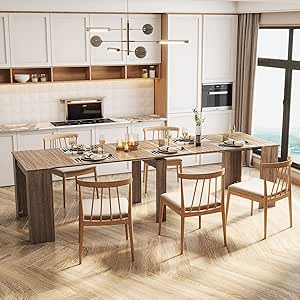 | Best for Maximum Seating | Brand: DMAITH | Model: Table721 | Material: Engineered wood | VIEW LATEST PRICE | See Our Full Breakdown |
| Extendable Dining Table with Storage, Walnut |  | Best for Console Storage | Brand: DMAITH | Model: Table721 | Materials: Engineered wood, MDF, and metal | VIEW LATEST PRICE | See Our Full Breakdown |
| Extendable Dining Table with Storage Shelf, Black |  | Best Shape-Shifting Design | Color: Black | Shape: Round when unextended; oval when extended | Dimensions: 59 x 43 x 30 inches | VIEW LATEST PRICE | See Our Full Breakdown |
| HOMBIX Extendable Dining Table, Walnut |  | Best for Frequent Size Changes | Brand: HOMBIX | Color: Walnut | Materials: MDF top, particle board frame, engineered wood legs | VIEW LATEST PRICE | See Our Full Breakdown |
| Extendable Dining Table with Storage Sideboard, Walnut |  | Best Integrated Dining Setup | Material: MDF | Color: Walnut | Finish: Natural wood stain | VIEW LATEST PRICE | See Our Full Breakdown |
| Belinda Mid-Century Modern Modular Dining Table, Black, 54 x 108 Inches |  | Best Statement Table for Large Rooms | Dimensions: 108 x 54 x 31 inches | Weight: 402 pounds | Materials: Solid wood base; oak veneer MDF top | VIEW LATEST PRICE | See Our Full Breakdown |
| Extendable Dining Table with Storage Cabinet, Walnut |  | Best for Flexible Room Layouts | Brand and model: St.Mandyu DJ1269 | Dimensions: 33.9 x 102 x 30 inches | Weight: 212 pounds | VIEW LATEST PRICE | See Our Full Breakdown |
| COMUHOME Drop Leaf Folding Dining Table with Storage |  | Best Mobile Table with Storage | Open dimensions: 60.2 x 31.5 x 28.5 inches | Collapsed length: 13 inches | Weight: 55 pounds | VIEW LATEST PRICE | See Our Full Breakdown |
| Expandable Solid Rubberwood Dining Table for 2–6, Walnut |  | Best Compact Solid-Wood Pick | Unextended dimensions: 23.6 x 31.5 x 29.5 inches | Extended dimensions: 47.2 x 31.5 x 29.5 inches | Material and color: Solid rubberwood; walnut | VIEW LATEST PRICE | See Our Full Breakdown |
| HOMBIX Expandable Dining Table, Walnut |  | Best for Large, Changing Guest Lists | Dimensions: 35.43 x 118.11 x 30.71 inches | Extended and unextended length: 118.5 inches extended; 20.1 inches unextended | Weight: 125.7 pounds | VIEW LATEST PRICE | See Our Full Breakdown |
| Extendable Rectangular Dining Table, Walnut |  | Best for Maximum Seating Range | Material: MDF with aluminum telescopic mechanism | Finish and shape: Walnut; rectangular | Dimensions: 35.4 × 118.1 × 30.7 inches | VIEW LATEST PRICE | See Our Full Breakdown |
| DMAITH Extendable Dining Table, Walnut, 71–106.5 in |  | Best for a Tidy, Self-Storing Leaf | Material: Engineered wood | Color and shape: Walnut; rectangular | Dimensions: 35.5 × 106.5 × 30 inches | VIEW LATEST PRICE | See Our Full Breakdown |
| Extendable Dining Table with Charging Station and LED Lights, Walnut |  | Best for Tech-Forward Small Spaces | Material: MDF tabletop with metal frame | Color and shape: Walnut; rectangular | Dimensions: 27.56 × 98.43 × 35.63 inches | VIEW LATEST PRICE | See Our Full Breakdown |
| Walnut Solid Wood Extendable Dining Table, 47.2–63 Inches |  | Best Solid-Wood Compact Pick | Material: FAS-grade rubberwood | Color and style: Walnut; mid-century modern | Shape: Oblong | VIEW LATEST PRICE | See Our Full Breakdown |
| modular dining table | Seating capacity | Dimensions |
|---|---|---|
| DMAITH Extendable Dining Table | 2–12 people | — |
| Extendable Dining Table with S | 2–10 people | 36.6 x 99 x 31 inches |
| Extendable Dining Table with S | — | 59 x 43 x 30 inches |
| HOMBIX Extendable Dining Table | 2–12 people | 35.43 x 118.11 x 30.71 inches |
| Extendable Dining Table with S | 2–11 people | — |
| Belinda Mid-Century Modern Mod | — | 108 x 54 x 31 inches |
| Extendable Dining Table with S | Up to 9 | 33.9 x 102 x 30 inches |
| COMUHOME Drop Leaf Folding Din | 6–8 | — |
| Expandable Solid Rubberwood Di | 2 unextended; up to 6 extended | — |
| HOMBIX Expandable Dining Table | 2 to 14 | 35.43 x 118.11 x 30.71 inches |
| Extendable Rectangular Dining | 2–12 people | 35.4 × 118.1 × 30.7 inches |
| DMAITH Extendable Dining Table | 4–12 people | 35.5 × 106.5 × 30 inches |
| Extendable Dining Table with C | Up to 8 | 27.56 × 98.43 × 35.63 inches |
| Walnut Solid Wood Extendable D | 4–8 people | 31.5 × 63 × 29.5 inches |
More Details on Our Top Picks
DMAITH Extendable Dining Table, 20–118.5 Inches, Oak
The 20-to-118.5-inch range makes this DMAITH the clearest choice here for households that need one table to handle both everyday meals and large gatherings. It shrinks to a console and stores its leaves underneath, so the modular setup does not require finding a separate home for extension panels. Compared with the HOMBIX Extendable Dining Table, it offers similarly expansive seating but has a stated width of 35.5 inches and a listed capacity of up to 12. Its 125-pound weight makes frequent room changes a chore, though, and the engineered-wood construction is less compelling for buyers seeking solid wood. I’d choose it for adaptable capacity, not lightweight flexibility; the oak color may also look different under varying light.
Pros:- Adjusts from console size to a table listed for up to 12 people.
- Leaves store underneath, reducing the need for separate panel storage.
- Smooth-gliding metal rails support the extension process.
- Oak finish can suit both modern and classic interiors.
Cons:- At 125 pounds, it is difficult to move often.
- Engineered-wood construction may not suit buyers seeking solid wood.
- The oak color may vary with lighting.
Best for: Hosts who routinely move between a compact two-person setup and meals for up to 12, and can leave the table in place.
Not ideal for: People who frequently rearrange their dining area or want a solid-wood table; this model weighs 125 pounds and uses engineered wood.
- Brand:DMAITH
- Model:Table721
- Material:Engineered wood
- Color:Oak
- Shape:Rectangular
- Length:20–118.5 inches
- Width:35.5 inches
- Height:31 inches
- Seating capacity:2–12 people
Our verdict“Choose this DMAITH if you need the lineup’s broadest stated seating range and can accept a heavy engineered-wood table.”
Extendable Dining Table with Storage, Walnut
This DMAITH makes the most sense for buyers who want a compact console that doubles as useful storage, rather than the longest possible dining surface. It extends from 20 to 100 inches for up to 10 people, and its cabinet and drawer give the folded setup a job between meals. That is a different kind of modularity from the DMAITH Extendable Dining Table, 20–118.5 Inches, Oak, which reaches farther and stores leaves underneath but does not list a storage cabinet. The tradeoff is a shorter maximum length and a heavier 135-pound build. Its 300-pound weight capacity and damp-cloth care instructions suit practical daily use, but assembly is required, and the extra cabinet makes this a less minimal option when folded.
Pros:- Converts from a 20-inch console to a dining table for up to 10.
- Storage cabinet and one drawer add utility when the table is folded.
- Listed 300-pound weight capacity supports substantial everyday use.
- Surface can be wiped clean with a damp cloth.
Cons:- Maximum extension is shorter than the 118.5-inch DMAITH and HOMBIX options.
- At 135 pounds, it is cumbersome to reposition.
- Assembly is required.
Best for: Apartment dwellers or small-home owners who want a console with built-in storage that can expand for dinners of up to 10.
Not ideal for: Hosts who need seating for 12 or buyers who want the lightest, easiest-to-reposition modular table; it stops at 100 inches and weighs 135 pounds.
- Brand:DMAITH
- Model:Table721
- Materials:Engineered wood, MDF, and metal
- Color:Walnut
- Shape:Rectangular
- Extension range:20–100 inches
- Dimensions:36.6 x 99 x 31 inches
- Seating capacity:2–10 people
- Weight capacity:300 pounds
Our verdict“Pick this model if built-in console storage matters more than reaching the lineup’s longest dining configuration.”
Extendable Dining Table with Storage Shelf, Black
Unlike the console-to-banquet tables in this roundup, this model changes its footprint and silhouette: it starts as a 43-inch round table for four and opens into a 59-inch oval for up to eight. That makes it a strong fit for buyers who want a more sociable everyday arrangement without committing to a long rectangular table. Its removable leaf is simpler in concept than the multi-panel systems on the HOMBIX and sideboard models, while the lower shelf keeps dining essentials close. The tradeoff is a smaller maximum capacity and the need to store the leaf when it is out. At 80 pounds it is lighter than those larger options, but still not especially convenient to move often; assembly is also required.
Pros:- Round-to-oval conversion changes both seating capacity and table shape.
- One removable leaf keeps the extension system relatively straightforward.
- Lower shelf provides a place for dining essentials.
- Pedestal base and cross-style support allow chairs to tuck underneath.
Cons:- Maximum stated capacity is eight, below the larger console-extension models.
- The removable leaf needs separate storage when not installed.
- At 80 pounds, it may still be cumbersome to move.
Best for: Households that usually seat four and occasionally need a round-to-oval table for gatherings of up to eight.
Not ideal for: Hosts who need seating for 10 or more, or anyone who wants a console-sized folded footprint; this table stays a substantial dining piece.
- Color:Black
- Shape:Round when unextended; oval when extended
- Dimensions:59 x 43 x 30 inches
- Unextended seating capacity:4 people
- Extended seating capacity:Up to 8 people
- Tabletop material:MDF
- Frame material:Carbon steel
- Base:Pedestal with reinforced cross base
- Item weight:80 pounds
Our verdict“Choose this table for a round everyday layout that can become an oval for occasional gatherings, not for maximum seating or compact storage.”
HOMBIX Extendable Dining Table, Walnut
HOMBIX earns its place through a five-leaf extension system that lets buyers choose intermediate lengths instead of jumping from compact console to full banquet table. It ranges from a 20.1-inch console to 118.5 inches and is listed to seat up to 12, putting it in the same high-capacity class as the DMAITH Extendable Dining Table, 20–118.5 Inches, Oak. The aluminum telescopic mechanism and reinforced iron center leg are designed to support that broad span, while the described water-, scratch-, and heat-resistant top suits busy dining. The compromise is that the five panels are removable, so this setup depends on having somewhere to keep them. At 121.3 pounds it is also not a table to shift around casually, even though assembly is limited to attaching the legs.
Pros:- Five removable leaves allow more sizing choices than a single-leaf design.
- Expands from a narrow console to a table listed for up to 12.
- Aluminum telescopic mechanism and reinforced iron center leg support the extended setup.
- Top is described as waterproof, scratch-resistant, and heat-resistant.
Cons:- Removable leaves require storage when they are not in use.
- At 121.3 pounds, moving the table is difficult.
- MDF and particle-board components may not suit buyers seeking solid wood.
Best for: Families or hosts who want several usable table lengths between everyday meals and gatherings of up to 12.
Not ideal for: People without storage space for removable leaves or buyers who need a lightweight table they can move around regularly.
- Brand:HOMBIX
- Color:Walnut
- Materials:MDF top, particle board frame, engineered wood legs
- Dimensions:35.43 x 118.11 x 30.71 inches
- Extension range:20.1–118.5 inches
- Extension leaves:5 removable leaves, each 35.4 x 19.7 inches
- Seating capacity:2–12 people
- Expansion mechanism:Aluminum telescopic mechanism with reinforced iron center leg
- Weight:121.3 pounds
Our verdict“Choose HOMBIX over a simpler extension table if adjustable intermediate lengths matter and you have room to store its five leaves.”
Extendable Dining Table with Storage Sideboard, Walnut
This option treats modular dining as a complete storage-and-table arrangement: four removable panels extend the table for up to 11, and a sideboard provides glass-door storage and open shelves. Its under-sideboard bracket gives the panels a designated home, a practical advantage over the HOMBIX Extendable Dining Table, whose five removable leaves need separate storage. Casters, support legs, an aluminum telescopic mechanism, and safety locks are intended to make extension and setup more manageable. The cost of that integrated design is bulk: at 176.4 pounds, this is the heaviest option in this group, and it calls for two-person assembly. The 0.59-inch MDF top is described as waterproof and wear-resistant, but buyers seeking a light, freestanding table—or a set that includes chairs—should look elsewhere.
Pros:- Four removable panels adjust capacity for groups of 2–11.
- Under-sideboard bracket stores extension panels with the dining setup.
- Sideboard combines glass-door storage with open shelves.
- Casters, support legs, telescopic mechanism, and safety locks support adjustment and stability.
Cons:- At 176.4 pounds, it is especially difficult to move.
- Two-person assembly is recommended.
- Chairs are not included.
Best for: Households furnishing a dining area from scratch that want extension panels stored with a sideboard and regularly host up to 11 people.
Not ideal for: Renters who move often, solo assemblers, or buyers seeking chairs in the same purchase; the unit weighs 176.4 pounds, assembly is recommended for two people, and chairs are not included.
- Material:MDF
- Color:Walnut
- Finish:Natural wood stain
- Extended length:118.11 inches
- Extension panels:4 removable panels
- Seating capacity:2–11 people
- Tabletop thickness:0.59 inches
- Storage:Sideboard with two glass doors and open shelves; under-sideboard panel bracket
- Item weight:176.4 pounds
Our verdict“Choose this integrated set if you want panel storage and sideboard space together, and can accommodate its weight and assembly needs.”
Belinda Mid-Century Modern Modular Dining Table, Black, 54 x 108 Inches
The Belinda takes a different approach to modularity than the folding and telescoping tables in this roundup: its two tops and two bases allow for different configurations, while its 54-by-108-inch footprint is built around a substantial dining setup. The fluted solid wood pedestal bases give it a more furniture-forward look than the HOMBIX Expandable Dining Table, which relies on removable leaves and a telescopic mechanism to serve changing group sizes. A 2-inch-thick oak-veneer MDF top adds visual weight, though the veneer construction is not the same as a solid wood top. The tradeoff is scale: at 402 pounds, this table is difficult to reposition, and its full dimensions demand generous floor space. I’d skip it for compact homes or anyone seeking a table that folds away.
Pros:- Two tabletop sections and two bases allow different configurations.
- Solid wood bases have a distinctive fluted design.
- Thick tabletop gives the large table a substantial visual profile.
- Black oak veneer brings visible wood-grain variation.
Cons:- At 402 pounds, repositioning is difficult.
- The 108-inch length requires considerable dining-room space.
- The tabletop is oak-veneer MDF rather than solid wood.
Best for: Buyers with a spacious dining room who want a substantial black table with configurable components and a sculptural pedestal base.
Not ideal for: Apartment dwellers or anyone who needs frequent, easy reconfiguration; its 402-pound weight and 108-inch length make moving and placement challenging.
- Dimensions:108 x 54 x 31 inches
- Weight:402 pounds
- Materials:Solid wood base; oak veneer MDF top
- Finish:Black
- Tabletop thickness:2 inches
- Shape and base:Rectangular; pedestal
- Included components:2 table tops, 2 bases
- Recommended use:Indoor
Our verdict“Choose the Belinda if you have room for a large statement table and value configurable sections over compact storage or quick extension.”
Extendable Dining Table with Storage Cabinet, Walnut
This table is the most adaptable choice here for buyers who need several distinct footprints, not just a compact and an expanded setting. Its five length settings range from 19.7 to 102 inches, so it can serve as a narrow surface day to day and open up for meals with as many as nine people. That range is broader than the COMUHOME Drop Leaf Folding Dining Table’s console-to-table format, while the included storage cabinet adds a place for dinnerware. Reinforced metal telescopic slides support the length changes, but the engineered materials and laminated finish make it a more function-led option than the Belinda’s solid wood bases and thick veneer top. At 212 pounds, it is not easy to shift around, and its full length needs a clear, spacious room. Buyers wanting a lightweight, quick-to-store table should look elsewhere.
Pros:- Five length settings offer more layout choices than a simple open-or-closed table.
- Extends to 102 inches and seats up to nine.
- Storage cabinet provides dedicated space for dinnerware and kitchen essentials.
- Reinforced metal telescopic slides support repeated adjustments.
Cons:- The 212-pound weight makes repositioning difficult.
- Full extension requires substantial floor space.
- Engineered materials and a laminated finish offer a different feel from solid-wood furniture.
Best for: Households that alternate between a narrow everyday layout and a long dining setup, and want a matching cabinet for tableware.
Not ideal for: People in small rooms who cannot accommodate a 102-inch table when extended or who need to move furniture regularly.
- Brand and model:St.Mandyu DJ1269
- Dimensions:33.9 x 102 x 30 inches
- Weight:212 pounds
- Adjustable lengths:5 settings, from 19.7 to 102 inches
- Seating capacity:Up to 9
- Material and finish:Engineered materials; laminated
- Color and shape:Walnut; rectangular
- Usage:Indoor
Our verdict“Pick this model if several table lengths and built-in dish storage matter more than easy movement or a solid-wood construction.”
COMUHOME Drop Leaf Folding Dining Table with Storage
The COMUHOME is aimed at homes where the table needs to clear the way between meals. Its drop leaves fold to a 13-inch collapsed length, and four wheels make it easier to roll into position than the heavy Belinda or the 212-pound Extendable Dining Table with Storage Cabinet. When opened, it seats six to eight; two drawers and a lower shelf keep small dining items and folding chairs close at hand. The tradeoff is a lighter-duty build: its 0.7-inch plywood and engineered-wood top has a listed total weight capacity of 300 pounds, so it does not have the substantial feel of the Belinda’s thick top. Two wheels lock, but the other two do not. Chairs are sold separately, and assembly is required, so this is best for buyers who value storage and mobility over a heavy, fixed dining surface.
Pros:- Folds down to a 13-inch length for compact storage.
- Four wheels help with repositioning, and two lock for stability.
- Two drawers and a bottom shelf add practical storage.
- Water-resistant surface is designed for wipe-clean maintenance.
Cons:- Folding chairs are sold separately.
- The 0.7-inch top and 300-pound total capacity are less substantial than the Belinda’s heavy tabletop design.
- Assembly is required.
Best for: People in multipurpose homes who want a wheeled dining table that folds compactly and stores dining essentials underneath.
Not ideal for: Buyers who want a thick, heavy-duty tabletop, included chairs, or a table that stays firmly in place without relying on only two locking wheels.
- Open dimensions:60.2 x 31.5 x 28.5 inches
- Collapsed length:13 inches
- Weight:55 pounds
- Materials:Plywood and engineered wood; metal legs
- Tabletop thickness:0.7 inches
- Seating capacity:6–8
- Storage and mobility:Two drawers, bottom shelf, four wheels (two lockable)
- Capacity and warranty:300-pound total capacity; 3-year limited warranty
Our verdict“Choose the COMUHOME for a movable, storage-equipped table that can fold away, not for the solid feel of a permanent dining centerpiece.”
Expandable Solid Rubberwood Dining Table for 2–6, Walnut
For a compact home that still needs room for guests, this rubberwood table offers a smaller everyday footprint than the HOMBIX Expandable Dining Table, which can stretch to 118.5 inches and seat up to 14. The walnut table starts at 23.6 inches wide and expands to 47.2 inches, with space for up to six. Its solid rubberwood construction sets it apart from the engineered-wood tops on the HOMBIX and the COMUHOME, while a concealed compartment gives it a place to keep tableware or work supplies. It can also act as a desk or coffee table, adding flexibility without requiring a large permanent dining layout. The compromise is capacity: six is its upper limit, and chairs are not included. Assembly is required, though the product data estimates about 15 minutes for one person.
Pros:- Compact 23.6-inch unextended width suits smaller rooms.
- Expands to seat up to six without the footprint of the HOMBIX.
- Solid rubberwood construction and a 1.57-inch tabletop.
- Concealed storage and use as a desk or coffee table add versatility.
Cons:- Maximum seating is six, below the capacity of the larger extendable options.
- Dining chairs are not included.
- Assembly is required.
Best for: Apartment residents or small households who want a solid-wood table for two that can expand for occasional meals with guests.
Not ideal for: Large families or frequent hosts who need seating beyond six, or buyers who expect chairs to be included.
- Unextended dimensions:23.6 x 31.5 x 29.5 inches
- Extended dimensions:47.2 x 31.5 x 29.5 inches
- Material and color:Solid rubberwood; walnut
- Shape:Square
- Tabletop thickness:1.57 inches
- Weight:52 pounds
- Seating capacity:2 unextended; up to 6 extended
- Maximum weight recommendation:350 pounds
- Features and assembly:Expandable, foldable, concealed storage; assembly required
Our verdict“Choose this table if you want solid rubberwood and a small daily footprint, and only need occasional seating for up to six.”
HOMBIX Expandable Dining Table, Walnut
The HOMBIX offers the widest guest-capacity range in this group: five removable leaves take it from about 20 inches to 118.5 inches, with seating listed for two to 14. That makes it a stronger fit for large gatherings than the Extendable Dining Table with Storage Cabinet, which tops out at nine, and more adaptable to varied group sizes than the Belinda’s fixed 108-inch dimensions. Its aluminum telescopic mechanism handles the extension, while an iron central leg supports the layout. The tradeoff is a high-gloss MDF top rather than the Belinda’s oak-veneer MDF and solid wood bases, so buyers seeking a natural wood look may prefer the Belinda. At 125.7 pounds, it is still a substantial piece, and its longest setting needs a large room. Assembly is required, and all five leaves need somewhere to go when removed.
Pros:- Five removable leaves create a broad range of table lengths.
- Listed seating capacity runs from two to 14.
- Aluminum telescopic mechanism supports extension.
- 660-pound weight capacity provides a high stated load limit.
Cons:- The 118.5-inch extended length demands substantial room.
- At 125.7 pounds, the table is difficult to move.
- High-gloss MDF may not suit buyers who prefer visible natural wood grain.
Best for: Frequent hosts who need one table to serve a small everyday setup and occasional gatherings of up to 14.
Not ideal for: Small-room buyers or anyone who wants a natural wood surface and does not have convenient storage for five removable leaves.
- Dimensions:35.43 x 118.11 x 30.71 inches
- Extended and unextended length:118.5 inches extended; 20.1 inches unextended
- Weight:125.7 pounds
- Top material and finish:Engineered wood (MDF); high-gloss
- Top thickness:0.8 inches
- Extension leaves:5 removable leaves, each 35.4 x 19.7 inches
- Seating capacity:2 to 14
- Mechanism and leg material:Aluminum telescopic mechanism; iron leg
- Weight capacity:660 pounds
Our verdict“Choose the HOMBIX if your guest list varies widely and you have space to extend the table and store its removable leaves.”
Extendable Rectangular Dining Table, Walnut
For buyers who need one table to shift from a small everyday footprint to a large gathering setup, this model has the widest stated range in this group: it extends from 23.6 to 118.1 inches and is listed for 2 to 12 people. Four removable panels let you add capacity in stages, while the telescopic mechanism and wheeled center support help manage the long span. Compared with the DMAITH Extendable Dining Table, Walnut, 71–106.5 in, this table starts much shorter and reaches farther, but its four panels also mean more pieces to handle and store. The waterproof, abrasion-resistant MDF top suits busy multipurpose rooms, though MDF is a different proposition from the solid rubberwood construction of the smaller walnut table in this roundup. Assembly is recommended for two, and chairs are not included.
Pros:- Four removable panels provide several size configurations, from a compact two-person setup to a table listed for 12.
- Telescopic mechanism and wheeled center support are designed to help extend and support the long tabletop.
- Waterproof, abrasion-resistant surface is suited to frequent dining and multipurpose use.
- Walnut finish and modern farmhouse styling can suit both dining rooms and flexible living spaces.
Cons:- Four separate panels require storage and more handling than a single-leaf extension.
- Assembly is recommended for two people, and the two shipping boxes are both needed.
- MDF construction may not suit buyers seeking the solid-wood feel of the rubberwood option in this roundup.
Best for: Households that regularly host large groups but need a compact table footprint for everyday use.
Not ideal for: Buyers who want a solid-wood table, a simple one-person extension, or a setup that does not require storing multiple panels.
- Material:MDF with aluminum telescopic mechanism
- Finish and shape:Walnut; rectangular
- Dimensions:35.4 × 118.1 × 30.7 inches
- Length range:23.6–118.1 inches
- Extension panels:4 removable panels, each 23.6 × 35.4 inches
- Seating capacity:2–12 people
- Tabletop thickness:0.59 inches
- Base:Pedestal with wheeled central support
- Assembly:Recommended for 2 people
Our verdict“Choose this model if your priority is a dramatic, flexible size range for hosting up to 12, and skip it if you want solid wood or minimal panel storage.”
DMAITH Extendable Dining Table, Walnut, 71–106.5 in
The self-storing center leaf is the main reason to choose this table: it expands from 71 to 106.5 inches, then keeps its extension inside the table rather than requiring a separate storage spot. That makes it a more straightforward fit for households that want occasional extra seating without managing several loose panels. It is listed for 4 to 12 people, matching the large-hosting capacity of the 23.6–118.1-inch Extendable Rectangular Dining Table, Walnut, but it starts at a much longer 71 inches and reaches a shorter maximum. The 1.5-inch engineered-wood top and stated 200-pound support capacity suit everyday dining and meetings, though shoppers seeking solid wood should look at the FAS-grade rubberwood table instead. Assembly is required, and its indoor-only design limits placement.
Pros:- Self-storing center leaf avoids the need to find separate storage for the extension.
- Extends from 71 to 106.5 inches and is listed to seat up to 12.
- Engineered-wood construction has a stated supported weight of up to 200 pounds.
- Assembly hardware and instructions are included.
Cons:- Its 71-inch unextended length is less suited to compact dining areas than the 23.6-inch-starting Extendable Rectangular Dining Table, Walnut.
- Engineered wood is not the solid rubberwood construction offered by another walnut option in the roundup.
- Assembly is required, and the table is designed for indoor use.
Best for: Families or meeting hosts who want a table for four or more with a hidden leaf that stays stored in the table.
Not ideal for: Small-space buyers who need a compact everyday length, or shoppers who specifically want solid-wood construction or outdoor use.
- Material:Engineered wood
- Color and shape:Walnut; rectangular
- Dimensions:35.5 × 106.5 × 30 inches
- Length range:71–106.5 inches
- Seating capacity:4–12 people
- Tabletop thickness:1.5 inches
- Maximum supported weight:200 pounds
- Extension mechanism:Removable, self-storing center leaf
- Care:Wipe with a damp cloth
Our verdict“Pick this DMAITH model if you want a large table with a leaf that stores neatly inside it, but choose a shorter-starting design for a small everyday footprint.”
Extendable Dining Table with Charging Station and LED Lights, Walnut
This is the most feature-led option here: it folds into a 19.6-inch console, extends to 98.4 inches, and adds a charging station and configurable LED lighting. That combination makes it more than a conventional expandable dining table, particularly in a room that doubles as a work or entertaining space. Its four leaves provide a broader setup range than the Walnut Solid Wood Extendable Dining Table, 47.2–63 Inches, which offers a simpler extension and solid rubberwood but less maximum seating. This model is listed for up to eight, so it does not match the 12-person capacity of either large walnut table in the roundup. The 2 AC outlets and 2 USB ports add practical access to power, but the 4.92-foot cord affects placement. MDF construction, required assembly, and indoor-only use are tradeoffs.
Pros:- Folds to a 19.6-inch console and extends to 98.4 inches for flexible room use.
- Four leaves support several configurations and seating for up to eight.
- Charging station includes 2 AC outlets and 2 USB ports.
- LED strip offers app- or button-controlled colors and modes.
Cons:- Its stated capacity of up to eight is lower than the 12-person options in this roundup.
- MDF tabletop construction may not appeal to buyers comparing it with the solid rubberwood table.
- Requires assembly, uses a 4.92-foot power cord, and is intended for indoor use only.
Best for: Apartment dwellers or multipurpose-room owners who want a compact console that can serve as a dining table and provide nearby power and lighting.
Not ideal for: Buyers who need seating for more than eight, prefer solid wood, or do not want electronics and a power cord built into their dining furniture.
- Material:MDF tabletop with metal frame
- Color and shape:Walnut; rectangular
- Dimensions:27.56 × 98.43 × 35.63 inches
- Folded and extended lengths:19.6 inches folded; 98.4 inches extended
- Extension leaves:4
- Seating capacity:Up to 8
- Maximum weight recommendation:200 pounds
- Charging station:2 AC outlets and 2 USB ports
- Lighting:LED strip with over 60,000 colors, music mode, mic mode, and timer
Our verdict“Choose this model when compact storage, charging, and lighting matter more than solid-wood construction or maximum group capacity.”
Walnut Solid Wood Extendable Dining Table, 47.2–63 Inches
Among these four, this is the clear choice for buyers who value solid rubberwood and a restrained everyday footprint over maximum extension. It grows from 47.2 to 63 inches and is listed to seat four to eight, making it a more modest fit than the 106.5-inch DMAITH table or the 118.1-inch Extendable Rectangular Dining Table, Walnut. The hidden lift system with a locking track keeps the extension mechanism out of sight, while rounded corners and a smooth painted surface suit a dining area where a softer profile is preferred. Its stated 300-pound weight capacity is higher than the 200-pound recommendations listed for the two larger engineered-wood tables. The tradeoff is limited reach: it will not serve the largest gatherings in this group, and the four legs require assembly. Chairs are not included.
Pros:- FAS-grade rubberwood offers solid-wood construction rather than MDF or engineered wood.
- Hidden lift system and locking track keep the extension mechanism discreet.
- Extends from 47.2 to 63 inches for occasional additional seating.
- Rounded corners, smooth painted surface, and stated 300-pound capacity support everyday dining needs.
Cons:- The 63-inch maximum length and seating for up to eight fall short of the larger 12-person tables in the roundup.
- Assembly is required, and chairs are not included.
- The stated warranty is two years, which may matter to buyers comparing long-term coverage.
Best for: Buyers furnishing a compact dining area who prefer solid rubberwood and need occasional seating for up to eight.
Not ideal for: Hosts who regularly seat more than eight or need a table that can expand beyond 63 inches.
- Material:FAS-grade rubberwood
- Color and style:Walnut; mid-century modern
- Shape:Oblong
- Dimensions:31.5 × 63 × 29.5 inches
- Length range:47.2–63 inches
- Seating capacity:4–8 people
- Weight capacity:300 pounds
- Extension mechanism:Hidden lift system with locking track
- Warranty:2 years
Our verdict“Choose this table for compact everyday dining and solid-wood construction, but look elsewhere if your gatherings regularly exceed eight people.”
How We Picked
I compared these tables through the practical demands of modular dining: how their stated configurations could serve changing household sizes, how much flexibility their extension or folding designs appear to offer, and whether storage adds useful function or demands a larger, more complicated footprint. I also weighed the available material and size information, since a table’s maximum length is only helpful if the room can accommodate it and people can still move around it.
The ranking favors options with a clear, useful role and a convincing balance of adaptability and everyday fit. The DMAITH 20–118.5-inch model leads for its unusually wide stated range; the COMUHOME and rubberwood models earn attention for distinct compact or small-group use cases. Storage-rich tables are ranked for buyers who want more than a surface, but they do not automatically outrank simpler designs: added compartments can increase bulk, and the provided product details do not specify extension mechanisms, assembly demands, or all dimensions. Where those details are absent, I treat them as questions to verify rather than assume.
Factors to Consider When Choosing Modular Dining Tables
A modular table should solve a real change in your routine, not just promise a larger surface. I would start with the room, then compare how often you expect to change the table’s configuration and what you will do with any leaves or folding parts when they are not in use.
Measure the full dining zone, not just the tabletop
Measure the table in its everyday form and its largest planned configuration, then map both onto the room with chairs pulled out. A useful check is whether people can pass behind seated diners without blocking a doorway or a kitchen route. Do not rely on the advertised table length alone: storage cabinets, trestle-style supports, and the chair footprint can all affect usable clearance. Marking the outline on the floor with painter’s tape can reveal awkward circulation before delivery. If the extended version only fits when the room is cleared, ask whether that setup is realistic for the occasions you expect to host. For compact rooms, a smaller extension or drop-leaf format may be more practical than buying the longest table available.
Choose a configuration you will actually change
Extension systems differ in how much work they ask of the owner: some rely on integrated leaves, while others may require handling separate components or folding sections. The product details here do not identify every mechanism, so confirm how the chosen model opens, locks, and returns to its compact size. Think about who will operate it and whether one person can manage the change without lifting a heavy panel. If you host only a few times a year, a simple setup may matter more than a dramatic maximum size. If the table changes configuration weekly, ease of operation becomes a daily-use feature rather than a minor convenience. Ask where detached leaves are stored before treating the extended capacity as a benefit.
Decide whether built-in storage earns its footprint
Shelves, cabinets, and sideboard-style bases can keep placemats or serving pieces close to the table, which is helpful in a room with little other storage. They can also make the table visually heavier and restrict where chairs fit, particularly at the ends. Compare the storage you gain with the clearance you lose around knees, chair legs, and the floor. Check door swing, shelf access, and whether the compartments fit the items you actually plan to store. A separate cabinet may offer more flexibility if you later rearrange the dining area, while an integrated unit can reduce the need for another piece of furniture. Choose storage for a specific use, not just because it is listed as a feature.
Match seating capacity to normal use and occasional hosting
Capacity claims are most useful when paired with the table’s dimensions and the chair widths you own. A table advertised for more diners may still feel crowded if each place setting has limited elbow room or the base interferes with chair placement. Count your regular household first, then decide how many extra seats you need on a typical hosting day. It may be better to keep a compact everyday setup and add temporary chairs than to live with an oversized table all year. Also check whether the extended surface leaves room for serving dishes without squeezing diners. For a small household, an extension intended for occasional guests can be more useful than choosing a large fixed footprint.
Compare materials, finish, and care needs
Names such as walnut can describe a color or finish, so confirm the actual material and construction rather than inferring solid wood from the appearance. Solid-wood and rubberwood listings may appeal to buyers who want wood construction, but the finish, joinery, and care instructions still affect long-term suitability. Ask whether the surface needs coasters, prompt spill cleanup, or specific cleaners, especially if meals with children are common. A darker finish can make marks or dust more visible depending on the surface, while a textured grain may hide everyday wear better than a very smooth finish. Review the product’s cleaning guidance before choosing based on color alone. If durability is your priority, look for clear construction and warranty information rather than relying on a material label by itself.
Pay for useful flexibility, not a headline maximum
A large extension range has value only when it matches a real need and the room can accommodate it. Compare the smallest configuration, the usual everyday size, and the maximum size rather than focusing only on the biggest number. A table with charging features or lighting may suit a multipurpose room, but those extras add complexity that may not help a household seeking a simple dining surface. Before paying for added functions, check how they are powered, where cords run, and whether they can be used safely around food and spills. For a first modular table, a predictable extension or folding design can be easier to live with than a feature-heavy model. Spend more when the construction, materials, or mechanism solves a recurring problem—not just because the feature list is longer.
Frequently Asked Questions
How much room should I leave around an extendable dining table?
Measure from the table edge to the nearest wall, cabinet, or walkway with chairs pulled out, not only when the chairs are tucked in. The extended setup should allow diners to sit and stand without blocking the main route through the room. If you regularly host, tape out the largest configuration and place your chairs around it before ordering. Also account for any base storage that may limit where chairs can slide. When the extended footprint only works by blocking a doorway, choose a smaller maximum size or a folding style instead.
Are built-in shelves or cabinets worth choosing over a simpler table?
They are useful when you lack nearby storage and have a clear plan for what will go inside, such as linens or serving pieces. Their tradeoff is a larger visual and physical footprint, and the base may affect chair placement or legroom. Measure the storage unit and check its doors or access points against nearby walls and furniture. If you already have a sideboard, the extra storage may add bulk without solving a real problem. A simpler table can be the better fit when open space and flexible seating matter more.
Should I choose a drop-leaf table or an extendable table with leaves?
A drop-leaf design can be appealing when a table needs to stay narrow most of the time and expand without storing a separate leaf. An extendable model may offer a larger surface, but its mechanism and any loose components need a convenient storage plan. Compare the compact dimensions as well as the expanded ones, since that everyday footprint is the one you will live with most often. Check how much effort it takes to raise, secure, or remove each section. The better choice depends on how often you change the setup and whether compact storage or a larger hosting surface matters more.
Can one modular table work for both everyday meals and larger gatherings?
It can, if the everyday size suits your room and the expanded version gives enough seating for the gatherings you actually host. Verify that the maximum configuration leaves space for chairs and circulation, rather than treating the listed length as proof of comfortable capacity. Consider whether the table changes size easily enough for you to use the feature often. A model that is difficult to extend may remain in its compact form even when guests arrive. For occasional events, also decide whether spare chairs and serving space will fit alongside the expanded table.
What should I confirm before buying a table advertised as solid wood or rubberwood?
Check which parts are solid wood and whether the top, legs, leaves, or storage components use different materials. Confirm the finish and cleaning instructions, since those affect how the surface handles routine spills and marks. Ask how extension leaves match the tabletop and whether the grain or color varies across added sections. Construction details such as joinery and support matter too, particularly on a table that changes length. If the listing is unclear, seek material specifications and warranty terms before choosing it over a table with more transparent details.
Conclusion
For the best overall fit, I’d start with the DMAITH Extendable Dining Table, 20–118.5 Inches, Oak, because its stated range gives it the widest scope for changing use—provided your room can handle the expanded size. For value-minded buyers, I’d compare the simpler extendable models and prioritize a workable everyday footprint over storage or electronic extras; the product details provided do not establish a price-based value winner. For a premium-leaning choice, consider the Walnut Solid Wood Extendable Dining Table if verified solid-wood construction and its 47.2–63-inch range fit your priorities. For beginners, the Expandable Solid Rubberwood Dining Table for 2–6 offers a clear small-group use case without the complexity implied by a very broad extension range. For specific needs, choose the COMUHOME Drop Leaf Folding Dining Table with Storage when compact storage matters, or a storage-cabinet model when dining-room organization is the priority. Before deciding, verify dimensions, materials, extension operation, and clearance; those details matter more than the word “modular” on its own.