
Studio monitor speakers are built to tell you the truth about your mix, and the twelve models compared here range from sub-$100 desktop pairs to reference-grade nearfields capable of carrying real production work. My top pick is the JBL 305P MkII, which offers the most accurate imaging and flattest response in this lineup for serious mixing. If budget leads your decision, the PreSonus Eris 3.5 and Edifier MR3 deliver honest sound at desktop-friendly prices. The main tradeoffs you will face are accuracy versus convenience (Bluetooth adds color), woofer size versus desk space, and whether you need mixing truth or just pleasant listening. Keep reading for the full ranked breakdown.

Get furniture and decor delivered free — and shop member deals
- Fast, free delivery on millions of items
- Access to Prime Big Deal Days deals on October 6–7
- Prime Video, Amazon Music and more included
Complete the kit


Key Takeaways
- The JBL 305P MkII earned the top spot because its 5-inch woofer and waveguide tweeter produce the most neutral, mix-trusting sound in this group — but it lacks Bluetooth, so it is purely a wired production tool.
- Several ‘monitors’ here are really hybrid bookshelf speakers: the Edifier R2750DB MKII and R1280T sound great for listening but color the sound, making them better for content consumption than critical mixing.
- Among compact 3.5-inch options, the PreSonus Eris 3.5 and Mackie CR3.5 split the difference — Eris wins on accuracy, Mackie wins on flexibility with its tone knob and front-facing convenience.
- The Ortizan C7 appears twice (black and white) with identical acoustics, so finish — not performance — is the deciding factor between those two entries.
- Bluetooth is now standard at the budget end (Rockville ASM4, Ortizan C7, Sanyun SW208, Edifier MR3), but every wireless option trades a small amount of accuracy for convenience, which matters most when tracking and mixing.
| Edifier R2750DB MKII 3-Way Powered Bookshelf Speakers, 144W RMS, Walnut |  | Best for Home Studios and Dual-Purpose Listening Rooms | Power: 144W RMS | Configuration: 3-way stereo pair | Drivers: 7-inch woofer, 4.5-inch midrange, 1-inch silk-dome tweeter | VIEW ON AMAZON | See Our Full Breakdown |
| Rockville ASM4 4-Inch Active Studio Monitor Speakers with Bluetooth, Pair |  | Best Budget Entry Point | Speaker type: Active studio monitor pair | Woofer: 4 inches | Tweeter: 1-inch silk dome | VIEW ON AMAZON | See Our Full Breakdown |
| Ortizan C7 Powered Studio Monitor Speakers, Pair, Bluetooth 5.3, Black |  | Best for Small-Space Desktop Production | Quantity: Pair | Drivers: 3.5-inch carbon-fiber mid-bass, 0.75-inch silk-dome tweeter | Bluetooth: Version 5.3 | VIEW ON AMAZON | See Our Full Breakdown |
| JBL 305P MkII 5-Inch 2-Way Powered Studio Reference Monitors (Pair) |  | Best Overall Mixing Reference | Configuration: 2-way powered pair | Drivers: 5-inch woofer, 1-inch tweeter | Amplifiers: Dual 41W Class-D per monitor | VIEW ON AMAZON | See Our Full Breakdown |
| Edifier MR3 Powered Studio Monitor Speakers with Bluetooth |  | Best Compact Desktop Hybrid | Frequency response: 52Hz–40kHz | RMS output: 18W × 2 | Peak SPL: 92.5 dB | VIEW ON AMAZON | See Our Full Breakdown |
| Edifier R1280T Powered Bookshelf Speakers |  | Best Casual Listening Pick | Type: Powered bookshelf speakers | Channels: 2.0 | Inputs: 3.5 mm AUX and dual RCA | VIEW ON AMAZON | See Our Full Breakdown |
| Ortizan C7 Powered Studio Monitor Speakers, Pair, Bluetooth 5.3, White |  | Best Connectivity on a Budget | Speaker Type: Powered studio monitor | Quantity: Pair | Bluetooth: 5.3 | VIEW ON AMAZON | See Our Full Breakdown |
| PreSonus Eris 3.5 Powered Studio Monitors (Pair) |  | Best for Small Desks | Configuration: Stereo pair | Amplification: 50 watts | Woofer: 3.5-inch woven composite | VIEW ON AMAZON | See Our Full Breakdown |
| Mackie CR3.5 Studio Monitors (Pair), 3.5-Inch Woofers, Tone Knob, Black |  | Best Complete Starter Kit | Quantity: Pair | Woofer: 3.5 inches | Color: Black | VIEW ON AMAZON | See Our Full Breakdown |
| PreSonus Eris 4.5 Two-Way 4.5-Inch Nearfield Studio Monitors (Pair) |  | Best Step-Up Nearfield | Woofer: 4.5 inches | Amplification: 50 watts Class AB (25W per side) | Tweeter: 1-inch silk dome | VIEW ON AMAZON | See Our Full Breakdown |
| Sanyun SW208 3-Inch Active Bluetooth Bookshelf Speakers with 24-Bit DAC | 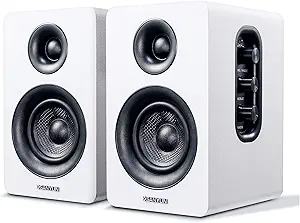 | Best Ultra-Budget Compact Pick | Driver size: 3 inches | Driver material: Carbon fiber | Power: 30 W per speaker | VIEW ON AMAZON | See Our Full Breakdown |
| M-Audio BX3 3.5-Inch Wired Studio Monitors (Pair) |  | Best Bundle for Beginners | Speaker configuration: One active speaker and one passive speaker | Woofer size: 3.5 inches | Woofer material: Black Kevlar | VIEW ON AMAZON | See Our Full Breakdown |
| studio monitor speaker | Inputs | Controls |
|---|---|---|
| Edifier R2750DB MKII 3-Way Pow | — | — |
| Rockville ASM4 4-Inch Active S | — | — |
| Ortizan C7 Powered Studio Moni | RCA, USB, 3.5 mm AUX, 6.35 mm balanced TRS | — |
| JBL 305P MkII 5-Inch 2-Way Pow | Balanced XLR and ¼-inch TRS | Boundary EQ, HF Trim |
| Edifier MR3 Powered Studio Mon | TRS, RCA, AUX | — |
| Edifier R1280T Powered Bookshe | 3.5 mm AUX and dual RCA | Side-panel bass and treble knobs |
| Ortizan C7 Powered Studio Moni | — | — |
| PreSonus Eris 3.5 Powered Stud | Balanced TRS, RCA, front-panel aux | — |
| Mackie CR3.5 Studio Monitors | — | Tone Knob; Location Switch |
| PreSonus Eris 4.5 Two-Way 4.5- | 1/4-inch TRS balanced, RCA, 1/8-inch aux | High- and low-frequency tuning |
| Sanyun SW208 3-Inch Active Blu | — | Volume, treble, and bass adjustment |
| M-Audio BX3 3.5-Inch Wired Stu | — | High and low EQ dials; left/right active speaker position switch |
More Details on Our Top Picks
Edifier R2750DB MKII 3-Way Powered Bookshelf Speakers, 144W RMS, Walnut
Not everyone wants a speaker that only does one job. The R2750DB MKII stands out for its true 3-way design — a dedicated 4.5-inch midrange driver sits between the 7-inch woofer and silk-dome tweeter, which is a step up in driver separation from the two-way designs in this roundup like the JBL 305P MkII. Where the JBL is built for mixing accuracy, this Edifier leans toward versatility: HDMI eARC makes it a natural TV companion, LDAC Bluetooth handles casual streaming, and a wired subwoofer output leaves room for bass expansion.
The tradeoff is honest — this is a consumer-leaning speaker with app EQ and presets, not a flat reference tool. Serious mix engineers will want the JBL’s neutral tuning instead. But for a producer who also watches movies and plays games at the same desk, the flexibility here is hard to beat.
Pros:- True 3-way driver design with dedicated midrange for clearer vocal and instrument separation
- HDMI eARC plus optical, coaxial, and Bluetooth makes it a genuine dual-purpose TV and studio speaker
- Subwoofer output allows the bass response to grow with your setup
- Hi-Res Audio support and 24-bit/96kHz DSP keep quality high across sources
Cons:- Not a flat reference monitor — presets and consumer tuning make it less reliable for critical mixing decisions
- Woofer is ported but still benefits from an external sub for deep low-end tracking
- Requires tabletop real estate and wired power for both cabinets
Best for: Home studio owners and desktop users who want one speaker pair for music production, TV, and streaming
Not ideal for: Mixing engineers who need a flat reference response — the app-driven EQ and consumer tuning color the sound compared with purpose-built monitors
- Power:144W RMS
- Configuration:3-way stereo pair
- Drivers:7-inch woofer, 4.5-inch midrange, 1-inch silk-dome tweeter
- Amplification:Quad Class-D
- Connectivity:HDMI eARC, optical, coaxial, line-in, Bluetooth 6.0 (LDAC)
- Subwoofer output:Wired
- EQ:9-band with 4 presets via EDIFIER ConneX app
Our verdict“Buy this if your desk doubles as a studio and an entertainment center; skip it if you need a strictly neutral mixing reference.”
Rockville ASM4 4-Inch Active Studio Monitor Speakers with Bluetooth, Pair
The Rockville ASM4 earns its place as the low-cost on-ramp to monitoring. The 4-inch woofer is a meaningful size advantage over 3.5-inch options like the Ortizan C7, giving it more low-end reach at a stated 50 Hz — enough to hear a kick drum without guessing. Input variety is genuinely useful: optical for a TV, RCA and aux for a computer, and Bluetooth 5.0 for phone playback.
Compared with the PreSonus Eris 3.5, though, the Rockville skips balanced inputs and room-tailoring controls, so placement flexibility is limited. The listing’s frequency response figures are also inconsistent between sections, which is worth a grain of salt when sizing up the bass claims. Front-panel volume is convenient, but there’s no headphone output for late-night work.
For a first pair on a tight budget, the tradeoffs are acceptable — just know what you’re not getting.
Pros:- 4-inch woofers reach deeper than the 3.5-inch competition in this roundup
- Unusually broad input selection for the price: optical, RCA, aux, and Bluetooth 5.0
- Compact footprint fits crowded desks and small edit bays
- Front-panel volume control keeps adjustments within reach
Cons:- No balanced TRS or XLR inputs for professional audio interfaces
- Inconsistent frequency response claims in the product listing make bass performance hard to verify
- No headphone output or EQ controls for tuning to your room
Best for: First-time producers and content creators who need an affordable stereo pair that covers every input they might own
Not ideal for: Buyers planning to expand with an audio interface using balanced outputs — there’s no TRS or XLR input here
- Speaker type:Active studio monitor pair
- Woofer:4 inches
- Tweeter:1-inch silk dome
- Power:50W RMS / 200W peak
- Connectivity:Bluetooth 5.0, optical, RCA, 3.5 mm aux, ¼-inch TS
- Enclosure:MDF, rear-firing port
- Frequency response:Down to 50 Hz (stated)
Our verdict“A sensible first pair if budget is the deciding factor, but interface users should spend up for balanced inputs.”
Ortizan C7 Powered Studio Monitor Speakers, Pair, Bluetooth 5.3, Black
Desktop producers working within arm’s length of their speakers have different needs than someone mixing in a treated room, and the Ortizan C7 is built for exactly that scenario. Its balanced 6.35 mm TRS inputs put it a step above the Rockville ASM4 for interface connectivity, and the built-in 24-bit DAC over USB means you can skip an interface entirely for simple setups — a feature shared with the Sanyun SW208 but paired here with more input options.
The front-panel headphone output is a quiet advantage for apartment producers who mix at night; the Edifier MR3 also offers this, but the C7 keeps it alongside carbon-fiber drivers that stay composed at moderate volume. The honest limitation: 3.5-inch mid-bass drivers simply run out of air below the low mids. Bass-heavy genres will need a subwoofer or a good pair of headphones to verify the bottom octaves.
Pros:- Balanced TRS inputs support proper interface connections
- Built-in 24-bit DAC over USB removes the need for a separate interface in simple setups
- Front-panel headphone output enables silent late-night work
- Bluetooth 5.3 plus RCA and aux covers every casual listening source
Cons:- 3.5-inch carbon-fiber drivers deliver limited low-frequency output
- Small drivers compress at higher volumes, so they’re best kept nearfield
- No room-correction or EQ options to adjust for desk placement
Best for: Apartment and dorm producers who need nearfield monitors with balanced inputs, USB audio, and a headphone jack for quiet sessions
Not ideal for: Producers of bass-heavy electronic music — the small drivers can’t reproduce sub-bass frequencies reliably
- Quantity:Pair
- Drivers:3.5-inch carbon-fiber mid-bass, 0.75-inch silk-dome tweeter
- Bluetooth:Version 5.3
- DAC:Built-in 24-bit
- Inputs:RCA, USB, 3.5 mm AUX, 6.35 mm balanced TRS
- Output:Front-panel headphone jack
- Color:Black
Our verdict“The right pick for tight-desk producers who value connectivity and quiet operation over bass extension.”
JBL 305P MkII 5-Inch 2-Way Powered Studio Reference Monitors (Pair)
If the goal is making decisions you can trust, the JBL 305P MkII is the most professionally oriented pick in this lineup. Its Image Control Waveguide — borrowed from JBL’s flagship M2 mastering monitors — creates a wide sweet spot and precise stereo imaging that consumer-tuned options like the Edifier R2750DB MKII can’t match. The Boundary EQ and HF Trim switches matter more than they look: they let you compensate for desk reflections and wall proximity, something no app-based EQ in this roundup does as deliberately.
The tradeoff is focus. There’s no Bluetooth, no HDMI, no remote, and no convenience features — the 305P MkII does one thing well. It also demands a balanced signal chain, so budget for an audio interface with XLR or TRS outputs. Compared with the Mackie CR3.5, you give up casual connectivity but gain a speaker you can actually mix on for years.
Pros:- Image Control Waveguide delivers a wide sweet spot and accurate stereo imaging
- Boundary EQ and HF Trim controls compensate for real-world desk and wall placement
- Balanced XLR and TRS inputs integrate cleanly with professional interfaces
- 108 dB peak SPL gives plenty of headroom for critical listening levels
Cons:- No Bluetooth, HDMI, or casual playback inputs — strictly a wired studio tool
- Requires an audio interface with balanced outputs for best performance
- 5-inch woofer still benefits from a sub for full low-end evaluation
Best for: Home and project studio owners who want a professional-grade mixing reference they won’t outgrow
Not ideal for: Buyers wanting an all-in-one desk speaker for music, TV, and streaming — there’s no Bluetooth or consumer inputs here
- Configuration:2-way powered pair
- Drivers:5-inch woofer, 1-inch tweeter
- Amplifiers:Dual 41W Class-D per monitor
- Inputs:Balanced XLR and ¼-inch TRS
- Controls:Boundary EQ, HF Trim
- Peak SPL:108 dB
- Enclosure:15 mm MDF with ABS baffle
Our verdict“The pick for anyone whose priority is trustworthy mixes over multimedia convenience.”
Edifier MR3 Powered Studio Monitor Speakers with Bluetooth
The Edifier MR3 occupies the middle ground between the consumer-leaning Edifier R1280T and the pro-focused JBL 305P MkII. Its Hi-Res certification and 52Hz–40kHz response stretch well beyond typical compact monitors, and the multipoint Bluetooth is genuinely practical — pair your phone and computer simultaneously without re-pairing, a convenience the JBL simply doesn’t attempt.
Where it gives ground is power: 18W × 2 RMS is modest, best suited to nearfield listening at a desk rather than filling a room. The app-driven sound modes and EQ offer useful flexibility, though purists will note that tuning by ear with sliders isn’t the same as a properly flat reference. Compared with the PreSonus Eris 3.5, the MR3 counters with better wireless features and a wider stated frequency range, while both share the compact-desktop mission.
For casual production and serious listening in one small package, the balance here works.
Pros:- Hi-Res Audio certified with an unusually wide 52Hz–40kHz frequency response for this size
- Multipoint Bluetooth keeps two devices connected at once
- TRS, RCA, and aux inputs plus app-based EQ cover both studio and casual sources
- MDF cabinet construction reduces resonance compared with plastic alternatives
Cons:- 18W × 2 RMS output limits usable volume and low-end authority
- App-based EQ and sound modes sit between monitoring and consumer tuning rather than offering a strict flat reference
- Small drivers make sub-bass evaluation unreliable without headphones or a sub
Best for: Desktop users who split time between light music production and high-quality casual listening
Not ideal for: Anyone mixing at loud volumes or in a larger room — 18W per channel and 92.5 dB SPL run out of headroom quickly
- Frequency response:52Hz–40kHz
- RMS output:18W × 2
- Peak SPL:92.5 dB
- Drivers:3.5-inch mid-low, 1-inch tweeter
- Inputs:TRS, RCA, AUX
- Wireless:Multipoint Bluetooth
- Cabinet:MDF
Our verdict“A smart desk-side compromise for listeners who produce occasionally and stream constantly — just don’t expect room-filling volume.”
Edifier R1280T Powered Bookshelf Speakers
The Edifier R1280T occupies an interesting spot in this lineup: it’s less a precision tool and more a comfortable everyday speaker. The dual RCA plus AUX inputs mean a computer and a phone (or DAC) can stay connected at once, which the Mackie CR3.5 doesn’t match for casual multi-source setups. Side-panel bass and treble knobs let you shape the sound to taste rather than to a reference standard.
The tradeoff is accuracy. Compared with the PreSonus Eris 3.5, the R1280T’s single 4-inch full-range driver and 13 mm tweeter give it a warmer, less revealing character — pleasant for music and video, less trustworthy for mixing decisions. There’s no balanced input either, so it isn’t built for audio interfaces. This model makes the most sense for listeners who want speaker charm over studio honesty.
Pros:- Connects to two audio devices at the same time
- Bass and treble knobs allow easy tonal shaping
- Remote control for convenient volume changes
- Classic wood-effect finish suits home decor better than most monitors
Cons:- Single full-range driver sacrifices the separation a dedicated two-way monitor provides
- No balanced TRS input for professional audio gear
- Tuning controls favor taste over reference accuracy
Best for: Desk listeners and casual music fans who want warm, adjustable sound with two devices connected simultaneously
Not ideal for: Producers who need flat reference response and balanced inputs — the full-range driver colors the sound and there’s no TRS connection
- Type:Powered bookshelf speakers
- Channels:2.0
- Inputs:3.5 mm AUX and dual RCA
- Tweeter:13 mm silk dome
- Driver:4-inch full-range
- Controls:Side-panel bass and treble knobs
- Finish:Wood-effect vinyl
Our verdict“Buy this for enjoyable everyday listening at a desk, not for making mixing decisions.”
Ortizan C7 Powered Studio Monitor Speakers, Pair, Bluetooth 5.3, White
The Ortizan C7 stands out for sheer input flexibility at its price: Bluetooth 5.3, RCA, AUX, USB, and — surprisingly for a budget pair — a balanced 6.35 mm TRS input for interfaces and controllers. That last point puts it closer to the PreSonus Eris 3.5 in workflow terms than you’d expect, and the built-in 24-bit DAC plus front-panel headphone jack make it a tidy all-in-one desk hub.
What holds it back is transparency of spec: unlike the Eris 3.5’s published 50 watts and 80 Hz–20 kHz range, Ortizan publishes no power or frequency figures, which makes honest comparison difficult before purchase. The 3.5-inch carbon fiber mid-bass drivers also suggest limited low-end reach compared with the Eris 4.5. This pick makes sense for streamers and beginners who want every connection option covered cheaply, accepting some uncertainty about raw performance.
Pros:- Five input types including balanced TRS for production gear
- Built-in 24-bit DAC improves digital source quality
- Front-panel headphone output for private monitoring
- Bluetooth 5.3 keeps wireless listening simple
Cons:- No published power output or frequency response specifications
- 3.5-inch drivers likely limit low-end extension
- Lacks the established track record of brands like PreSonus or Mackie
Best for: Beginners and streamers who want wireless plus balanced wired inputs and a headphone jack in one affordable package
Not ideal for: Buyers who want verified performance data before committing — power output and frequency response aren’t specified
- Speaker Type:Powered studio monitor
- Quantity:Pair
- Bluetooth:5.3
- Connectivity:Bluetooth, RCA, AUX, USB, 6.35 mm TRS
- Mid-Bass Driver:3.5-inch carbon fiber
- Tweeter:0.75-inch silk dome
- DAC:Built-in 24-bit
- Headphone Output:Front panel
Our verdict“A connectivity-first budget pick for multi-source desk setups, best for those comfortable with unverified specs.”
PreSonus Eris 3.5 Powered Studio Monitors (Pair)
The PreSonus Eris 3.5 is the safe, well-documented choice in the compact tier. Published specs — 50 watts, 80 Hz–20 kHz — and high/low room-tuning controls give it a level of transparency the Ortizan C7 can’t offer, and the front-panel aux and headphone jack make it genuinely practical for daily desktop use alongside production work.
Compared with the Eris 4.5, the smaller woofers mean bass rolls off around 80 Hz, so kick-drum weight and sub-bass detail disappear — anyone producing bass-heavy electronic music will feel the ceiling. Against the Mackie CR3.5, the Eris leans more neutral and analytical, while Mackie leans slightly more forgiving and adds placement aids in the box. This pick makes the most sense for producers in tight spaces who want trustworthy tuning without paying for output they can’t use.
Pros:- Published power and frequency specs allow informed comparison
- High- and low-frequency tuning controls adapt the sound to your room
- Balanced TRS, RCA, and front aux inputs cover every desk source
- Front headphone jack switches to private listening instantly
Cons:- Bass rolls off at 80 Hz, limiting low-end accuracy
- 50 watts total is modest for larger rooms
- Neutral voicing exposes flaws in poorly mixed recordings
Best for: Home producers and content creators with small desks who want accurate, tunable sound with verified specs
Not ideal for: Bass-driven producers in medium rooms — the 80 Hz low end misses sub-bass detail that larger woofers capture
- Configuration:Stereo pair
- Amplification:50 watts
- Woofer:3.5-inch woven composite
- Tweeter:1-inch silk dome
- Frequency Range:80 Hz–20 kHz
- Inputs:Balanced TRS, RCA, front-panel aux
- Acoustic Controls:High- and low-frequency tuning
Our verdict“The most dependable compact monitor pair here for small-desk production — just don’t expect sub-bass truth.”
Mackie CR3.5 Studio Monitors (Pair), 3.5-Inch Woofers, Tone Knob, Black
What separates the Mackie CR3.5 from the PreSonus Eris 3.5 is everything in the box: isolation pads and all cables included, so a first-time buyer is set up in minutes without extra purchases. The Tone Knob shifts voicing between a more relaxed and more forward character, while the Location Switch corrects bass buildup when placed near a wall — a smarter, simpler solution to placement problems than the Eris’s separate EQ knobs.
The compromise is precision. The Tone Knob blends high and low adjustment into one control, which is friendlier for beginners but coarser than the independent tuning on the Eris 3.5 or Eris 4.5. Mackie also positions these squarely as desk monitors for small studios; in a larger untreated room they’ll run out of headroom. This option stands out as the best turnkey entry point in the roundup.
Pros:- Isolation pads and all cables included out of the box
- Location Switch corrects bass response for wall-adjacent placement
- Tone Knob offers quick, beginner-friendly voicing changes
- Voicing designed to represent mixes accurately at desk distance
Cons:- Single Tone Knob is less precise than independent high/low EQ
- Output suits small rooms only — larger spaces will strain them
- 3.5-inch woofers limit low-frequency reach
Best for: First-time producers who want monitors, cables, and isolation pads bundled together with simple placement correction
Not ideal for: Engineers wanting fine-grained EQ control — the single Tone Knob is too coarse for precise room correction
- Quantity:Pair
- Woofer:3.5 inches
- Color:Black
- Controls:Tone Knob; Location Switch
- Included Accessories:Isolation pads and all cables
- Intended Placement:Desks and small studios
Our verdict“The easiest on-ramp into monitoring: everything you need is in one box, at the cost of tuning precision.”
PreSonus Eris 4.5 Two-Way 4.5-Inch Nearfield Studio Monitors (Pair)
The PreSonus Eris 4.5 is the natural upgrade within this lineup’s compact tier. The larger 4.5-inch woven-composite woofers reach deeper and tighter than the Eris 3.5’s 80 Hz floor, giving kick drums and bass lines real definition, while Class AB amplification at 50 watts keeps the midrange smooth in a way budget Class D designs often don’t. Add high/low room tuning, three input types, and a front headphone output, and it covers both production and everyday listening.
Tradeoffs remain relative to full-size monitors like the JBL 305P MkII: a 4.5-inch driver still can’t reproduce true sub-bass, and 25 watts per side limits how loud you can mix before compression colors the sound. The automatic power-saving mode after 40 minutes can also annoy anyone who steps away mid-session. This model is better suited to the serious home producer who has outgrown 3.5-inch speakers but isn’t ready for 5-inch money.
Pros:- Larger woofers deliver tighter, deeper bass than the Eris 3.5
- Class AB amplification keeps the midrange smooth and natural
- Room-tuning controls plus three input options cover pro and consumer gear
- Automatic power-saving mode reduces idle power draw
Cons:- No true sub-bass reproduction from a 4.5-inch driver
- 25 watts per side limits clean maximum volume
- 40-minute auto shutoff can interrupt long sessions
Best for: Home producers upgrading from small speakers who want tighter bass and fuller midrange without jumping to 5-inch monitors
Not ideal for: Producers of bass-heavy genres in larger rooms — still no true sub-bass and limited maximum volume
- Woofer:4.5 inches
- Amplification:50 watts Class AB (25W per side)
- Tweeter:1-inch silk dome
- Inputs:1/4-inch TRS balanced, RCA, 1/8-inch aux
- Controls:High- and low-frequency tuning
- Headphone Output:Front panel, amplified
- Power-Saving Mode:After 40 minutes idle
- Quantity:Pair
Our verdict“The logical step up for producers who’ve hit the bass ceiling of 3.5-inch monitors but don’t need 5-inch power.”
Sanyun SW208 3-Inch Active Bluetooth Bookshelf Speakers with 24-Bit DAC
For shoppers who want nearfield sound without the studio-monitor price, the Sanyun SW208 carves out a niche the bigger names don’t really touch. The standout trick here is the built-in 24-bit DAC over USB — plug straight into a computer and you bypass the laptop’s mediocre onboard audio, something the wired-only M-Audio BX3 can’t claim. Bluetooth 5.0 adds wireless convenience that most dedicated monitors, like the JBL 305P MkII, simply don’t offer at any price.
The tradeoffs are real, though. A 3-inch carbon fiber driver means bass response bottoms out early, and the sculptable treble and bass controls invite drift away from a flat reference. Compared with the Rockville ASM4’s 4-inch drivers, the SW208 gives up low-end authority, and its tuning leans more casual-listening than mixing-grade.
Pros:- Built-in 24-bit DAC delivers cleaner USB audio than most laptop headphone jacks
- Bluetooth 5.0 plus USB gives both wireless and wired input options
- Adjustable treble and bass lets you tailor the sound to your room
- Very compact footprint fits crowded desks
Cons:- 3-inch drivers limit bass depth for music with heavy low-end
- Tone controls and consumer-leaning tuning reduce accuracy for mixing reference
- Plastic build feels less robust than MDF-cabinet monitors like the M-Audio BX3
Best for: Students and desktop users on a tight budget who mainly stream from a phone or laptop and want better sound than built-in speakers
Not ideal for: Anyone mixing tracks that need accurate low-end — the small drivers and tone controls make these better for listening than critical reference work
- Driver size:3 inches
- Driver material:Carbon fiber
- Power:30 W per speaker
- Connectivity:Bluetooth 5.0, USB
- DAC:Built-in 24-bit
- Controls:Volume, treble, and bass adjustment
- Standby feature:Noise elimination
Our verdict“A sensible entry point for casual desktop listening and light content work, but serious mixers should step up to larger drivers.”
M-Audio BX3 3.5-Inch Wired Studio Monitors (Pair)
The M-Audio BX3 wins on out-of-the-box readiness: cables, foam isolation pads, and bundled MPC Beats software mean a first-time producer can be working the same day the box arrives. That package puts pressure on the similarly priced PreSonus Eris 3.5, which offers a cleaner sonic reputation but fewer accessories in the carton.
Sonically, the Kevlar woofers and silk dome tweeters aim for the balanced, slightly smooth voicing M-Audio is known for, and the front-panel headphone jack plus aux input is genuinely useful for dorm desks where a controller or phone is always in reach. The catch is the power architecture: one active speaker driving one passive means a single amp doing double duty, and the 120W peak figure overstates real output compared with dual-amped designs. Bass depth also trails the Eris 4.5 and JBL 305P MkII.
Pros:- Complete accessory bundle includes cables, foam feet, and MPC Beats software
- Kevlar woofers and silk dome tweeters produce smooth, balanced voicing
- Front-panel aux input and headphone jack suit desktop and streaming setups
- Multiple rear inputs (1/4-inch, 1/8-inch, RCA) accept nearly any source
Cons:- Wired-only design limits placement flexibility versus Bluetooth models like the Sanyun SW208
- 3.5-inch woofers run thin on bass for bass-heavy genres
- Single active speaker driving a passive partner is less clean than bi-amped monitors
Best for: Beginner producers and streamers who want a complete starter kit with software, cables, and pads included from day one
Not ideal for: Producers needing confident low-end and higher volume — the 3.5-inch woofers and single-amp design lag behind the JBL 305P MkII
- Speaker configuration:One active speaker and one passive speaker
- Woofer size:3.5 inches
- Woofer material:Black Kevlar
- Tweeter type:Natural silk dome
- Power:120W
- Cabinet:MDF with bass-reflex design
- Rear inputs:1/4-inch, 1/8-inch, and RCA
- Front connections:1/8-inch auxiliary input and headphone jack
- Controls:High and low EQ dials; left/right active speaker position switch
Our verdict“The easiest on-ramp into studio monitoring for new creators who value a full kit over maximum bass authority.”

How We Picked
I ranked these twelve models on four buyer-facing criteria: sonic accuracy (how flat and uncolored the response is for mixing), low-end capability (what woofer size and wattage realistically deliver at desktop distances), connectivity and convenience (inputs, Bluetooth, onboard controls), and value at the price point. True reference monitors with neutral tuning ranked above pleasant-sounding bookshelf hybrids, because the whole point of a monitor is revealing flaws rather than flattering them.
The ranking also reflects intended use. A bedroom producer mixing nightly needs different tools than a streamer or casual listener, so I placed accuracy-first models like the JBL 305P MkII and PreSonus Eris 4.5 at the top, versatile mid-priced options in the middle, and lifestyle-leaning hybrids lower — not because they are bad speakers, but because they answer a different question than “what does my mix actually sound like?”
| studio monitor speaker | Controls |
|---|---|
| Edifier R2750DB MKII 3-Way Pow | — |
| Rockville ASM4 4-Inch Active S | — |
| Ortizan C7 Powered Studio Moni | — |
| JBL 305P MkII 5-Inch 2-Way Pow | Boundary EQ, HF Trim |
| Edifier MR3 Powered Studio Mon | — |
| Edifier R1280T Powered Bookshe | Side-panel bass and treble knobs |
| Ortizan C7 Powered Studio Moni | — |
| PreSonus Eris 3.5 Powered Stud | — |
| Mackie CR3.5 Studio Monitors | Tone Knob; Location Switch |
| PreSonus Eris 4.5 Two-Way 4.5- | High- and low-frequency tuning |
| Sanyun SW208 3-Inch Active Blu | Volume, treble, and bass adjustment |
| M-Audio BX3 3.5-Inch Wired Stu | High and low EQ dials; left/right active speaker position switch |
Factors to Consider When Choosing Studio Monitor Speakers
Before picking a pair from the list above, it helps to understand what actually separates monitors from each other — and where buyers most often go wrong.Woofer Size and Your Room
The most common mistake is buying woofers that are too big for the space. A 5-inch monitor like the JBL 305P MkII needs some breathing room and a bit of distance to sound balanced; crammed against a wall on a shallow desk, it can boom and mislead you. In a small bedroom or dorm setup, a 3-to-4-inch pair often delivers more accurate bass simply because the speakers fit the room. Also remember that small woofers roll off below roughly 60 Hz — you will not hear sub-bass problems without adding a subwoofer later, so plan your upgrade path rather than expecting one pair to do everything.
Flat Response Versus Fun Sound
Monitors are deliberately unforgiving: a flat response curve exposes harsh vocals, muddy lows, and harsh cymbals so you can fix them. Consumer-flavored bookshelf speakers boost bass and treble to sound exciting, which feels great on day one and causes mixes that translate badly everywhere else. Decide honestly which you need. If you produce, mix, or record podcasts, choose flat. If you mostly want great-sounding playback for music, games, and movies, a warmer tuned pair is a legitimate choice — just do not call it a mixing tool. This single distinction explains most of the ordering in my roundup.
Bluetooth: Convenience With a Cost
Wireless input is genuinely useful for quickly auditioning reference tracks from a phone, and half the models here include it. But Bluetooth codecs compress audio and add a layer of processing between your source and the drivers, so any critical listening should go through the wired connection. The practical pattern I saw: Bluetooth pairs are ideal hybrid workhorses for creators who both mix and casually listen, while pure wired monitors keep the signal chain clean. If you do both, favor a model with both wired and wireless inputs rather than choosing one at the expense of the other.
Front Versus Rear Controls and Ports
Placement flexibility depends heavily on where the knobs live. Front-mounted volume, headphone out, and aux input — found on the Mackie CR3.5, M-Audio BX3, and PreSonus Eris pairs — make daily life on a desk far easier. Rear-facing ports also demand a few inches of clearance from the wall or the bass tuning goes wrong, which is a real constraint in tight spaces. Check where the volume knob sits before buying; reaching behind a speaker twenty times a day gets old fast.
Cables, Stands, and the Hidden Budget
Most powered monitors ship with basic cables at best, and many budget pairs expect you to supply your own interconnects. Factor in balanced TRS or XLR cables if your interface supports them — they reduce noise over longer runs — plus isolation pads or foam wedges to decouple the speakers from your desk. Decoupling alone often improves clarity more than a speaker upgrade. A modest pair on proper stands with clean cabling will outperform a better pair sitting bare on a resonant desk.
When to Pay More
Spending up in this category mostly buys you three things: larger woofers with deeper bass, better amplification and tweeters with cleaner detail, and professional features like acoustic room-tuning switches. If you mix for others or release music publicly, those upgrades pay for themselves in fewer translation surprises. If you are learning, podcasting, or editing video, a competent small pair plus room treatment is the smarter allocation. Do not pay a premium for wattage you cannot use at nearfield distances of two to four feet.
Frequently Asked Questions
Can I use studio monitors for casual music listening, gaming, and movies?
Yes, and many people do — but the experience differs from consumer speakers. Because monitors aim for a flat response, they sound more honest and less immediately exciting: bass will not thump the way a boosted hifi speaker does, and poorly recorded tracks will reveal their flaws. Several models in this roundup, like the Edifier MR3 and Ortizan C7, include Bluetooth specifically so they can double as everyday listening speakers. If entertainment is your main use and mixing is occasional, pick one of those hybrids. If mixing is primary, accept the honest sound — your ears will adjust within a week.
Do I need 5-inch woofers, or are 3.5-inch monitors enough?
It depends on your room and your genre. A 3.5-inch pair such as the PreSonus Eris 3.5 or Mackie CR3.5 is genuinely sufficient for voice work, podcasting, video editing, and mixing at low to moderate volumes in a small room. A 5-inch model like the JBL 305P MkII extends lower and handles more volume cleanly, which matters for bass-heavy electronic or hip-hop production. The catch: big woofers in tiny untreated rooms often cause more bass problems than they solve. Match the speaker to the space first, the genre second.
Is Bluetooth on a studio monitor a dealbreaker for serious mixing?
No, as long as wired inputs are also present — and every Bluetooth model in this roundup includes them. Use Bluetooth for quick phone playback and reference listening; use the wired connection from your interface whenever you are actually mixing or recording. The wireless circuitry itself does not degrade the analog path. The only real risk is building the habit of monitoring over Bluetooth, where codec compression can hide problems in the top end. Treat it as a convenience feature, not your working signal chain.
Do I need an audio interface to use powered monitors?
Not strictly — any device with a headphone jack or line output can drive them, and models with front aux inputs make that easy. But an interface is worth adding if you record anything, because it provides proper balanced outputs, lower noise, and a headphone jack in a sensible spot. Many budget monitors also use unbalanced RCA or TRS inputs, so check cable compatibility before ordering. For pure listening, your computer’s output is fine; for production, an interface is the natural next purchase.
Should I buy one pair now or save longer for a premium set?
Start with an honest pair in the budget tier and spend the savings on acoustic treatment, because a treated room with modest speakers beats an untreated room with excellent ones. The PreSonus Eris 3.5 and Mackie CR3.5 are accurate enough that upgrading later will teach you more than waiting will. Where saving up makes sense is if you already know you need 5-inch low end for bass-driven genres — jumping straight to the JBL 305P MkII avoids a redundant purchase. Speakers also hold value well, so trading up later is painless.
Conclusion
For most buyers, the JBL 305P MkII is the best overall choice: it is the only genuinely reference-grade model here, and if mixing accuracy is the goal, nothing else in the lineup matches its imaging. The PreSonus Eris 3.5 takes best value — honest tuning, useful front-panel controls, and a price that leaves room for treatment and cables. Best premium goes to the PreSonus Eris 4.5, which adds low-end weight and headroom for producers who want nearfield accuracy with more authority.
Beginners should start with the Mackie CR3.5 or M-Audio BX3, both forgiving, easy to place, and simple to connect. For desk space constraints, the Sanyun SW208 fits where nothing else will. If your real priority is great everyday sound with occasional production work, the Edifier R2750DB MKII or Ortizan C7 are the hybrids to beat — just be clear that they flatter rather than reveal. Choose based on what you will actually do at the desk, not the spec sheet.
Halloween Picks
halloween
As an affiliate, we earn on qualifying purchases.