
For most campers who need meaningful power without a bulky setup, the Renogy 200W Portable Solar Panel is my best overall pick; the ZOUPW 200W suits power-station owners, while the FlexSolar 100W is a more compact choice with an IP67 waterproof rating. The main tradeoff is portability versus usable output: small panels pack easily but recharge devices slowly, while larger panels need more space, careful positioning, and compatible equipment. Bundled power stations simplify charging but may limit how much solar capacity you can add later. Read on for the full breakdown and guidance on matching panel size to your camping setup.

Get furniture and decor delivered free with Prime
- Fast, free delivery on millions of items
- Prime Video, Amazon Music and more included
- Member-only deals all year
Complete the kit


Key Takeaways
- 200W models form the most versatile middle ground in this lineup: they offer more room to recharge a power station than pocketable USB panels without the footprint of the 400W and 480W options.
- The largest panels are not automatically the best camping picks. The Renogy 400W and bifacial ZOUPW 480W are aimed at high-demand setups with room for deployment, not quick breaks or crowded campsites.
- Small USB chargers solve a different problem from power-station panels. The FlexSolar 40W and SOLUPUP 30W are for direct device charging, while larger panels are better matched to battery-based systems.
- Compatibility is a deciding factor. Panels with MC4 or other connection options may offer flexibility, but buyers still need to confirm voltage, connectors, and input limits for their battery or power station.
- Bundled systems trade flexibility for simplicity. The Jackery Explorer 300 with 40W panel and ZeroKor 300W station with 60W panel put storage and charging together, but their included panels are smaller than the standalone options.
| Twelseavan 200W Foldable Portable Solar Panel with USB-C and MC4 Output |  | Best Overall for Flexible Camp Charging | Maximum power: 200 W | Conversion efficiency: 24% | USB-C output: Up to 60 W | VIEW ON AMAZON | See Our Full Breakdown |
| Renogy 200W Portable Solar Panel |  | Best for Efficient Power-Station Charging | Power: 200 W | Conversion efficiency: 25% | Cell type and count: N-Type monocrystalline silicon; 16 cells | VIEW ON AMAZON | See Our Full Breakdown |
| ZOUPW 200W Portable Solar Panel for Power Stations |  | Best for Broad Connector Compatibility | Maximum power: 200 W | Conversion efficiency: 23.5% | USB-C output: PD 60 W | VIEW ON AMAZON | See Our Full Breakdown |
| DOKIO 100W Portable Foldable Solar Panel Kit for 12V Batteries |  | Best Lightweight Option for 12V Setups | Maximum power: 110 W | Output voltage: 12 V DC | Amperage: 6.1 A | VIEW ON AMAZON | See Our Full Breakdown |
| Jackery Explorer 300 Portable Power Station with 40W Solar Panel |  | Best Beginner Solar-Power Bundle | Battery capacity: 292 Wh | Peak surge output: 600 W | Battery chemistry: LiFePO4 | VIEW ON AMAZON | See Our Full Breakdown |
| MHPOWOS 220W Portable Folding Solar Panel |  | Best for Higher-Capacity Camp Power | Maximum power: 220 W | Output voltage: 40 V | Maximum voltage: 48 V | VIEW ON AMAZON | See Our Full Breakdown |
| FlexSolar 100W Foldable Portable Solar Panel Charger, IP67 Waterproof |  | Best for Charging Devices and a Power Station | Maximum power: 100 W | Conversion efficiency: 23%+ | Weight: 1.85 kg (4.1 lb) | VIEW ON AMAZON | See Our Full Breakdown |
| ZOUPW 480W Bifacial Portable Solar Panel |  | Best for High-Draw Base Camps | Maximum power: 480 W | Cell type: N-type monocrystalline | Conversion efficiency: 25%+ | VIEW ON AMAZON | See Our Full Breakdown |
| FlexSolar 40W Foldable Solar Panel Charger |  | Best Compact Panel for Personal Devices | Maximum power: 40 W | Solar conversion efficiency: 24% | USB-A output: QC 3.0, up to 18 W | VIEW ON AMAZON | See Our Full Breakdown |
| SOLUPUP 30W Foldable Solar Charger with USB-A and USB-C Outputs |  | Best for Simple Two-Device Charging | Maximum panel power: 30 W | Listed maximum output: 15 W | Output voltage: 5 V DC | VIEW ON AMAZON | See Our Full Breakdown |
| ZeroKor 300W Portable Power Station with 60W Solar Panel | 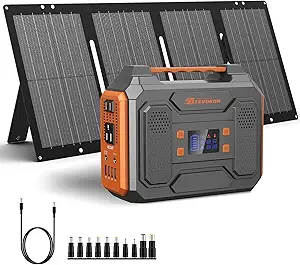 | Best All-in-One Starter Kit | Power station maximum output: 300W | Included solar panel output: 60W | Solar cell type: Monocrystalline | VIEW ON AMAZON | See Our Full Breakdown |
| Renogy 400W Foldable Portable Solar Panel |  | Best for High-Power Base Camps | Maximum power: 400W | Efficiency: 23% | Amperage capacity: 12.1A | VIEW ON AMAZON | See Our Full Breakdown |
| Renogy 100W Portable Foldable Solar Panel |  | Best Compact Panel for Direct Device Charging | Maximum power: 100W | Conversion efficiency: 25% | Amperage capacity: 5.66A | VIEW ON AMAZON | See Our Full Breakdown |
| Renogy ShadowFlux 200W N-Type Solar Panel |  | Best for Campsites with Partial Shade | Power: 200W | Cell type: N-Type monocrystalline silicon with 16BB technology | Cell efficiency: 25% | VIEW ON AMAZON | See Our Full Breakdown |
| ZOUPW 100W Foldable Portable Solar Panel |  | Best for Power-Station Compatibility | Maximum power: 100W | Cell type: Monocrystalline | Efficiency: 23.5% | VIEW ON AMAZON | See Our Full Breakdown |
| solar panels for camping | Weight | Maximum power |
|---|---|---|
| Twelseavan 200W Foldable Porta | 15.7 lb | 200 W |
| Renogy 200W Portable Solar Pan | 13.89 lb | — |
| ZOUPW 200W Portable Solar Pane | 19 lb | 200 W |
| DOKIO 100W Portable Foldable S | 6 lb | 110 W |
| Jackery Explorer 300 Portable | 12.9 lb | — |
| MHPOWOS 220W Portable Folding | Listed as 8.07 kg and 8.5 kg | 220 W |
| FlexSolar 100W Foldable Portab | 1.85 kg (4.1 lb) | 100 W |
| ZOUPW 480W Bifacial Portable S | 22.5 lb | 480 W |
| FlexSolar 40W Foldable Solar P | 0.8 kg (1.76 lb) | 40 W |
| SOLUPUP 30W Foldable Solar Cha | 2.4 lb | — |
| ZeroKor 300W Portable Power St | — | — |
| Renogy 400W Foldable Portable | 30.2 lb | 400W |
| Renogy 100W Portable Foldable | 7.3 lb | 100W |
| Renogy ShadowFlux 200W N-Type | 23.8 lb | — |
| ZOUPW 100W Foldable Portable S | 9.5 lb | 100W |
More Details on Our Top Picks
Twelseavan 200W Foldable Portable Solar Panel with USB-C and MC4 Output
The Twelseavan pairs 200W of rated output with several ways to charge: its MC4 connection can feed a compatible power station, while 60W USB-C PD and other onboard ports handle devices directly. That makes it more adaptable at a campsite than the DOKIO 100W, which is lighter but aimed more at 12V battery setups and smaller charging needs. Four kickstands and a magnetic handle help with positioning and carrying, while the IP65 rating adds protection against dust and water jets—not a license to leave it in heavy rain. The tradeoff is its 15.7-pound weight, which is less appealing for hikes from the car. Its rated output also depends on strong, direct sun, so cloudy conditions will slow charging.
Pros:- Rated 200W output suits camp power stations with compatible solar input.
- USB-C PD up to 60W can charge supported devices directly.
- MC4 cable and three DC adapters offer connection options for compatible gear.
- Four kickstands and a magnetic handle support setup and carrying.
Cons:- At 15.7 lb, it is cumbersome for longer carries.
- Full output requires ample direct sunlight.
- IP65 protection does not make the panel suitable for submersion.
Best for: Car campers who want one panel for a compatible power station and direct USB-C device charging.
Not ideal for: Backpackers or campers who need a light, compact panel to carry far from the vehicle.
- Maximum power:200 W
- Conversion efficiency:24%
- USB-C output:Up to 60 W
- Other device outputs:QC3.0 up to 18 W; USB 5 V / 3 A
- Connector:MC4
- Weight:15.7 lb
- Folded size:23 × 22 in
Our verdict“Choose the Twelseavan for car camping when you want a 200W-class panel with direct USB-C charging and flexible power-station connections.”
Renogy 200W Portable Solar Panel
The Renogy is a strong fit for campers who want a 200W panel in a relatively light package. Its 16 N-Type cells carry a stated 25% efficiency rating, and its 13.89-pound weight is lower than the Twelseavan’s 15.7 pounds and well below the ZOUPW 200W’s 19 pounds. Four kickstands help you angle the panel toward the sun, while USB-C PD and two USB-A ports offer direct charging for smaller devices. The key catch is its MC4 output and separately sold 4-in-1 adapter: buyers need to check their power station’s input requirements and may need an extra cable. Its 45W USB-C output is also lower than the Twelseavan’s 60W, making that model a better match for devices that can use the higher rate.
Pros:- Stated 25% efficiency from 16 N-Type monocrystalline cells.
- Lighter than the Twelseavan and ZOUPW 200W panels.
- USB-C PD and dual USB-A ports support direct device charging.
- Four kickstands allow different positioning angles.
Cons:- The 4-in-1 adapter is sold separately.
- Power-station compatibility depends on the station’s input requirements.
- USB-C output is limited to 45W, below the Twelseavan’s 60W.
Best for: Car campers seeking a portable 200W panel with a relatively low carry weight and direct USB charging.
Not ideal for: Campers who need a bundled multi-connector adapter or want the lineup’s higher USB-C output.
- Power:200 W
- Conversion efficiency:25%
- Cell type and count:N-Type monocrystalline silicon; 16 cells
- USB-C output:PD 45 W
- Other USB outputs:Dual USB-A
- Weight:13.89 lb
- Folded dimensions:23.72 × 22.99 × 1.97 in
- Warranty:2-year material and workmanship warranty
Our verdict“Pick the Renogy if you want a lighter 200W-class camp panel and are willing to confirm or source the right power-station adapter.”
ZOUPW 200W Portable Solar Panel for Power Stations
The ZOUPW’s clearest camping advantage is its included 5-in-1 cable, with XT60, Anderson, and several DC connector options for connecting to compatible power stations. That is more connection flexibility out of the box than the Renogy 200W, whose 4-in-1 adapter is sold separately. The panel also supplies USB-C PD up to 60W for direct device charging, plus USB-A, and its adjustable kickstands help with sun alignment. An ETFE surface and IP67 panel rating add outdoor protection, though the junction box is water-resistant rather than submersible. The compromise is substantial: at 19 pounds, it is the heaviest of these three 200W panels, and its 12-month warranty is shorter than the Renogy’s two years. It suits vehicle-based camps better than walk-in sites.
Pros:- Included 5-in-1 cable supports several common power-station connector types.
- USB-C PD output reaches 60W for compatible devices.
- IP67-rated panel and ETFE surface are suited to outdoor use.
- Four adjustable kickstands help with panel positioning.
Cons:- At 19 lb, it is heavier than the Renogy and Twelseavan 200W panels.
- The junction box is water-resistant but not submersible.
- The 12-month warranty is shorter than the Renogy panel’s stated warranty.
Best for: Car campers with a power station that uses one of the included connector types and who want direct USB-C charging.
Not ideal for: Walk-in campers prioritizing low carry weight, or anyone expecting the junction box to withstand submersion.
- Maximum power:200 W
- Conversion efficiency:23.5%
- USB-C output:PD 60 W
- USB-A output:QC3.0
- Connectors:XT60, Anderson, DC7909, DC8020, DC5521
- Panel material:ETFE coating and monocrystalline solar cells
- Weight:19 lb
Our verdict“Choose the ZOUPW when connector flexibility matters more than carrying weight and your campsite is vehicle-accessible.”
DOKIO 100W Portable Foldable Solar Panel Kit for 12V Batteries
At 6 pounds, the DOKIO is much easier to move and stow than the 200W Twelseavan, Renogy, or ZOUPW panels. Its separate PWM controller and 9.84-foot cable make it a practical choice for campers maintaining a compatible 12V battery or arranging the panel in a sunny spot a short distance from the vehicle. SAE, XT60, DC, and alligator-clip connections add flexibility for battery-oriented setups, and dual USB ports cover basic device charging. This is not the right pick for everyone with a power station: the station’s maximum solar input can limit how much of the panel’s output it accepts. Compared with the Renogy 200W, it offers less rated power, and its USB output may vary when used in sunlight without a battery. Its strength is light, straightforward 12V use—not fast power-station charging.
Pros:- At 6 lb, it is far lighter than the 200W panels in this group.
- Separate PWM controller provides a battery-focused charging setup.
- The 9.84-foot cable allows flexible panel placement.
- SAE, XT60, DC, alligator-clip, and dual USB connections cover varied uses.
Cons:- Its output is lower than the 200W Renogy, Twelseavan, and ZOUPW panels.
- Some power stations may limit the panel’s usable output.
- USB output may vary in sunlight when used without a battery.
Best for: Campers maintaining a compatible 12V battery who value low carry weight, a separate controller, and a long cable.
Not ideal for: Campers who need fast recharging from a power station or whose station has a restrictive solar-input rating.
- Maximum power:110 W
- Output voltage:12 V DC
- Amperage:6.1 A
- Weight:6 lb
- Folded dimensions:18.9 × 26 × 0.47 in
- Charge controller:Standalone PWM controller
- Cable length:9.84 ft (3 m)
- Connectors:SAE, XT60, DC, alligator clips
Our verdict“Choose the DOKIO for lightweight camping power on a compatible 12V battery, not for the fastest power-station recharge.”
Jackery Explorer 300 Portable Power Station with 40W Solar Panel
Unlike the Twelseavan, Renogy, and ZOUPW panels, this Jackery is a power station bundled with a small solar panel, so it gives first-time campers a battery and several ways to run devices—not just a way to harvest sunlight. The 292Wh capacity, 300W rated output, AC outlets, USB ports, and car port cover common campsite electronics, while its LiFePO4 battery is rated for over 4,000 charge cycles before reaching 70% capacity. The tradeoff is the included panel’s 40W rating: the stated estimate to reach 80% capacity is about 7.5 hours, making it a slower solar setup than pairing a station with a 200W panel. At 12.9 pounds for the station, plus the panel, it is also a bundle to carry rather than a single lightweight panel. It makes more sense for modest loads and simple setup than rapid replenishment.
Pros:- Includes a 292Wh power station and a 40W solar panel.
- AC, USB, and car ports support several kinds of campsite devices.
- LiFePO4 battery is rated for over 4,000 cycles before reaching 70% capacity.
- 100W USB-C PD port can charge compatible devices.
Cons:- The included 40W panel is much lower-output than the 200W panels in this roundup.
- The stated solar charge estimate is about 7.5 hours to reach 80% capacity.
- The station and panel may ship separately.
Best for: First-time car campers who want an all-in-one battery-and-panel bundle for phones, lights, and other modest loads.
Not ideal for: Campers who need rapid solar recharging, higher sustained output, or a panel-only setup for an existing power station.
- Battery capacity:292 Wh
- Peak surge output:600 W
- Battery chemistry:LiFePO4
- Included solar panel:40 W
- Ports:2 AC outlets, 1 USB-C PD, 2 USB-A, 1 car port
- Weight:12.9 lb
- Solar charge estimate:About 7.5 hours to reach 80% capacity
Our verdict“Pick this bundle for a ready-to-use starter setup with modest campsite loads, but choose a higher-output panel pairing if solar recharge speed matters.”
MHPOWOS 220W Portable Folding Solar Panel
For campers who want to replenish a compatible power station faster than a 100W panel can, the 220W rating gives this foldable model a clear role. Its four kickstands help angle the panel toward the sun at camp, while the IP67 rating suits outdoor use better than a basic device-only charger. Compared with the FlexSolar 100W Foldable Portable Solar Panel Charger, MHPOWOS offers more stated capacity but weighs about 8 kg, making it a less appealing pick for backpackers or anyone carrying gear far from the car.
The main buying check is compatibility: its 40V output may exceed a power station’s accepted input range, and the station can limit the power it actually takes. The listed weight also varies between product details, so I would treat it as a substantial car-camping panel rather than a light travel accessory.
Pros:- 220W stated maximum output suits higher-capacity camping power stations.
- Four kickstands make it easier to position the panel toward available sunlight.
- IP67 rating offers protection against dust and water exposure.
- 7-in-1 solar connector supports compatible power-station connections.
Cons:- 40V output is incompatible with some power stations.
- At about 8 kg, it is heavy for hiking or long-distance carrying.
- Product details give different weights, and actual input depends on the power station.
Best for: Car campers with a power station that accepts the panel’s 40V output and can use up to 220W of solar input.
Not ideal for: Backpackers and owners of power stations with lower input-voltage limits or charging caps that would leave much of the panel’s stated output unused.
- Maximum power:220 W
- Output voltage:40 V
- Maximum voltage:48 V
- Amperage capacity:5.5 A
- Conversion efficiency:23.5%
- Cell material:Monocrystalline silicon
- Connector:7-in-1 solar connector
- Weight:Listed as 8.07 kg and 8.5 kg
- Folded size:23.5 × 21.25 × 2.3 in
Our verdict“Choose this for car camping and a compatible high-input power station, but skip it if low weight or broad voltage compatibility matters more.”
FlexSolar 100W Foldable Portable Solar Panel Charger, IP67 Waterproof
The 100W output and direct device ports make this a flexible middle ground for campers who want to charge a phone or tablet without routing every device through a power station. It has USB-C, USB-A, and DC outputs, and its included adapter cable can connect to compatible stations. Compared with the FlexSolar 40W Foldable Solar Panel Charger, this model offers more panel capacity and a stronger DC output; compared with the heavier MHPOWOS 220W, it is easier to carry and less demanding of a high-input power station.
At 1.85 kg, it is portable for car camping, though its unfolded footprint still needs room and clear sun. IP67 protection is useful when conditions get dusty or wet, but the panel cannot make up for clouds or poor positioning. Check adapter and station compatibility before relying on it as your main charging source.
Pros:- USB-C, USB-A, and DC outputs serve several types of camping devices.
- 100W capacity is a useful step up from small phone-focused panels.
- IP67 rating protects against dust and water exposure.
- Folded weight of 1.85 kg is manageable for car-based trips.
Cons:- Power varies with sunlight, weather, and panel placement.
- Adapter compatibility differs across power stations and devices.
- Its large unfolded surface needs clear space at camp.
Best for: Car campers who want one portable panel for direct USB device charging and occasional input to a compatible power station.
Not ideal for: Campers who need high-wattage power-station charging, or backpackers who prioritize the smallest possible packed setup.
- Maximum power:100 W
- Conversion efficiency:23%+
- Weight:1.85 kg (4.1 lb)
- Folded dimensions:12.99 × 10.43 × 2.17 in
- Unfolded dimensions:45.47 × 26.18 in
- USB-C output:PD 3.0, up to 45 W
- USB-A output:Up to 18 W
- DC output:Up to 100 W
- Water and dust resistance:IP67
Our verdict“Pick this for versatile device and modest power-station charging without carrying a 220W-class panel.”
ZOUPW 480W Bifacial Portable Solar Panel
Among these five options, the 480W rating makes this the clear choice for a base camp built around a large compatible power station or RV setup. Its bifacial cells can collect light from both sides, which may help when the panel is placed where reflected light reaches the rear surface. The ground stakes and extension cable also give campers more flexibility to position it away from the vehicle. Compared with the MHPOWOS 220W, it offers much more stated capacity, but its 22.5-pound weight and wide deployed dimensions make it a poor fit for lightweight trips.
IP68 construction adds outdoor protection, yet this is not a set-and-forget fixed array: the product data cautions against long-term fixed, series, or parallel connections. Shade and debris can cut output and contribute to heat buildup, so it needs a clear, monitored spot and a power station whose input limits match the panel.
Pros:- 480W stated capacity suits high-draw base-camp power needs.
- Bifacial design can capture light reaching the back of the panel.
- IP68-rated construction is suited to outdoor deployment.
- Includes ground stakes, storage bag, and extension cable.
Cons:- At 22.5 lb with a 138.6-inch listed length, it is bulky to transport and place.
- Not recommended for long-term fixed installations or series and parallel connections.
- Shade or debris can lower output and contribute to heat buildup.
Best for: Car campers or RV users running a compatible high-capacity power station who can give a large panel a clear ground-level setup.
Not ideal for: Backpackers, compact-camp users, and anyone seeking a permanent array or planning to connect panels in series or parallel.
- Maximum power:480 W
- Cell type:N-type monocrystalline
- Conversion efficiency:25%+
- Maximum voltage:42.5 V
- Amperage capacity:11.3 A
- Weight:22.5 lb
- Dimensions:138.6 × 0.9 × 32.6 in
- Water and dust resistance:IP68
- Warranty:36 months
Our verdict“Choose it for a spacious, high-power base camp with compatible equipment, not for compact or foot-access camping.”
FlexSolar 40W Foldable Solar Panel Charger
At 0.8 kg and a folded size close to a small daypack, this is the easiest option here to carry beyond a vehicle. USB-A and USB-C outputs let it charge personal devices directly, while the DC output can serve a compatible small power station. Compared with the SOLUPUP 30W Foldable Solar Charger, it has a higher stated panel output and adds a 19V DC connection; the tradeoff is that neither compact panel is a substitute for a larger setup when you need sustained power for multiple camp appliances.
The IP67-rated panel and built-in electrical protections are reassuring for outdoor use, but the junction box is not fully waterproof. It also stores no energy, so a phone left connected will not keep charging after sunset or through a cloud unless you pair the panel with a power bank. Direct sun and careful positioning matter more than its 24% efficiency figure alone suggests.
Pros:- Lightweight 0.8 kg foldable design suits portable camping kits.
- USB-A, USB-C, and DC outputs cover personal devices and compatible small stations.
- IP67-rated panel construction offers dust and water resistance.
- Overcurrent, overheating, and short-circuit protection supports safer charging.
Cons:- Does not store energy, so overnight charging requires a separate battery.
- Shade or partial coverage can substantially reduce output.
- The junction box is not fully waterproof.
Best for: Hikers and minimalist campers who want a lightweight way to top up phones, tablets, or a compatible small power station during daylight.
Not ideal for: Campers who need stored power overnight, dependable charging in shade, or enough output for larger appliances.
- Maximum power:40 W
- Solar conversion efficiency:24%
- USB-A output:QC 3.0, up to 18 W
- USB-C output:PD 2.0, up to 18 W
- DC output:19 V, up to 40 W
- Maximum voltage:20 V DC
- Weight:0.8 kg (1.76 lb)
- Folded dimensions:8.0 × 11.1 × 1.8 in
- Panel material:ETFE laminate
Our verdict“Choose this for lightweight daytime charging of personal devices, and pair it with a power bank if you need energy after dark.”
SOLUPUP 30W Foldable Solar Charger with USB-A and USB-C Outputs
The SOLUPUP is aimed at campers who want a straightforward way to charge small USB devices without carrying a power station. It has USB-A and USB-C ports, a foldable body, and an adjustable stand to help orient the panel toward the sun. Compared with the FlexSolar 40W Foldable Solar Panel Charger, it offers less stated panel capacity and no listed DC output, so it is less suited to power stations; its simple USB setup may suit a phone-and-headlamp kit better.
One spec deserves close attention: although the panel is rated at 30W, the listed maximum output is 15W. That limits charging speed and makes cloud cover or a poor angle more noticeable. IPX5 protection is also less complete than the IP67 ratings on the FlexSolar models, so this is better treated as a splash-resistant device charger than something to leave exposed in wet conditions.
Pros:- USB-A and USB-C ports support charging two devices when sunlight and output allow.
- Adjustable stand helps aim the panel at the sun.
- Foldable design and included carabiners support portable setup.
- Smart chip provides overcurrent, overvoltage, and short-circuit protection.
Cons:- Listed maximum output is 15W despite the 30W panel rating.
- IPX5 protection is less robust than the IP67-rated FlexSolar panels.
- Charging performance depends heavily on sun, temperature, angle, and cloud cover.
Best for: Campers who mainly need to top up a phone and another small USB device in direct sunlight and value a stand-equipped foldable panel.
Not ideal for: Power-station users, campers seeking faster charging, and anyone who needs stronger water protection than IPX5.
- Maximum panel power:30 W
- Listed maximum output:15 W
- Output voltage:5 V DC
- Output ports:USB-A and USB-C
- Energy conversion efficiency:23% or higher
- Weight:2.4 lb
- Folded length:10.63 in
- Water resistance:IPX5
- Included accessories:USB-to-USB-C cable, 2 carabiners, user manual
Our verdict“Pick this for basic USB device charging at camp, but choose the FlexSolar 40W if you need DC output or a higher stated panel capacity.”
ZeroKor 300W Portable Power Station with 60W Solar Panel
For campers who want a power station and panel in one purchase, the ZeroKor pairs a 60W monocrystalline panel with a unit rated for 300W AC output. That makes it a more ready-to-use choice than the Renogy 100W Portable Foldable Solar Panel, which is a panel rather than a complete power station kit. Multiple USB ports, two AC outlets, and AC, car, and solar charging give you options for phones, lights, and other modest loads. The built-in flashlight also adds reading and SOS modes for camp use.
The tradeoff is capacity: battery capacity is not specified, so it is difficult to estimate runtime, and the 300W ceiling rules out many appliances. Its panel’s junction box is not waterproof, so protect that part from rain. I’d pick it for simple electronics, not as a high-output camp power system.
Pros:- Includes a 60W monocrystalline solar panel and power station
- Offers two AC outlets, three standard USB ports, and a quick-charge USB port
- Can recharge from an AC outlet, a compatible panel, or a 12V car outlet
- Built-in protections and flashlight with reading and SOS modes
Cons:- 300W maximum AC output excludes many high-power appliances
- Battery capacity is not specified, making runtime hard to estimate
- Solar panel junction box is not waterproof
Best for: First-time campers who want a bundled solar panel and power station for phones, lights, and other low-wattage devices.
Not ideal for: Campers planning to run high-wattage appliances or needing predictable multi-day runtime, since output is capped at 300W and battery capacity is unspecified.
- Power station maximum output:300W
- Included solar panel output:60W
- Solar cell type:Monocrystalline
- Solar panel conversion efficiency:20.5%
- AC outlets:2
- USB ports:3 standard USB ports and 1 quick-charge USB port
- Solar panel USB-C output:Up to 15V/2A
- Protection features:Short circuit, over-current, over-voltage, overload, and overheating protection
Our verdict“Choose the ZeroKor for a simple bundled setup to recharge small devices at camp, but skip it if you need substantial appliance power or clearly stated battery capacity.”
Renogy 400W Foldable Portable Solar Panel
The Renogy 400W is the highest-output panel in this group, making it better suited to a vehicle-based base camp than a short hike to a tent. Its 400W rating and 23% efficiency offer more generation potential than the Renogy 100W Portable Foldable Solar Panel, especially when paired with a compatible power station or battery system. The foldable format and carry case help with transport, while IP67 protection and reinforced construction address the rougher conditions of outdoor use.
That output comes with a real portability cost: at 30.2 pounds, it is much heavier than the 100W Renogy panel and awkward for foot travel. It also needs compatible equipment; a charge controller is not included, and the Renogy 4-in-1 adapter cable is sold separately. Shading and sunlight still affect actual generation, despite the panel’s parallel wiring approach. I’d favor it for camps with a vehicle and meaningful power needs, not minimalist setups.
Pros:- 400W rated output offers substantially more generation potential than 100W panels
- 23% efficiency in a foldable format
- IP67 waterproofing with fiberglass reinforcement and ETFE-coated cells
- Includes a carry case for transport and storage
Cons:- 30.2-pound weight makes it unsuitable for carrying far on foot
- Charge controller is not included
- Renogy 4-in-1 adapter cable is sold separately and actual output varies with conditions
Best for: Car campers and RV travelers who can transport a heavy panel and want higher solar input for a compatible power station or 12V/24V battery system.
Not ideal for: Backpackers and campers seeking a ready-to-connect kit, since the panel weighs 30.2 pounds and requires compatible charging equipment and possibly separate adapters.
- Maximum power:400W
- Efficiency:23%
- Amperage capacity:12.1A
- Maximum voltage:67.5V DC
- Weight:30.2 lb
- Folded dimensions:27.9 × 33.7 × 3.2 in
- Connector type:MC4
- Warranty:3 years on materials and workmanship
Our verdict“Pick this Renogy for vehicle-supported camps that can use its higher output, but choose a smaller panel if weight and simple setup matter more.”
Renogy 100W Portable Foldable Solar Panel
For campers who want a panel that can charge devices directly as well as feed a compatible power station, this Renogy 100W model has a useful mix of outputs. Its USB-C port rated up to 45W and two USB-A outputs can handle common personal electronics without requiring a separate power station for every charge. At 7.3 pounds, it is far easier to manage around camp than Renogy’s 400W foldable panel, though it still makes more sense in a car than in a backpack.
The stated 25% conversion efficiency and IP67 rating are attractive for a portable panel, but they do not remove the limits of a 100W rating: cloudy conditions, angle, and connected equipment affect real output. For 12V battery charging, you’ll need a compatible charge controller, and the 4-in-1 adapter cable is sold separately. Compared with the ZOUPW 100W Foldable Portable Solar Panel, this Renogy weighs less and offers a higher stated efficiency, while both provide direct USB charging.
Pros:- Stated 25% conversion efficiency
- Weighs 7.3 pounds and folds for easier camp transport
- USB-C output up to 45W and two USB-A outputs support direct charging
- IP67 rating and hail-resistant ETFE coating
Cons:- 100W maximum output may be limiting for larger power stations or heavy use
- 4-in-1 adapter cable is sold separately
- Charge controller is not included for 12V battery systems
Best for: Car campers who want a relatively lightweight 100W panel with USB-C and USB-A outputs for phones, tablets, and a compatible power station.
Not ideal for: Campers who need high daily energy production or a complete battery-charging kit, since it is limited to 100W and requires separate equipment for 12V batteries.
- Maximum power:100W
- Conversion efficiency:25%
- Amperage capacity:5.66A
- Maximum voltage:21.6V
- Weight:7.3 lb
- Folded dimensions:22.99 × 22.54 × 1.57 in
- USB-C output:45W maximum
- USB-A outputs:18W and 15W
- Warranty:3 years on output, materials, and workmanship
Our verdict“Choose this Renogy when you want a lighter 100W camping panel with direct USB charging, but plan for separate accessories if charging a 12V battery.”
Renogy ShadowFlux 200W N-Type Solar Panel
The ShadowFlux is the lineup’s shade-focused choice: its N-Type cells and ShadowFlux technology are designed to sustain generation in partial shade and reduce hot-spot risks. That makes it a more targeted option for a camp spot where tree cover is hard to avoid than the Renogy 100W Portable Foldable Solar Panel, whose listed features focus more on portability and direct USB charging. At 200W with a stated 25% cell efficiency, it offers more rated power than that smaller foldable panel, while the aluminum frame and weather-resistant design suit longer-term outdoor installations.
This is not the easiest panel to move around a campsite: it weighs 23.8 pounds and measures nearly 50 inches long. It is described for RV, marine, rooftop, and off-grid use, so tent campers should check mounting and connector fit before buying; the provided details do not specify connector compatibility. I’d choose it for a fixed or vehicle-mounted setup where partial shade is a recurring problem, not frequent repositioning.
Pros:- ShadowFlux technology is designed to improve generation in partial shade
- 200W output and 25% cell efficiency
- Weather-resistant design rated IP67 or higher
- Long output warranty, including a 25-year warranty to 80% power
Cons:- At 23.8 pounds and nearly 50 inches long, it is cumbersome for mobile camp setups
- Connector compatibility is not specified in the provided product details
- Designed for mounted or off-grid applications rather than quick, frequent repositioning
Best for: RV and vehicle campers setting up a semi-permanent panel where partial shade from trees or nearby structures can affect solar collection.
Not ideal for: Backpackers or campers who need a lightweight, foldable panel with clearly specified plug compatibility for a portable power station.
- Power:200W
- Cell type:N-Type monocrystalline silicon with 16BB technology
- Cell efficiency:25%
- Maximum voltage:36.5V
- Output voltage:12V DC
- Dimensions:49.69 × 30.08 × 1.18 in
- Weight:23.8 lb
- Warranty:5-year output warranty; 25-year output warranty to 80% power
Our verdict“Choose the ShadowFlux for a vehicle or fixed camp setup where partial shade is a persistent issue, and skip it if easy carrying and simple connector matching are priorities.”
ZOUPW 100W Foldable Portable Solar Panel
The ZOUPW 100W panel is a practical match for campers who already own a power station and want an easy-to-position solar input. Its five-connector cable supports a range of compatible stations, and the adjustable kickstands make it easier to angle the panel toward the sun than a panel that must lie flat. Built-in USB-C and USB-A ports also let you charge smaller devices directly. Compared with the Renogy 100W Portable Foldable Solar Panel, this model includes the five-connector cable and kickstands, while the Renogy is lighter and lists a higher 25% efficiency.
The ZOUPW’s 9.5-pound weight is manageable beside a vehicle but less appealing for carrying on foot, and its one-year warranty is shorter than Renogy’s three-year coverage. Its 100W rating is suited to modest camp charging, not fast replenishment of a large battery. I’d shortlist it for station owners who value connector flexibility and adjustable setup over minimum weight or longer warranty coverage.
Pros:- Includes a five-connector cable for compatible power stations
- Adjustable kickstands help position the panel toward sunlight
- Built-in USB-C and two USB-A ports enable direct device charging
- IP67-rated ETFE coating for outdoor use
Cons:- At 9.5 pounds, it is bulky for carrying on foot
- 100W rated output may not meet high-demand charging needs
- 12-month warranty is shorter than the Renogy 100W panel’s stated three-year warranty
Best for: Car campers with a compatible power station who want multiple connector options, adjustable panel positioning, and USB charging for small devices.
Not ideal for: Backpackers and buyers prioritizing low weight or longer warranty coverage, since it weighs 9.5 pounds and carries a 12-month warranty.
- Maximum power:100W
- Cell type:Monocrystalline
- Efficiency:23.5%
- Maximum voltage:24.3V
- Output voltage:20.16V
- Water resistance:IP67
- Weight:9.5 lb
- USB-C output:PD 15V/3A
- Warranty:12 months
Our verdict“Pick the ZOUPW if you camp by car and want flexible power-station connections with built-in kickstands, but choose a lighter panel for foot travel.”
How We Picked
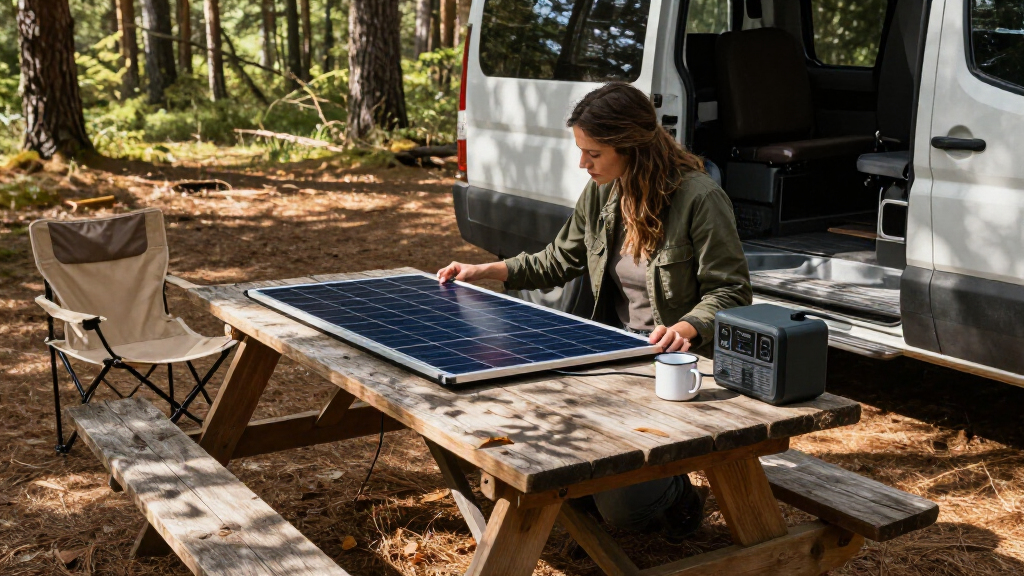
I ranked these options around the jobs campers actually need solar to do: charge phones directly, replenish a battery or power station, or support higher-demand equipment at a base camp. I weighed stated wattage alongside portability, connection flexibility, weather protection where specified, and whether a product includes energy storage. A panel’s wattage is a rating, not a guarantee of real-world output, so I treated larger capacity as useful only when a camper can carry, position, and connect the panel.
The order favors practical versatility for a range of camping setups rather than the highest wattage alone. The Renogy 200W leads as a broadly capable standalone panel; 100W options and smaller chargers rank higher for specific lightweight needs, while large arrays suit campers with substantial power demands and space. Bundled power stations are judged for convenience, but their included panel size and upgrade needs affect their place. Because product listings do not establish every system’s compatibility, buyers should verify input limits and connector details before purchase.
Factors to Consider When Choosing Solar Panels For Camping
Choose a camping solar panel around the equipment you need to power and how long you stay in one place. A panel that is easy to carry can be more useful than a higher-output model that stays packed away, while a powerful panel can disappoint if it cannot connect to your battery. These factors help narrow the field before comparing individual models.
Match panel output to your daily energy use
Start with the devices you plan to charge and how often you use them, rather than buying by wattage alone. Phones and small electronics can suit direct USB charging, while a cooler, laptop, or several devices may call for a power station and a larger panel. Add up the energy needs of your key devices from their labels or manuals, then allow for cloudy periods and less-than-ideal panel angles. A rated output describes panel capacity under test conditions, not a promise of that much power all day. Buying far more panel than your battery can accept can add weight without speeding up charging. For multi-day trips, prioritize a setup that can replenish your battery during the daylight hours available at camp.
Check the full charging chain, not just the panel
Solar charging only works smoothly when the panel, cable, charge controller, and battery or power station are compatible. Before buying, check the destination device’s maximum solar input, supported voltage range, connector type, and whether it requires a particular controller. MC4 connectors can give a standalone panel flexibility, but adapters do not make an electrically incompatible setup safe or faster. Some bundled power stations simplify the connection, though the included panel may not be enough for your usage. Avoid assuming that a panel advertised for power stations will connect to every brand. If the product details leave a connector or voltage question unanswered, confirm it with the maker before taking it camping.
Balance packed size against setup space
Foldable panels are easier to transport than rigid modules, but their folded dimensions and weight still matter when your vehicle or pack is already full. A larger panel can shorten charging time in good sun, yet it needs open ground and frequent repositioning to stay aimed at the sun. At a small campsite, under trees, or during a short stop, a modest USB charger may be more practical than a high-output array. Think about where the panel will sit while you are away from it and whether you can secure it from wind or foot traffic. Compare the packed footprint with the usable area you can reliably set aside. For hike-in trips, prioritize carry weight; for a drive-in base camp, deployment space may matter more.
Plan for clouds, shade, and changing sun
Solar output drops when clouds, branches, or nearby terrain shade a panel, and a camping site rarely offers perfect sun all day. Choose a setup you can reposition as the sun moves, and keep the panel clear of shadows from tents, awnings, and people. A bigger panel can provide more capacity in good conditions, but it cannot remove the effects of persistent shade. If your trip depends on power for essential equipment, use a battery as a buffer rather than expecting direct sunlight to meet every moment of demand. Check whether your charging device can pause and resume input reliably as conditions change. For shaded or unpredictable campsites, plan a backup charging option or lower your expected energy use.
Treat weather protection and care as part of the choice
Weather claims can help distinguish panels, but they do not mean every connector, cable, or attached power station can be left in rain. Check the stated protection rating and the maker’s limits for wet conditions, then protect exposed connections and store the panel dry after use. Folding panels need careful handling around hinges, fabric, and cables; avoid sharp bends and keep grit away from folding joints. Dust and fingerprints can reduce light reaching the cells, so a soft cloth and sensible storage help maintain performance. Do not leave a panel where wind can tip it or where vehicles and campsite traffic can damage it. A rugged-sounding specification is useful only when it matches the parts of the setup exposed outdoors.
Decide whether you need a bundled battery
A panel produces power only when sunlight is available, while a power station stores energy for evening use and cloudy spells. Bundled kits are easier for beginners because the panel and storage are packaged together, but the included panel may recharge the battery slowly relative to its capacity. Standalone panels make more sense if you already own a compatible power station or want to choose the battery separately. Compare the battery’s capacity and solar-input ceiling with the panel before paying for a matched bundle. If your needs may grow, check whether the system accepts additional panels and whether it supports the connectors you can source. For a short trip with only phones to charge, a battery bundle may be unnecessary weight.
Frequently Asked Questions
Is a 100W panel enough for a weekend camping trip?
It can be enough if your main needs are phones, lights, and occasional small-device charging, especially when paired with a battery that stores daytime power. It is less suited to repeated high-draw use or recharging a large power station quickly. Your location, shade, season, and available sun hours affect what it can deliver, so do not plan around the panel’s rated wattage as continuous output. List the devices you need and their daily energy use, then compare that total with the battery and charging time you can expect. If you need more margin, a 200W panel may be a better fit, provided your power station accepts its input.
Should I buy a panel with a power station or choose them separately?
A bundle is a straightforward choice if you have no battery yet and want the panel and storage in one purchase. Its tradeoff is that the included panel may be relatively small, which can make battery replenishment slow on a short or cloudy day. Buying separately gives you more freedom to choose a panel size that fits your energy use, but you must check input limits, voltage, and connectors. Compare the bundle’s solar input capacity with its battery capacity rather than judging it by the panel rating alone. If you already own a compatible station, a standalone panel is often the simpler route.
Can I charge devices directly from a camping solar panel?
Some compact panels include USB outputs for direct charging, which can work well for phones and other small electronics in steady sunlight. Direct charging can be less reliable when clouds pass or the panel shifts, and not every device handles interruptions equally well. A battery or power bank between the panel and your device stores energy and smooths out changes in sunlight. Larger panels may be designed mainly for a power station or 12V battery rather than direct USB charging. Check the output ports and charging guidance for both the panel and your devices before setting off.
Does a higher-wattage panel always recharge a power station faster?
No. The power station’s maximum solar input, the panel’s voltage and current, connection losses, and sunlight all limit charging speed. A 400W panel cannot deliver its full rated output if the station accepts less, and a connector mismatch can prevent charging altogether. Larger panels can still help when they produce more power under real camping conditions, but only if the station can use that input. Check the station manual for its supported range and maximum input before choosing a panel. When those limits are unclear, confirm compatibility with the manufacturer instead of relying on wattage labels alone.
Is a bifacial panel worth bringing to a campsite?
A bifacial panel can collect light from both sides, but the extra benefit depends on how much light reaches its rear surface. Bright ground and open space can help, while grass, dark soil, tents, or close placement against an object may limit the effect. It also needs room and a suitable position, which can be awkward at a crowded or shaded campsite. If you cannot expose both sides, a simpler panel may be easier to deploy for similar practical use. Choose bifacial construction for an open base camp where positioning is possible, not as a guaranteed increase in every setting.
Conclusion
Best overall: I would start with the Renogy 200W Portable Solar Panel for campers who need a capable standalone panel for a power-based setup. Best value-style fit: the Renogy 100W Portable Foldable Solar Panel makes more sense for lighter energy needs and a smaller deployment footprint. Best premium capacity: choose the Renogy 400W or ZOUPW 480W bifacial only if you have high power demands, a compatible station, and space to set them up. Best for beginners: the Jackery Explorer 300 with 40W panel or ZeroKor 300W station with 60W panel bundles storage and solar charging, though their included panels are modest. For specific needs, pick the FlexSolar 40W or SOLUPUP 30W for direct small-device charging, the FlexSolar 100W for its stated IP67 rating, or the DOKIO 100W for a 12V battery-oriented setup. The right choice is the one that fits your energy use, transport limits, and equipment connections—not simply the panel with the biggest number.
Fall Picks
fall essentials
As an affiliate, we earn on qualifying purchases.