
Among these portable sewing machines, I rank the Brother CS7000X as the best overall for shoppers who want a portable full-featured machine for sewing and quilting. The Brother XM2701 is a simpler, lighter choice for everyday sewing, while the SINGER Stitch Sew Quick suits quick repairs when carrying a full machine is impractical. The main tradeoff is between compactness and capability: handheld menders travel easily but handle a narrower range of work, while larger portable machines offer more control and stitch options. I also weigh setup, included accessories, and how well each type matches a beginner’s or experienced sewer’s needs. Read on for the full breakdown and recommendations by use.

Get furniture and decor delivered free with Prime
- Fast, free delivery on millions of items
- Prime Video, Amazon Music and more included
- Member-only deals all year
Complete the kit


Key Takeaways
- Portable does not always mean handheld: The lineup ranges from cordless mending tools to full sewing-and-quilting machines, so buyers should match portability to the work they expect to do.
- The Brother CS7000X leads for capability: Its LCD interface and quilting focus make it the strongest all-around option here, though its broader feature set is more than a repair-only user needs.
- The Brother XM2701 is a practical middle ground: Its 27 stitches offer more room to grow than basic 12-stitch models without the quilting emphasis of the CS7000X or XR3774.
- Handheld machines are repair specialists: The SINGER Stitch Sew Quick models and similar handheld picks favor quick, small mending jobs, not the controlled seams and project range of a standard machine.
- Included kits are not the same as machine capability: Large accessory bundles can help beginners start, but they do not make a compact machine suitable for heavy fabrics, long seams, or quilting.
| Rxmeili Portable 12-Stitch Sewing Machine with 42-Piece Sewing Kit |  | Best Battery-Powered Full-Size Pick | Brand: Rxmeili | Model: RXM001 | Stitches: 12 | VIEW ON AMAZON | See Our Full Breakdown |
| SINGER Stitch Sew Quick Portable Handheld Cordless Mending Machine |  | Best for On-the-Spot Repairs | Brand: SINGER | Model: Stitch Sew Quick | Dimensions: 8 × 2.5 × 1.125 inches | VIEW ON AMAZON | See Our Full Breakdown |
| Brother XR3774 Sewing and Quilting Machine with 37 Built-In Stitches |  | Best for Portable Quilting Setups | Built-in stitches: 37 | Buttonhole: 1-step | Needle threader: Automatic | VIEW ON AMAZON | See Our Full Breakdown |
| Brother FB1757X Mechanical Sewing Machine |  | Best Simple Mechanical Option | Model: FB1757X | Type: Mechanical sewing machine | Built-in stitches: 17 | VIEW ON AMAZON | See Our Full Breakdown |
| Brother XM3700 Sewing Machine – 37 Built-in Stitches |  | Best for Supported Beginner Sewing | Built-in stitches: 37 | Auto-size buttonhole: Yes | Needle threader: Automatic | VIEW ON AMAZON | See Our Full Breakdown |
| Singer MX60 Lightweight Portable Sewing Machine with Accessory Kit |  | Best Portable Full-Size Beginner Machine | Brand: Singer | Model: MX60 | Weight: 10 lbs | VIEW ON AMAZON | See Our Full Breakdown |
| Stoigeld Portable Sewing Machine for Beginners, 12 Stitches |  | Best for Lightweight Carrying | Brand: Stoigeld | Model: 725 (SM-725) | Product size: 10.3 × 9.5 × 4.4 inches | VIEW ON AMAZON | See Our Full Breakdown |
| Singer Stitch Quick+ Portable Cordless Mending Machine Bundle (Two-Thread) |  | Best for Cordless Quick Repairs | Brand: Singer | Model: Stitch Quick+ | Stitch type: Two-thread lock stitch | VIEW ON AMAZON | See Our Full Breakdown |
| Handheld Sewing Machine with Wooden Storage Box & 142-Piece Sewing Kit |  | Best All-in-One Repair Kit | Machine type: Handheld sewing machine | Total pieces: 142 | Power supply: Dual power supply | VIEW ON AMAZON | See Our Full Breakdown |
| Brother CS7000X Sewing and Quilting Machine with LCD Display |  | Best for Portable Quilting | Brand: Brother | Model: CS7000X | Built-in stitches: 70 | VIEW ON AMAZON | See Our Full Breakdown |
| Mini Sewing Machine for Beginners with Fabric Bundles and Finger Guard |  | Best for Guided First Projects | Brand: KPCB Tech | Model: FHSM-201 | Included fabric: 20 cotton squares, 8 × 8 in each | VIEW ON AMAZON | See Our Full Breakdown |
| Aovly Z600CE Portable Handheld Sewing Machine Kit |  | Best for Cord-Free Quick Repairs | Brand: Aovly | Model: Z600CE | Dimensions: 9.45 × 5.51 × 4.13 in | VIEW ON AMAZON | See Our Full Breakdown |
| Brother SE700 Sewing and Embroidery Machine |  | Best for Portable Sewing and Embroidery | Machine type: Sewing and embroidery combo | Embroidery field: 4 × 4 in | Work area: 6.4 × 4.0 in | VIEW ON AMAZON | See Our Full Breakdown |
| Brother XM2701 Portable Sewing Machine – 27 Stitches |  | Best for Versatile Everyday Sewing | Built-in stitches: 27 | Automatic needle threader: Yes | Bobbin: Drop-in top bobbin | VIEW ON AMAZON | See Our Full Breakdown |
| SINGER M1000 Portable Mending Machine with Accessory Kit |  | Best Lightweight Pick for Mending | Weight: 5.5 lb | Dimensions: 11.4 × 5.1 × 9.4 in | Stitch applications: 32 | VIEW ON AMAZON | See Our Full Breakdown |
| portable sewing machine | Included accessories | Model | Brand |
|---|---|---|---|
| Rxmeili Portable 12-Stitch Sew | 42-piece sewing kit | RXM001 | Rxmeili |
| SINGER Stitch Sew Quick Portab | — | Stitch Sew Quick | SINGER |
| Brother XR3774 Sewing and Quil | Machine cover, wide table, 8 sewing feet, instructional DVD, and more | — | — |
| Brother FB1757X Mechanical Sew | — | FB1757X | — |
| Brother XM3700 Sewing Machine | White accessory pouch, 5 sewing feet, 3-piece needle set, twin needle, 4 bobbins, user manual | — | — |
| Singer MX60 Lightweight Portab | — | MX60 | Singer |
| Stoigeld Portable Sewing Machi | 32 sewing threads, 20 practice fabrics, foot pedal, power cord, bobbins, needles, and threader | 725 (SM-725) | Stoigeld |
| Singer Stitch Quick+ Portable | 39-piece kit with thread, bobbins, machine needles, needle threader, seam ripper, and drawstring bag | Stitch Quick+ | Singer |
| Handheld Sewing Machine with W | — | — | — |
| Brother CS7000X Sewing and Qui | Wide table, 10 sewing feet, quilt guide, hard protective case, and trilingual manual | CS7000X | Brother |
| Mini Sewing Machine for Beginn | — | FHSM-201 | KPCB Tech |
| Aovly Z600CE Portable Handheld | 20 thread colors, replacement needles, safety scissors, needle threader, measuring tape, seam ripper, buttons, and pins | Z600CE | Aovly |
| Brother SE700 Sewing and Embro | Eight sewing feet, embroidery hoop, and embroidery arm | — | — |
| Brother XM2701 Portable Sewing | Three-piece needle set, twin needle, four bobbins, and manual | — | — |
| SINGER M1000 Portable Mending | All-purpose foot, extra needle, bobbins, manual needle threader, and power cord | — | — |
More Details on Our Top Picks
Rxmeili Portable 12-Stitch Sewing Machine with 42-Piece Sewing Kit
The Rxmeili suits buyers who want more than a handheld repair tool but still need flexibility away from a fixed sewing setup. Its 12 stitches, reverse function, and two speeds cover basic mending, alterations, and crafts, while the 42-piece kit gives new sewists useful supplies in one package. Unlike the SINGER Stitch Sew Quick, it has a tabletop format with a foot pedal or button control, making it a better fit for planned small projects than quick repairs on hanging curtains. Battery operation is handy when an outlet is unavailable, though the machine uses four AA batteries and cannot run on batteries and its AC adapter at the same time. At 2.4 kg, it is portable for storage or occasional transport, but it is not as grab-and-go as a handheld model. Buyers should follow its operating instructions carefully to reduce the risk of jams or broken needles.
Pros:- Offers 12 stitches and reverse stitching for a wider range of basic projects than a single-purpose mending tool
- Can run from an AC adapter or four AA batteries
- Foot pedal and button switch give users a choice of control
- Includes a 42-piece sewing kit
Cons:- Incorrect operation can cause jams or broken needles, so careful setup and use matter
- AC power and batteries cannot be used at the same time
- Its tabletop design is less convenient for on-the-spot repairs than the handheld SINGER Stitch Sew Quick
Best for: Beginners and casual crafters who want a compact tabletop machine, basic stitch variety, and battery power for occasional sewing away from an outlet.
Not ideal for: Sewists planning frequent heavy-fabric work or those who want a handheld machine for repairs directly on curtains, bedding, or garments.
- Brand:Rxmeili
- Model:RXM001
- Stitches:12
- Power:AC adapter or 4 AA batteries
- Controls:Foot pedal and button switch
- Weight:2.4 kg
- Dimensions:12.2 × 5.9 × 11.8 inches
- Included accessories:42-piece sewing kit
Our verdict“Choose the Rxmeili for portable, small-scale sewing with more stitch options than a handheld mender, provided you are comfortable following its operating instructions.”
SINGER Stitch Sew Quick Portable Handheld Cordless Mending Machine
When portability means sewing a quick repair without taking a garment or curtain down, the handheld, cordless design is the main reason to choose the SINGER Stitch Sew Quick. It is far smaller than the Rxmeili tabletop machine and can reach fabric that would be awkward to feed through a conventional machine. That convenience comes with a narrow job description: it is intended for quick mending, particularly on lightweight fabrics, rather than longer seams or regular garment construction. The package includes bobbins, needles, a thread spindle, and a needle threader, but neither four AA batteries nor the power adapter is included, so it may not be ready to use straight away. Although the listed compatibility spans several fabric types, the product information cautions that heavy fabrics may be difficult. Compared with the Brother FB1757X, it is much easier to carry but far less suited to controlled, repeatable sewing projects.
Pros:- Handheld form is easy to store and carry
- Cordless operation supports repairs away from a wall outlet when powered by batteries
- Can be used on fabric without removing drapes or bedding
- Includes bobbins, needles, a thread spindle, and a needle threader
Cons:- Four AA batteries and the power adapter are not included
- Not well suited to heavy fabrics or sustained sewing projects
- Some users report durability issues
Best for: Travelers and households that need a compact tool for occasional, quick repairs on lightweight clothing, bedding, or curtains that are still in place.
Not ideal for: People sewing long seams, building garments, or regularly repairing heavy fabrics; buyers who expect a complete powered setup in the box should also look elsewhere.
- Brand:SINGER
- Model:Stitch Sew Quick
- Dimensions:8 × 2.5 × 1.125 inches
- Power:4 AA batteries or power adapter, not included
- Format:Handheld cordless mending machine
- Fabric compatibility:Lightweight fabrics; listed for silk, denim, wool, and leather
- Included components:Machine, bobbins, needles, thread spindle, needle threader
Our verdict“Pick the Stitch Sew Quick for occasional repairs where reach and portability matter more than the control and project range of a tabletop machine.”
Brother XR3774 Sewing and Quilting Machine with 37 Built-In Stitches
The Brother XR3774 is the strongest fit here for someone whose idea of a portable machine includes carrying a dedicated setup to a class or project space. Its 37 built-in stitches, one-step buttonhole, and eight sewing feet give it a broader project range than the 17-stitch Brother FB1757X. A wide table and quilting stitches also make it more practical for managing larger fabric pieces than compact machines such as the Rxmeili. That extra capability has a portability cost: the supplied table and accessories make this a more involved setup to move than a handheld mender, and the product data does not list its weight or dimensions. The automatic needle threader and jam-resistant drop-in bobbin simplify common setup tasks, but this model is intended for 120 V use in the United States. I would skip it for international travel or for buyers who only need occasional quick fixes.
Pros:- 37 built-in stitches include quilting, decorative, and blind hem options
- One-step buttonhole simplifies a common garment detail
- Wide table and eight sewing feet support varied sewing and quilting tasks
- Automatic needle threader and jam-resistant drop-in bobbin ease setup
Cons:- A wide table and accessory set make it less convenient to carry than a compact mending machine
- Designed for use in the United States at 120 V
- Product information does not provide weight or dimensions for judging portability
Best for: Quilters and hobby sewists who need a feature-rich machine they can carry between home and a class, studio, or project space.
Not ideal for: International buyers without compatible 120 V power, or anyone who wants a genuinely small handheld machine for quick repairs.
- Built-in stitches:37
- Buttonhole:1-step
- Needle threader:Automatic
- Bobbin:Jam-resistant drop-in top bobbin
- Included accessories:Machine cover, wide table, 8 sewing feet, instructional DVD, and more
- Voltage:120 V
- Intended market:United States
Our verdict“Choose the XR3774 if quilting features and a wide work surface matter more than the smallest possible carry size.”
Brother FB1757X Mechanical Sewing Machine
The Brother FB1757X favors straightforward mechanical controls over the broader feature sets found on the Brother XR3774 and XM3700. Its 17 built-in stitches cover everyday sewing needs, while a four-step buttonhole and reverse button provide practical basics without leaning on computerized features. For portability, the free arm is useful: it gives sleeves and cuffs a clearer path around the sewing area, a benefit a handheld mender does not provide for controlled garment work. LED lighting helps keep the needle area visible, but the available product details do not list weight, dimensions, or a carry handle, so its ease of transport is difficult to judge. Its stitch selection is also narrower than either 37-stitch Brother model, and mechanical controls may offer less precision for complex patterns. This makes most sense for buyers who value a simpler feature set over quilting breadth or advanced settings.
Pros:- 17 built-in stitches cover common sewing tasks
- Free arm helps guide sleeves and cuffs
- LED lighting illuminates the work area
- Reverse button adds a practical control for securing stitching
Cons:- Fewer stitch options than the Brother XR3774 and XM3700
- Four-step buttonhole takes more steps than the one-step style on the XR3774
- Mechanical controls may be less suited to precise, complex patterns
Best for: Sewists who want a mechanically controlled machine for basic mending and garment tasks, including sleeves and cuffs, without needing a large stitch library.
Not ideal for: Quilters or pattern-focused sewists who want more stitch choices, or shoppers who need verified weight and dimensions before selecting a machine for frequent transport.
- Model:FB1757X
- Type:Mechanical sewing machine
- Built-in stitches:17
- Buttonhole:4-step
- Controls:Reverse button
- Free arm:Yes
- Lighting:LED
Our verdict“Choose the FB1757X if you prefer a straightforward mechanical machine for everyday sewing and can accept fewer stitches than the larger-featured Brothers.”
Brother XM3700 Sewing Machine – 37 Built-in Stitches
The Brother XM3700 is a portable tabletop choice for beginners who want room to grow without stepping up to a quilting-focused setup like the XR3774. Its 37 stitches, automatic needle threader, and one-step auto-size buttonhole help with varied projects while reducing a few common setup hassles. The jam-resistant drop-in bobbin and free arm add practical value for routine sewing and small cylindrical items such as cuffs. Compared with the XR3774, the XM3700 comes with five named sewing feet and a useful accessory set, but its listed package does not include the XR3774’s wide table or quilting-focused bundle. Lifetime online, live chat, and phone support is a particular advantage for learners who may need help beyond the manual. It is lightweight, but the product information cautions that it may not suit heavy-duty fabrics. Its 120 V US-only power specification also limits where it can be used.
Pros:- 37 built-in stitches and a one-step auto-size buttonhole support varied beginner projects
- Automatic needle threader and jam-resistant drop-in bobbin simplify setup
- Free arm helps with cuffs, sleeves, and other small cylindrical projects
- Includes five sewing feet, needles, bobbins, and lifetime online, live chat, and phone support
Cons:- Designed for 120 V outlets in the United States
- Lightweight construction may not suit heavy-duty fabric work
- Does not list the wide table included with the Brother XR3774
Best for: Beginner and developing sewists who want a portable home machine with varied stitches, basic setup aids, and access to ongoing technical support.
Not ideal for: International users without compatible 120 V power, or sewists focused on heavy fabrics and quilting projects that need a wider work surface.
- Built-in stitches:37
- Auto-size buttonhole:Yes
- Needle threader:Automatic
- Bobbin:Jam-resistant drop-in top bobbin
- Free arm:Yes
- Included accessories:White accessory pouch, 5 sewing feet, 3-piece needle set, twin needle, 4 bobbins, user manual
- Voltage:120 V, US only
- Support:Lifetime online, live chat, and phone support
Our verdict“Choose the XM3700 if you want a portable beginner-friendly machine with a broad stitch set and ongoing support, rather than a quilting-oriented bundle or heavy-duty build.”
Singer MX60 Lightweight Portable Sewing Machine with Accessory Kit
For buyers who want a conventional sewing machine they can carry to a class or store in a small space, the Singer MX60 is a more substantial choice than the handheld mending machines in this roundup. Its 10-pound weight and metal frame offer a steadier setup for basic sewing, while preset stitch settings reduce decisions for beginners. The 57 stitch applications sound broad, but the machine has six basic stitches; the application count reflects preset combinations rather than 57 distinct stitch types. Compared with the lighter Stoigeld 725, it is heavier but has a more stable metal-frame design. The accessory kit helps new owners get started, though this remains a basic machine, and its one-year warranty is a limitation for buyers seeking longer coverage.
Pros:- 10-pound build is portable enough for classes and compact storage
- Metal frame provides a steadier sewing base than ultralight handheld options
- Preset stitch length and width simplify setup for beginners
- Accessory kit includes multiple feet, needles, bobbins, and tools
Cons:- Six basic stitches offer less variety than the 57 applications may suggest
- One-year manufacturer warranty is relatively short
- Heavier than the 4.2-pound Stoigeld 725 for frequent carrying
Best for: Beginner sewists who want a stable, conventional machine for mending, crafts, and occasional class use, with accessories included.
Not ideal for: Quilters or experienced sewists who need a broad range of distinct stitches, advanced controls, or a longer warranty.
- Brand:Singer
- Model:MX60
- Weight:10 lbs
- Dimensions:13 × 7 × 11.5 inches
- Power:72 Watts, 0.6 Amps
- Stitch applications:57
- Warranty:1 year manufacturer
Our verdict“Choose the MX60 if you want a portable, stable full-size-style machine for basic sewing, but skip it if stitch variety or long warranty coverage matters most.”
Stoigeld Portable Sewing Machine for Beginners, 12 Stitches
The Stoigeld 725 is the portability pick for someone who values low weight and compact storage above a more substantial machine. At 4.2 pounds, it is much easier to carry than the 10-pound Singer MX60, and its 12 built-in stitches, reverse function, and four-step buttonhole give beginners useful basics in a small package. The included practice fabric and thread make it easier to learn before working on a garment. That convenience comes with a firm limit: this machine is intended for light fabrics, not heavy materials or sustained work. Unlike the Singer MX60’s metal-frame design, the Stoigeld’s appeal is its lighter, smaller format, not a heavier-duty sewing platform. I’d choose it for simple home or school projects, but not for denim-heavy repairs or commercial use.
Pros:- At 4.2 pounds, it is easier to carry and store than the Singer MX60
- 12 built-in stitches, reverse, and a four-step buttonhole cover common beginner tasks
- Practice fabrics and thread support learning straight out of the box
- Compact dimensions suit small work areas and school use
Cons:- Light-fabric use limits its usefulness for heavy garments and thick seams
- Can jam when used with unsuitable materials
- Not intended for commercial or industrial sewing
Best for: Beginners, students, or apartment dwellers who need a lightweight machine for practice, light mending, and small projects in cotton or linen.
Not ideal for: Sewists who regularly work with heavy fabrics, thick seams, or long production runs; the machine is specified for light materials and home use.
- Brand:Stoigeld
- Model:725 (SM-725)
- Product size:10.3 × 9.5 × 4.4 inches
- Net weight:4.2 lbs
- Built-in stitches:12
- Buttonhole:4-step
- Fabric suitability:Thin cotton, linen, and light woven fabrics; up to 4–6 layers
- Included accessories:32 sewing threads, 20 practice fabrics, foot pedal, power cord, bobbins, needles, and threader
Our verdict“Pick the Stoigeld 725 for easy carrying and beginner practice on light fabrics, not for demanding repairs or heavier sewing.”
Singer Stitch Quick+ Portable Cordless Mending Machine Bundle (Two-Thread)
The Singer Stitch Quick+ is for repairs where bringing a conventional machine to the fabric is more useful than bringing the fabric to a sewing table. Its handheld and desktop modes suit quick fixes and small craft jobs, while two-thread lock stitching is a more secure approach than a simple single-thread tack. Compared with the full-size Singer MX60, it is far easier to position on an awkward tear but cannot take the place of a standard machine for larger, repeatable projects. The 39-piece kit adds useful supplies, and the built-in bobbin winder and thread cutter reduce some setup work. The portability has practical limits: batteries and the AC adapter are not included, and the product is intended for small jobs rather than extended sewing sessions.
Pros:- Handheld and desktop modes offer more placement flexibility than a conventional portable machine
- Two-thread lock stitch is designed for more secure stitching than a basic single-thread tack
- 39-piece accessory kit includes thread, bobbins, needles, and repair tools
- Built-in bobbin winder and thread cutter support quick setup and cleanup
Cons:- Four AA batteries and an AC adapter are not included
- Designed for small repairs and crafts rather than large projects
- Handheld format is less suited to long, consistent seams than the Singer MX60
Best for: People who need a portable machine for quick garment repairs, small craft projects, or stitching in places where a tabletop machine is inconvenient.
Not ideal for: Buyers planning large sewing projects or wanting a ready-to-use cordless kit without sourcing batteries or an AC adapter separately.
- Brand:Singer
- Model:Stitch Quick+
- Stitch type:Two-thread lock stitch
- Modes:Handheld, desktop, and lock
- Power options:4 AA alkaline batteries or AC adapter; neither included
- Included accessories:39-piece kit with thread, bobbins, machine needles, needle threader, seam ripper, and drawstring bag
- Built-in features:Bobbin winder, thread cutter, tension dial, and thread spool pin
Our verdict“Choose the Stitch Quick+ for portable spot repairs and crafts, but choose a conventional machine if you need to sew full projects.”
Handheld Sewing Machine with Wooden Storage Box & 142-Piece Sewing Kit
This handheld set stands out for the supplies around the machine: its 142-piece kit and wooden storage box make it a convenient choice for keeping basic repair tools together. Dual power supply offers flexibility, and the included scissors, thread, bobbins, needles, and other notions give a new owner more than the Singer Stitch Quick+ bundle’s 39-piece kit. That larger accessory count does not make the machine a stronger sewing option, though. Its stated maximum fabric thickness is 5/64 inch, and the instructions call for tying the thread manually after sewing to prevent unraveling. Compared with the Stitch Quick+, this kit is more focused on organized supplies than machine features such as a thread cutter or bobbin winder. It makes sense for simple mending and crafts, but not thick materials or users seeking secure machine-finished seams without extra steps.
Pros:- 142-piece assortment provides a wide range of basic sewing notions
- Wooden storage box keeps included tools and supplies organized
- Dual power supply allows more than one way to operate the machine
- Kit includes scissors, thread, bobbins, needles, and common repair accessories
Cons:- Maximum fabric thickness of 5/64 inch rules out many thick seams and materials
- Thread must be tied manually after sewing to help prevent unraveling
- Accessory quantity does not remove the limits of a handheld machine
Best for: Beginners or households that want a compact handheld mending option with a broad assortment of basic sewing supplies stored together.
Not ideal for: People repairing thick or elastic materials, or anyone who wants seams finished without manually tying threads after sewing.
- Machine type:Handheld sewing machine
- Total pieces:142
- Power supply:Dual power supply
- Maximum fabric thickness:5/64 inches
- Included storage:Wooden box
- Included supplies:Fabric scissors, yarn cutter, seam ripper, pin cushion, 22 thread rolls, 12 bobbins, pins, needles, buttons, thimbles, needle threaders, tape measure, and spare needle
- Suitable projects:Clothes, jeans, shopping bags, pet clothing, and DIY crafts
Our verdict“Choose this set for an organized, supply-rich mending kit, but select the Stitch Quick+ or a conventional machine for more machine-focused features or larger jobs.”
Brother CS7000X Sewing and Quilting Machine with LCD Display
The Brother CS7000X is the most capable project machine in this group, though its portability is about transport between workspaces rather than grab-and-go mending. Its 70 built-in stitches, automatic needle threader, wide table, and large needle-to-arm area make it better suited to quilting and varied sewing than the basic Singer MX60 or the handheld options. A hard case helps protect it during transport, while the metal frame supports a steadier sewing setup. The tradeoff is greater equipment and setup: this is not as compact or simple to carry as the Stoigeld 725, and the added workspace and accessories matter most when projects need them. Its fixed needle bar limits free-motion stitching, and its 120V-only design creates a power constraint outside the US without a suitable converter.
Pros:- 70 built-in stitches provide more variety than the Singer MX60’s six basic stitches
- Large needle-to-arm workspace and wide table accommodate bulkier quilt projects
- Automatic needle threader speeds a frequent setup task
- Hard protective case supports transport and storage
Cons:- Fixed needle bar limits free-motion stitching techniques
- 120V-only power design may require a converter outside the US
- Larger quilting setup is less convenient for quick carrying than the Stoigeld 725
Best for: Quilters and hobby sewists who need a portable-to-transport machine with a roomy work area, varied stitches, and included quilting accessories.
Not ideal for: People seeking a lightweight machine for quick repairs, free-motion quilting, or use in regions without compatible 120V power.
- Brand:Brother
- Model:CS7000X
- Built-in stitches:70
- Buttonhole styles:7 one-step auto-size
- Needle threader:Automatic
- Frame material:Metal
- Workspace:Large needle-to-arm space
- Included accessories:Wide table, 10 sewing feet, quilt guide, hard protective case, and trilingual manual
- Power compatibility:US 120V only
Our verdict“Choose the CS7000X if portable means taking a capable quilting machine between workspaces, but skip it for lightweight, quick mending or free-motion work.”
Mini Sewing Machine for Beginners with Fabric Bundles and Finger Guard
I’d pick the KPCB Tech FHSM-201 for a beginner who wants supplies and structured practice bundled with a compact machine. Its 20 pre-cut cotton squares give a new sewer material to learn on right away, while tutorial videos and two speed settings offer more guidance than the simpler repair-focused Aovly Z600CE. A finger guard is another useful touch for someone still learning to guide fabric safely. The machine’s double-thread setup is specified for up to five fabric layers, but that should not be mistaken for full-size capacity: the small sewing area limits project dimensions, and stitch variety is modest. Compared with the more versatile Brother XM2701, this is a practice-first choice, not the better fit for regular garment sewing or varied stitch work.
Pros:- Includes 20 pre-cut cotton squares for immediate practice
- Tutorial videos support guided learning
- Finger guard adds a safety feature for beginners
- Two speed settings provide a slower practice option
Cons:- Small sewing area restricts larger projects
- Limited stitch variety compared with full-size machines
Best for: First-time sewers who want practice fabric, basic tools, and guided mini projects in one portable package
Not ideal for: Sewers planning larger garments, frequent alterations, or projects that need a broad selection of stitch types
- Brand:KPCB Tech
- Model:FHSM-201
- Included fabric:20 cotton squares, 8 × 8 in each
- Stitch speeds:Slow and standard
- Thread capability:Double thread; specified for up to five fabric layers
- Safety feature:Finger guard
- Included tools:Bobbins, scissors, measuring tape, thimble, needle threader, and needles
Our verdict“Choose the FHSM-201 for a beginner-friendly practice bundle, but pick the Brother XM2701 for a wider range of ongoing sewing tasks.”
Aovly Z600CE Portable Handheld Sewing Machine Kit
The Aovly Z600CE is the most repair-oriented pick here: its 9.45-inch compact body, storage box, and battery-or-USB power suit small fixes when a conventional machine is inconvenient. Unlike the KPCB Tech FHSM-201, it does not come with practice fabric or tutorial videos; its appeal is having a compact kit of threads and basic tools ready for hems, buttons, and quick creative jobs. It’s rated for up to four layers of medium-weight fabric, which gives it a defined limit rather than making it a heavy-duty option. Battery operation offers flexibility, but batteries are not included, and the listed stitch rate is lower on USB than on battery power. I’d skip it for regular garment construction or demanding fabric work.
Pros:- Runs on batteries or USB power
- Compact dimensions and integrated storage box suit small spaces
- Accessory kit includes 20 thread colors and common repair tools
- Specified to sew up to four layers of medium-weight fabric
Cons:- Batteries are not included
- Designed for small projects rather than heavy-duty sewing
- Listed speed differs by power source, with slower operation on USB
Best for: People who need a compact machine and sewing supplies for occasional repairs, with the option to use batteries away from a USB power source
Not ideal for: Sewers making garments regularly or working on heavy materials who need a larger work area and sustained sewing capacity
- Brand:Aovly
- Model:Z600CE
- Dimensions:9.45 × 5.51 × 4.13 in
- Power sources:Batteries (not included) or USB
- Speed:375 stitches per minute on battery; 300 on USB
- Fabric capacity:Up to four layers of medium-weight fabric
- Included accessories:20 thread colors, replacement needles, safety scissors, needle threader, measuring tape, seam ripper, buttons, and pins
Our verdict“Choose the Z600CE for occasional portable repairs and flexible power, not as a substitute for a full-size sewing machine.”
Brother SE700 Sewing and Embroidery Machine
The Brother SE700 earns a distinct place for buyers who want a portable setup that handles both sewing and embroidery, rather than a lightweight machine devoted to basic mending. Its 103 sewing stitches and 135 built-in embroidery designs offer far more creative scope than the Brother XM2701, while the touchscreen and Wi-Fi or USB connectivity make design selection and transfer part of the workflow. That capability comes with a larger commitment: this is a computerized combo machine, not a grab-and-go handheld repair tool like the Aovly Z600CE. The 4 × 4-inch embroidery field sets a clear limit on design size, and its 120V US-only specification restricts where it can be used. I’d choose it for a dedicated sewing space where embroidery matters, not for travel-first portability.
Pros:- Combines sewing and embroidery functions in one machine
- Offers 103 built-in sewing stitches and 135 embroidery designs
- Wi-Fi and USB support design transfer
- Touchscreen, automatic needle threader, and included embroidery accessories support easier setup
Cons:- Embroidery is limited to a 4 × 4-inch field
- 120V US-only specification limits use outside compatible outlets
- Less suited to quick, cordless repairs than compact battery-powered options
Best for: Sewists with a home workspace who want one machine for everyday sewing and small-format embroidery, plus digital design transfer
Not ideal for: Travelers seeking a battery-powered repair machine or embroiderers who need a field larger than 4 × 4 inches
- Machine type:Sewing and embroidery combo
- Embroidery field:4 × 4 in
- Work area:6.4 × 4.0 in
- Display:3.7-inch color LCD touchscreen
- Built-in designs:135 embroidery designs
- Built-in stitches:103
- Embroidery fonts:10
- Connectivity and power:Wireless LAN and USB; 120V US-only
- Included accessories:Eight sewing feet, embroidery hoop, and embroidery arm
Our verdict“Choose the SE700 if embroidery and connected design tools justify a larger, plugged-in portable machine.”
Brother XM2701 Portable Sewing Machine – 27 Stitches
For a portable machine that can grow beyond simple repairs, I’d put the Brother XM2701 ahead of the mini and handheld options. Its 27 built-in stitches cover practical tasks such as blind hems, stretch seams, and zigzag finishing, while the free arm helps when sewing cuffs or sleeves. The automatic needle threader and drop-in bobbin also reduce routine setup friction. Compared with the SINGER M1000, the XM2701 makes a stronger case for varied sewing through its broader stitch selection; compared with the Brother SE700, it skips embroidery and computerized design features in favor of a simpler sewing-focused setup. That tradeoff keeps it more accessible, but it still requires a 120V US outlet and may not satisfy experienced sewers seeking advanced controls.
Pros:- 27 stitches cover utility, decorative, blind hem, zigzag, and stretch tasks
- Automatic needle threader and drop-in bobbin simplify setup
- Free arm helps with cuffs and sleeves
- Includes six sewing feet and additional needles and bobbins
Cons:- 120V US-only power specification limits use in other regions
- Lacks advanced features sought by professional sewers
- Does not offer the embroidery functions found on the Brother SE700
Best for: Beginners and home sewers who want a portable, sewing-focused machine for repairs, garments, and everyday projects
Not ideal for: Buyers needing embroidery, advanced computerized features, or a machine for use outside compatible 120V US outlets
- Built-in stitches:27
- Automatic needle threader:Yes
- Bobbin:Drop-in top bobbin
- Free arm:Yes
- Voltage:120V US-only
- Included sewing feet:Six
- Included accessories:Three-piece needle set, twin needle, four bobbins, and manual
Our verdict“Choose the XM2701 for a portable, general-purpose sewing machine with more stitch flexibility than a mending-focused model.”
SINGER M1000 Portable Mending Machine with Accessory Kit
At 5.5 pounds, the SINGER M1000 is the clearest choice for buyers who put low weight ahead of a broad project range. Its 32 stitch applications, free arm, reverse lever, and top drop-in bobbin cover common mending and lightweight-fabric tasks, making it more capable for basic sewing than a handheld repair tool such as the Aovly Z600CE. The M1000 remains smaller and more limited than the Brother XM2701, though: its 4.25-inch sewing area and stated focus on lightweight fabrics point toward hems, cuffs, and simple fixes rather than ambitious garment construction. The accessory kit is useful for getting started, but the machine’s compact working space and light-fabric remit are real boundaries. I’d favor it when portability matters more than room to maneuver.
Pros:- Lightweight at 5.5 pounds for easier storage and portability
- 32 stitch applications cover a range of basic mending tasks
- Free arm supports sewing cuffs and sleeves
- Top drop-in bobbin and reverse lever aid routine sewing
Cons:- Specified for lightweight fabrics and small projects
- 4.25-inch sewing area limits room for larger pieces
- Smaller work area offers less maneuvering space than the Brother XM2701
Best for: Sewers who need a lightweight, easy-to-store machine for mending, hems, cuffs, and other small projects on lightweight fabrics
Not ideal for: People sewing bulky materials, large projects, or garments that need a more spacious work area and wider fabric capability
- Weight:5.5 lb
- Dimensions:11.4 × 5.1 × 9.4 in
- Stitch applications:32
- Sewing area:4.25 in
- Sewing area height:3.75 in
- Bobbin type:Class 15, transparent, top drop-in
- Other features:Free arm and reverse stitch lever
- Included accessories:All-purpose foot, extra needle, bobbins, manual needle threader, and power cord
Our verdict“Choose the M1000 for lightweight, portable mending, but step up to the XM2701 if you need more room and broader everyday sewing utility.”
How We Picked
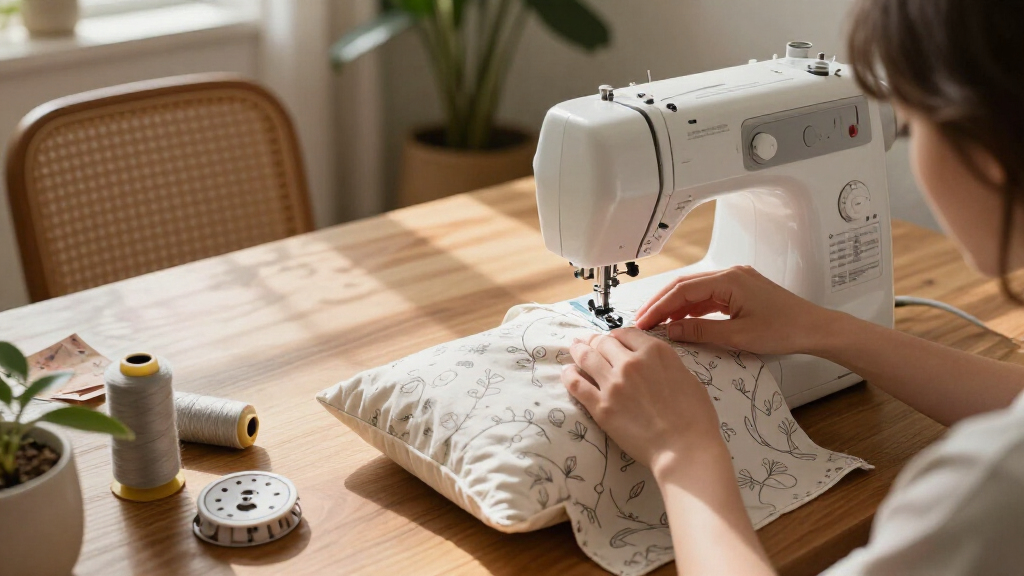
I compared these 15 options by the kind of work each can realistically support, not by portability alone. My criteria included stitch range and control, ease of setup and operation, the machine’s likely role in a home sewing routine, and whether its format suits travel, quick repairs, beginner practice, quilting, or embroidery. I also considered how included accessories and interface features could help—or distract from—the buyer’s main task.
The order favors machines that combine useful capability with manageable operation, which is why the Brother CS7000X leads as the most versatile full-size portable pick. Models such as the Brother XM2701 and Singer MX60 rank as simpler alternatives, while compact handheld tools rank lower for general sewing because their convenience comes with a narrower job range. Specialty machines such as the Brother SE700 may suit a particular buyer better than a general-purpose pick, but their added embroidery focus is not necessary for everyone.
Factors to Consider When Choosing Portable Sewing Machines
Before choosing, I would decide what “portable” needs to mean in your sewing routine. A machine that can be carried between rooms is a different purchase from one meant to fit in luggage or mend a hem away from home. These broader factors can help prevent buying a handy-looking tool that cannot handle your planned projects.
Match the machine format to the job
Start with the work you expect to do most often: quick seam repairs, garment construction, quilting, or embroidery. Handheld menders are small and easy to store, but they are purpose-built for limited repair tasks rather than serving as substitutes for standard sewing machines. A compact tabletop model makes more sense for recurring projects that need consistent fabric control. A common mistake is choosing by the word “portable” without checking whether the machine feeds and handles the materials your projects require. If you need one machine for varied home sewing, prioritize a standard machine that is still manageable to carry.
Check weight, footprint, and storage together
A machine can be light enough to move but still take up substantial shelf or table space once its accessories are unpacked. Check the dimensions and think about where it will be used, not just where it will be stored. If you plan to sew in different rooms, a carryable tabletop model may be more useful than the smallest handheld option, especially if you need room to guide fabric. For travel, also account for its power source and whether you can pack the necessary supplies. Buyers often focus on weight alone and overlook the work surface and storage needed to sew comfortably.
Choose stitch options for your actual projects
A high stitch count does not automatically mean a better fit. Straight stitching and a few practical options may cover basic repairs and beginner practice, while quilting or decorative work can call for more stitch choices and easier controls. Before paying for extra functions, list the projects you want to finish in the next year and check whether those functions help with them. Specialized features can add complexity without improving simple mending. The right balance is enough flexibility to support your plans, not the largest number printed on the box.
Treat accessories as a starter advantage, not a capability upgrade
Included kits can save a new sewer from having to source basic notions separately, but accessory counts say little about stitch quality or fabric handling. Look for useful items that match your plans, such as the appropriate presser feet or basic sewing supplies, rather than choosing a machine because its bundle sounds large. Extra pieces also require storage and may include items you never use. For beginners, a modest, relevant kit can make first projects easier to start. For experienced sewers, compatibility with the tools they already own may matter more.
Be realistic about fabric thickness and project scale
Portability does not tell you how well a machine will handle layered seams, denim, canvas, or bulky quilt sections. If those materials are part of your plan, look for a standard machine suited to the work and consult its manufacturer guidance rather than assuming a compact model can manage every fabric. A handheld tool is a poor choice for long, load-bearing seams or projects that need consistent control. Beginners may also find thick fabric harder to guide, even on a more capable machine. Starting with lighter woven fabrics can help build confidence while revealing whether your machine fits your needs.
Decide when extra features are worth carrying
An LCD, quilting functions, or embroidery capability can help when those features are part of regular projects, but they can add setup steps and take attention away from basic sewing. Compare the likely benefit with the space and learning time each feature asks of you. A beginner focused on hems may get more value from straightforward controls than from specialized functions. By contrast, someone planning quilting or embroidery may prefer a larger machine rather than outgrowing a minimal one. Choose added capability for a defined use, not as insurance against every possible future project.
Frequently Asked Questions
Can a handheld sewing machine replace a regular portable sewing machine?
Usually not. Handheld models in this roundup are best understood as compact mending tools for limited, quick repairs, while standard portable machines give you more control over fabric and support a broader set of sewing projects. If you need to sew garments, make longer seams, or work on projects that require consistent handling, choose a tabletop machine. A handheld option can still be useful as a secondary tool when size and quick access matter most. Decide based on the work you need it to do, rather than treating both formats as interchangeable.
Which type should I choose for quilting if I need to move the machine?
Look at portable standard machines designed with quilting in mind rather than choosing a handheld mender or a basic repair-focused model. In this roundup, the Brother CS7000X and XR3774 are the more relevant choices because quilting is part of their positioning. Consider how much table space and fabric support your quilt projects will need, since a machine’s portability does not remove the need to manage large pieces of fabric. If you quilt only occasionally, a simpler machine may still fit, but check its functions against your planned techniques first. For regular quilting, prioritize usable control and workspace over the smallest footprint.
Is a 12-stitch machine enough for a beginner?
It can be enough if your first goals are basic repairs and simple practice projects. A beginner does not need many stitches simply to learn threading, fabric control, and straight seams. The tradeoff is that a more limited machine may leave less room for projects that call for additional stitch choices. In this roundup, the 12-stitch models are better treated as straightforward entry points than as all-purpose machines for every future project. Choose one when its scope matches your plans, not just because a kit makes it look ready for anything.
Should I choose a machine with a large sewing kit included?
Choose a bundle for the usefulness of its contents, not its piece count. A kit can reduce the number of separate supplies a new sewer needs to gather, but it does not expand what the machine itself can sew. Check whether the included items suit your projects and whether they can be stored neatly alongside the machine. If you already own basic notions, a bundle may add little value to your setup. The machine’s format, controls, and project fit should guide the choice before the accessory package.
What should I prioritize if I will carry my sewing machine between locations?
Think about the complete sewing setup, including the machine, power needs, accessories, and surface area required to work. A handheld model is easier to pack but limited to small repair jobs, while a tabletop machine may support more work but needs more room and supplies. Consider how often you will move it and whether you need to sew at the destination or only make occasional repairs. Check the machine dimensions and storage arrangement rather than relying on a “portable” label. If your projects need steady fabric control, accepting a larger carry load may be the better tradeoff.
Conclusion
For most buyers who want one machine for varied home projects, I recommend the Brother CS7000X as best overall, particularly if quilting features and an LCD interface are useful. The Brother XM2701 is my best value-style choice for shoppers who want a straightforward standard machine with more stitch options than the simplest models, while the Brother SE700 is the premium specialty pick for buyers specifically interested in embroidery. Beginners can start with the Singer MX60 or a 12-stitch option if their plans are basic and they prefer a less complex setup. For quick, small repairs where portability matters more than project range, choose a SINGER Stitch Sew Quick or M1000-style mending tool. Match the machine to the work you will actually do, and the tradeoff between carrying ease and capability becomes much easier to judge.