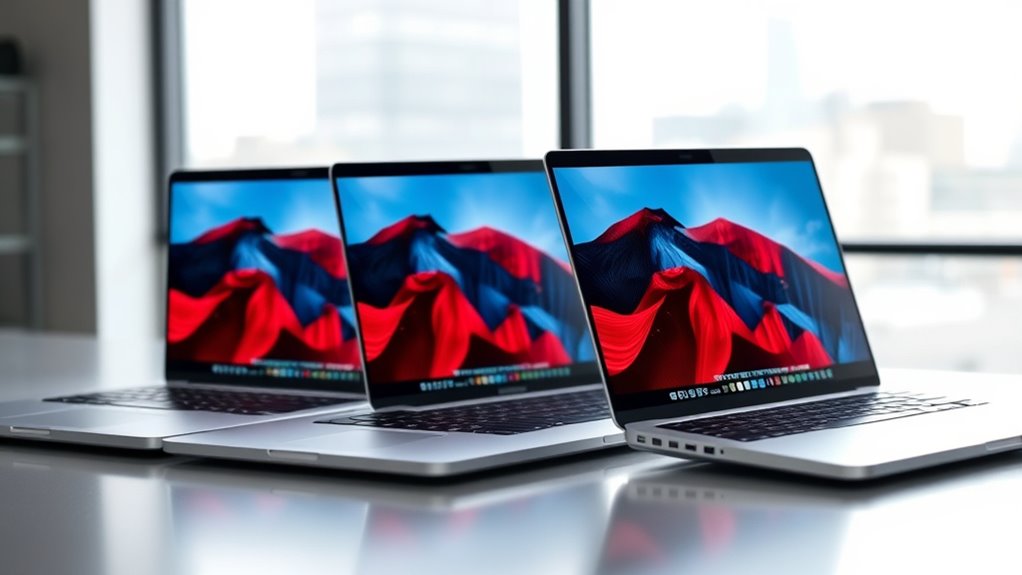

Choosing a 4TB MacBook Pro means deciding how much performance and portability you need alongside a large internal drive. My strongest picks are the 14-inch M5 Max for demanding work in a smaller footprint, the 16-inch M5 Max for a roomier screen and the same headline memory and storage, and the 14-inch M5 Pro for buyers who want 4TB without stepping up to Max-class hardware. The central tradeoff is clear: the newer configurations pair 4TB with powerful Apple silicon, while the renewed 2020 model offers a more compact, older Intel-based alternative with meaningful limits in performance and condition.

Get furniture and decor delivered free with Prime
- Fast, free delivery on millions of items
- Prime Video, Amazon Music and more included
- Member-only deals all year
I rank these options by how convincingly each configuration matches its intended buyer—not by storage capacity alone. A 4TB SSD can hold large media libraries, project files, and local work assets, but the chip, memory, screen size, and age determine whether the rest of the laptop suits your work. I also flag where listing details are incomplete or inconsistent so you can check the exact configuration before choosing.
Complete the kit


Key Takeaways
- The 14.2-inch M5 Max combines 4TB storage with 128GB memory and powerful graphics in the most travel-friendly new configuration listed here.
- The 16.2-inch M5 Max models offer more screen space than the 14-inch pick, but their size makes them less convenient to carry.
- The 14-inch M5 Pro is the sensible newer choice when 4TB matters more than having the M5 Max’s 40-core GPU and 128GB memory.
- The 2020 renewed Intel model is a fundamentally different, older option; its 4TB SSD does not make it equivalent to the Apple silicon configurations.
- Before buying, verify the exact model, memory, chip, included accessories, and return or renewal terms, especially where listing details are sparse.
| Apple MacBook Pro 14.2-inch with M5 Max, 18-core CPU, 40-core GPU, 128GB Memory, 4TB SSD, Space Black |  | Best Overall: maximum capability in a more portable size | Chip: Apple M5 Max | CPU / GPU: 18-core CPU / 40-core GPU | Display: 14.2-inch Liquid Retina XDR | VIEW ON AMAZON | See Our Full Breakdown |
| Apple MacBook Pro 16.2-inch with M5 Max, 18-core CPU, 40-core GPU, 128GB Unified Memory, and 4TB SSD – Space Black |  | Best for a large built-in display and fully listed connectivity | Chip: Apple M5 Max | CPU / GPU: 18-core CPU / 40-core GPU | Display: 16.2-inch Liquid Retina XDR | VIEW ON AMAZON | See Our Full Breakdown |
| Apple 16-inch MacBook Pro with M5 Max Chip, 128GB RAM, 4TB SSD, Space Black (2026) |  | Best for a simple large-screen M5 Max configuration | Chip: Apple M5 Max | CPU / GPU: 18-core CPU / 40-core GPU | Display: 16-inch Liquid Retina XDR | VIEW ON AMAZON | See Our Full Breakdown |
| Apple 14-inch MacBook Pro with M5 Pro Chip, 24GB RAM, 4TB SSD, Space Black |  | Best for 4TB storage without an M5 Max configuration | Chip: Apple M5 Pro | Display: 14-inch Liquid Retina XDR; listed resolution 3024 × 1964 | Memory: 24GB listed; verify memory technology and configuration | VIEW ON AMAZON | See Our Full Breakdown |
| 2020 Apple MacBook Pro (13-inch, 32GB RAM, 4TB SSD, Space Gray, Renewed) |  | Best for buyers specifically seeking a renewed Intel MacBook Pro | Model year: 2020 | Processor: Intel Core i5, 2.0GHz, four cores | Display: 13.3-inch Retina; listing states 3840 × 2160 pixels | VIEW ON AMAZON | See Our Full Breakdown |
| 4tb macbook pro laptop | Display | Memory | Storage | Chip |
|---|---|---|---|---|
| Apple MacBook Pro 14.2-inch wi | 14.2-inch Liquid Retina XDR | 128GB | 4TB SSD | Apple M5 Max |
| Apple MacBook Pro 16.2-inch wi | 16.2-inch Liquid Retina XDR | 128GB unified memory | 4TB SSD | Apple M5 Max |
| Apple 16-inch MacBook Pro with | 16-inch Liquid Retina XDR | 128GB | 4TB SSD | Apple M5 Max |
| Apple 14-inch MacBook Pro with | 14-inch Liquid Retina XDR; listed resolution 3024 × 1964 | 24GB listed; verify memory technology and configuration | 4TB SSD | Apple M5 Pro |
| 2020 Apple MacBook Pro | 13.3-inch Retina; listing states 3840 × 2160 pixels | 32GB DDR4 | 4TB SSD | — |
More Details on Our Top Picks
Apple MacBook Pro 14.2-inch with M5 Max, 18-core CPU, 40-core GPU, 128GB Memory, 4TB SSD, Space Black
This is my best overall choice because it combines a clearly specified M5 Max, 128GB of memory, and a 4TB SSD in a 14.2-inch MacBook Pro. That mix suits demanding creative work and large local projects without committing to the 16-inch models’ larger footprint. Compared with the M5 Pro 14-inch, it brings a far higher stated memory capacity and a 40-core GPU, making it the better fit for graphics-heavy workflows that can use those resources.
The Liquid Retina XDR display, three Thunderbolt 5 ports, HDMI, SDXC slot, and MagSafe 3 give this compact configuration useful flexibility at a desk or on location. The listing also specifies Wi-Fi 7, Bluetooth 6, a 12MP Center Stage camera, and support for up to four external displays. Those details make it easier to assess than the M5 Pro listing, whose configuration information is less complete.
The tradeoff is that this is a lot of laptop for everyday browsing, writing, and routine office tasks. Its 128GB memory and M5 Max graphics are aimed at intensive workloads, not merely storing a large library. I would choose a 16-inch M5 Max if screen area matters more than carrying ease; I would choose the M5 Pro if I want 4TB but do not need the top-tier listed GPU and memory. Check the exact product configuration before ordering.
Pros:- M5 Max with an 18-core CPU and 40-core GPU
- 128GB memory paired with a 4TB SSD
- 14.2-inch Liquid Retina XDR display with listed high brightness and contrast
- Thunderbolt 5, HDMI, SDXC, MagSafe 3, and support for up to four external displays
Cons:- M5 Max performance and 128GB memory may exceed ordinary everyday needs
- The 14.2-inch screen offers less workspace than either 16-inch M5 Max option
Best for: Creative professionals, developers, and on-device AI users who need 4TB storage, substantial memory, powerful graphics, and a laptop that is easier to carry than a 16-inch model.
Not ideal for: Everyday users who mainly browse, stream, or write, or buyers who would rather have a larger built-in display than a smaller body.
- Chip:Apple M5 Max
- CPU / GPU:18-core CPU / 40-core GPU
- Display:14.2-inch Liquid Retina XDR
- Memory:128GB
- Storage:4TB SSD
- Ports:Three Thunderbolt 5, MagSafe 3, SDXC, HDMI, headphone jack
- Wireless:Wi-Fi 7, Bluetooth 6
- Camera:12MP Center Stage
Our verdict“I’d choose this 14-inch M5 Max for a high-performance 4TB MacBook Pro that keeps portability ahead of a larger screen.”
Apple MacBook Pro 16.2-inch with M5 Max, 18-core CPU, 40-core GPU, 128GB Unified Memory, and 4TB SSD – Space Black
For buyers who want the 16.2-inch screen and a detailed specification sheet, this M5 Max model is the clearest large-screen choice. Its listed 18-core CPU, 40-core GPU, 128GB unified memory, and 4TB SSD match the core performance configuration of the 14-inch M5 Max, while the larger panel gives more room for timelines, layered documents, and side-by-side windows. Compared with the other 16-inch listing, this one spells out more of the display, ports, camera, audio, and wireless details.
It also specifies a Liquid Retina XDR display with 1600-nit peak brightness and 1000-nit sustained brightness, plus three Thunderbolt 5 ports, HDMI, SDXC, MagSafe 3, and a headphone jack. Those connections reduce the need to plan around adapters when combining storage cards, external displays, and peripherals. Six-speaker audio and a 12MP Center Stage camera round out a configuration suited to both studio work and video calls.
The main compromise is the larger body: it is less convenient for frequent travel than the 14-inch M5 Max, despite sharing its CPU, GPU, memory, and storage figures. Battery runtime is not specified in this listing, so I would not use it to make a direct endurance comparison. If the screen is not part of your daily workflow, the 14-inch model delivers the same headline compute and storage in a smaller format.
Pros:- M5 Max with 18-core CPU and 40-core GPU
- 128GB unified memory and 4TB SSD
- 16.2-inch Liquid Retina XDR display with listed brightness and contrast
- Detailed listing includes Thunderbolt 5, HDMI, SDXC, camera, audio, and wireless specifications
Cons:- Larger 16.2-inch chassis is less convenient to carry than the 14-inch M5 Max
- Battery runtime is not specified in the listing
Best for: Video editors, music producers, and other professionals who want a large built-in display, 128GB unified memory, 4TB storage, and clearly listed connections.
Not ideal for: Frequent travelers or buyers who value compactness more than screen area; also a poor fit if the listed 16-inch size is more than your desk or bag can accommodate.
- Chip:Apple M5 Max
- CPU / GPU:18-core CPU / 40-core GPU
- Display:16.2-inch Liquid Retina XDR
- Memory:128GB unified memory
- Storage:4TB SSD
- Ports:Three Thunderbolt 5, MagSafe 3, SDXC, HDMI, headphone jack
- Camera:12MP Center Stage
- Audio:Six speakers with Spatial Audio and Dolby Atmos support
Our verdict“I’d pick this 16-inch M5 Max when display space and well-documented connectivity matter more than travel convenience.”
Apple 16-inch MacBook Pro with M5 Max Chip, 128GB RAM, 4TB SSD, Space Black (2026)
This 16-inch M5 Max is a strong fit for buyers who already know they want a large MacBook Pro screen and the 128GB memory plus 4TB SSD combination. The listing identifies an 18-core CPU and 40-core GPU, so its central compute specifications align with the more detailed 16.2-inch M5 Max entry. I place it just behind that option because fewer supporting details are supplied here, not because the stated core configuration is weaker.
A bigger display is practical when you regularly work with dense interfaces or keep multiple windows visible. The advertised Liquid Retina XDR panel and all-day battery description make this a plausible workstation that can also leave the desk, while Apple-device integration may suit buyers already using the ecosystem. Compared with the 14-inch M5 Max, the benefit is screen area; the cost is a larger, heavier computer that is less appealing for frequent commuting.
The listing does not itemize the ports or give the display measurements and brightness figures found in the other 16-inch entry. It does specify a 140W USB-C power adapter, but buyers should verify the exact configuration and included accessories. If detailed port and screen information will influence your decision, I would favor the more fully documented 16.2-inch listing. If not, this remains a direct large-screen route to the stated M5 Max, 128GB, and 4TB combination.
Pros:- M5 Max with stated 18-core CPU and 40-core GPU
- 128GB RAM and 4TB SSD
- Large Liquid Retina XDR display
- 140W USB-C power adapter is listed
Cons:- Large and heavy compared with the 14-inch M5 Max
- Listing provides fewer port and display specifics than the other 16-inch M5 Max entry
- The high-end configuration is unnecessary for many general-purpose users
Best for: Professionals who want a 16-inch M5 Max with 128GB memory and 4TB storage, and who do not need every display and port detail spelled out in the listing.
Not ideal for: Travel-first buyers, or anyone who wants a fully itemized feature list before choosing between two closely matched 16-inch configurations.
- Chip:Apple M5 Max
- CPU / GPU:18-core CPU / 40-core GPU
- Display:16-inch Liquid Retina XDR
- Memory:128GB
- Storage:4TB SSD
- Battery:Advertised as all-day; no runtime figure provided
- Color:Space Black
- Power adapter:140W USB-C
Our verdict“I’d choose this 16-inch M5 Max for the large-screen, high-memory configuration, but I’d compare its exact listing details with the better-documented 16.2-inch alternative.”
Apple 14-inch MacBook Pro with M5 Pro Chip, 24GB RAM, 4TB SSD, Space Black
This 14-inch M5 Pro is the more restrained current-generation option in the group. It keeps the 4TB SSD and compact-screen format but lists 24GB of RAM rather than the 128GB found on the M5 Max models. That makes it a better match for buyers who need substantial storage for files and projects but do not have a clear need for the Max configurations’ stated 40-core GPU and very high memory capacity.
Its 14-inch Liquid Retina XDR display is a useful middle ground for people who work away from a fixed desk. The listing advertises up to 24 hours of battery life, though I would check how that figure is defined for the specific configuration. Compared with the 14-inch M5 Max, this pick trades listed memory and graphics headroom for a less extreme configuration; compared with the renewed 2020 Intel model, it offers a newer Apple silicon platform rather than older Intel hardware.
There is an important limitation in the supplied specifications: some details are not fully consistent. The listing calls the memory DDR3, while the model is described as an Apple silicon M5 Pro system, so verify the actual memory configuration with the seller before purchase. The listing also does not provide CPU and GPU core counts or port details. I would not select it on the battery claim alone, and users running unusually memory-intensive workloads should favor one of the 128GB M5 Max options.
Pros:- 4TB SSD in a 14-inch MacBook Pro
- M5 Pro chip for professional and creative workloads
- Compact format compared with the 16-inch M5 Max models
- Listing advertises up to 24 hours of battery life
Cons:- Listed 24GB memory is far below the 128GB M5 Max configurations
- Memory technology details in the supplied specifications appear inconsistent and should be verified
- CPU/GPU core counts and port selection are not provided
Best for: Buyers who want a 4TB SSD and a newer 14-inch MacBook Pro for professional or creative work, but do not expect to need 128GB memory or M5 Max graphics.
Not ideal for: Users with memory-heavy production workloads who need 128GB, or buyers who require complete and internally consistent technical details before ordering.
- Chip:Apple M5 Pro
- Display:14-inch Liquid Retina XDR; listed resolution 3024 × 1964
- Memory:24GB listed; verify memory technology and configuration
- Storage:4TB SSD
- Refresh rate:120Hz listed
- Battery:Advertised up to 24 hours
- Operating system:macOS
- Color:Space Black
Our verdict“I’d consider this M5 Pro for 4TB capacity and a smaller current-generation MacBook Pro, after confirming its memory and exact configuration.”
2020 Apple MacBook Pro (13-inch, 32GB RAM, 4TB SSD, Space Gray, Renewed)
This renewed 2020 MacBook Pro is the outlier in this roundup: it has 4TB storage, but uses a four-core Intel Core i5 and Intel Iris Plus graphics rather than the Apple silicon chips in the newer models. Its 32GB RAM sits between the listed 24GB M5 Pro and 128GB M5 Max configurations on paper, but memory capacity alone does not make it an equivalent choice for demanding current workflows. Its strongest case is for someone who wants this older platform and accepts the risks that come with a renewed laptop.
The 13.3-inch form factor and listed 1.4kg weight make it easier to carry than the 16-inch M5 Max models. The 4TB SSD also provides the same nominal internal capacity as the newer picks. However, the supplied display resolution is stated as 3840 × 2160, a detail I would verify against the specific unit rather than assume. The listing says qualified suppliers inspect and test the laptop and that battery capacity exceeds 80%, but that does not make its battery equivalent to a new machine.
Compared with the M5 Pro 14-inch, this model is older, Intel-based, and offered in renewed condition; compared with the M5 Max options, it is a poor fit for buyers seeking the strongest current performance. It runs macOS Ventura as listed, includes compatible rather than original accessories, and may show minor cosmetic wear. I would only choose it after confirming the unit’s condition, battery, included accessories, and support for the applications you rely on.
Pros:- 4TB SSD and 32GB RAM listed
- Compact 13.3-inch size and 1.4kg listed weight
- Renewed unit is described as inspected and tested
- Includes compatible accessories
Cons:- Older four-core Intel processor and integrated graphics trail the newer Apple silicon options in this lineup
- Renewed condition can mean cosmetic wear and battery variation
- Accessories are not original, and the listed display resolution should be verified
Best for: Buyers who specifically want a compact renewed Intel MacBook Pro with a 4TB SSD and understand the compromises of an older, pre-owned system.
Not ideal for: Buyers seeking current Apple silicon performance, a new-machine condition, a dependable battery baseline, or a clearly documented display configuration.
- Model year:2020
- Processor:Intel Core i5, 2.0GHz, four cores
- Display:13.3-inch Retina; listing states 3840 × 2160 pixels
- Memory:32GB DDR4
- Storage:4TB SSD
- Graphics:Intel Iris Plus integrated graphics
- Operating system:macOS Ventura
- Weight:1.4kg listed
- Condition:Renewed; battery capacity stated to exceed 80%
Our verdict“I’d choose this only when a renewed 2020 Intel MacBook Pro is an intentional preference, not as a performance substitute for the newer 4TB models.”

How We Picked
I treated 4TB internal storage as the starting requirement, then compared what each MacBook Pro pairs with that capacity. A large SSD is useful for sizeable photo and video libraries, project archives, and files that need to stay available offline. It does not, by itself, tell you whether the laptop can keep demanding applications responsive or whether its display and size work for your routine.
My ranking gives weight to chip and memory capability, practical screen size, port selection, and how clearly the supplied listing details support a buying decision. That puts the 14-inch M5 Max first for its unusual combination of a compact body, 128GB memory, and 4TB storage. The 16-inch M5 Max options follow for buyers who value workspace over portability; I distinguish them by how fully their specifications are presented, not by assuming different performance where the listed core hardware matches.
I also included the M5 Pro 14-inch because many 4TB buyers do not need a Max configuration, and the renewed 2020 Intel model because it is the only older-generation alternative in this set. Those entries have different tradeoffs: the Pro listing gives limited memory and performance detail, while the renewed laptop carries age, battery, and condition questions. I do not treat advertised performance claims as independent test results. Where specifications conflict or are absent, I call that out rather than filling gaps with guesses.
| 4tb macbook pro laptop | Chip |
|---|---|
| Apple MacBook Pro 14.2-inch wi | Apple M5 Max |
| Apple MacBook Pro 16.2-inch wi | Apple M5 Max |
| Apple 16-inch MacBook Pro with | Apple M5 Max |
| Apple 14-inch MacBook Pro with | Apple M5 Pro |
| 2020 Apple MacBook Pro | — |
Factors to Consider When Choosing 4tb Macbook Pro Laptops
I would start with your workload and daily setup, then use 4TB as the shared capacity requirement. Among these five, the biggest choices are M5 Pro versus M5 Max, 14-inch versus 16-inch, and new-generation configuration versus renewed Intel hardware.
Decide whether 4TB is the right kind of capacity
A 4TB SSD is useful when you need a large amount of active storage on the laptop itself: camera originals, video projects, design libraries, development assets, or files you need when disconnected from external drives. It can also reduce the need to rotate working files across smaller drives. I would still separate capacity from speed and compute needs: every listed option has 4TB, but their chips, memory, age, and condition differ sharply.
If most of your space is for backups or material you rarely open, an external drive or network storage may be a better part of your setup than paying for a large internal configuration. If you edit or work directly from large local libraries, internal storage can be more convenient. Think about how much space your current projects occupy and how quickly they grow, rather than treating 4TB as an automatic requirement.
Match M5 Pro or M5 Max to the work
The two M5 Max listings specify an 18-core CPU, 40-core GPU, and 128GB memory. That combination points toward graphics-heavy creative work, demanding multitasking, and workflows that can benefit from substantial unified memory. The 14-inch M5 Max offers those headline specifications in the more portable size; the 16-inch versions prioritize a larger display.
The M5 Pro option pairs its 4TB SSD with 24GB listed memory. It may make more sense when capacity is the main requirement and your workload does not call for the M5 Max configurations. Its listing has missing and potentially inconsistent technical details, so verify the configuration rather than inferring unlisted core counts. For routine productivity, either modern chip family may be more capable than needed; the right choice depends on the applications you actually run.
Choose screen size around your workday
The 14-inch models are easier to carry and take up less room on a desk, while the 16-inch models give more space for timelines, code, documents, and split-screen layouts. A larger panel can reduce window shuffling when the laptop is your main workstation. It also means accepting a larger body when commuting or traveling.
When comparing the two 16-inch M5 Max listings, their core chip, memory, and storage details match. The B0GV1GFZFQ listing supplies more specific display, camera, audio, and port information; B0GSXC4TZ9 lists a 140W USB-C adapter and describes all-day battery life but supplies fewer component details. I would compare the exact seller listing and configuration rather than assume the two have distinct performance.
Treat the renewed 2020 model as a separate category
The renewed 2020 MacBook Pro has a 4TB SSD, but it is not simply a less powerful version of the M5 models. It uses an Intel Core i5 processor and integrated graphics, runs macOS Ventura as listed, and comes in renewed condition with compatible accessories. Its battery capacity is described as exceeding 80%, which still allows more wear than buyers may accept in a new laptop.
Before choosing it, confirm the unit’s condition, display specification, battery details, included accessories, return window, and whether your required software supports the installed operating system and Intel hardware. I would favor an M5 configuration for current demanding creative or AI workloads. The renewed pick makes sense only if its age, platform, and condition are acceptable to you.
Check listing details before committing
Configuration labels can hide important differences, and product listings may omit or misstate technical details. The M5 Pro entry lists 24GB memory alongside a memory technology description that appears inconsistent with the Apple silicon configuration. The renewed 2020 entry supplies a display resolution that merits verification. I would confirm the precise model identifier, chip, memory, SSD capacity, display, and included charger with the seller.
For a renewed laptop, also check what inspection covers and what happens if the battery or cosmetic condition falls short of your expectations. For new M5 models, confirm the exact configuration and port details in the listing. These checks matter particularly when several products share the same 4TB capacity but differ greatly in platform and intended workload.
Frequently Asked Questions
Which 4TB MacBook Pro in this group is best for most demanding users?
I would start with the 14.2-inch M5 Max. It combines a stated 18-core CPU, 40-core GPU, 128GB memory, and 4TB SSD in a smaller body than the 16-inch models. If your work benefits from a larger built-in display and you do not mind the extra size, one of the 16-inch M5 Max options may suit you better.
Is the 16-inch M5 Max worth choosing over the 14-inch M5 Max?
Choose the 16-inch model if you regularly need more screen area for editing, composing, coding, or keeping multiple windows open. The listed M5 Max core counts, 128GB memory, and 4TB SSD match the 14-inch configuration, so the main decision is display space versus portability. The detailed B0GV1GFZFQ listing gives more supporting specification detail than the other 16-inch entry.
Should I choose the M5 Pro or M5 Max for a 4TB MacBook Pro?
The M5 Max listings make the clearest case for heavy graphics work and high-memory workloads, with 128GB memory and a stated 40-core GPU. The M5 Pro listing offers 4TB storage with 24GB memory, which may be enough when capacity matters more than maximum listed graphics and memory capability. Since the M5 Pro listing has incomplete and potentially inconsistent specifications, verify its exact configuration before deciding.
Is the renewed 2020 MacBook Pro a good alternative to the newer models?
It can suit a buyer who specifically wants a compact renewed Intel laptop and accepts an older platform, variable battery condition, and non-original accessories. It is not a direct performance substitute for the M5 Pro or M5 Max systems, despite sharing 4TB storage. Check the unit’s condition, battery, display information, software compatibility, and return terms before purchasing.
Who actually needs 4TB of internal storage?
4TB is most useful for people who keep large working libraries, video footage, project assets, or substantial offline files directly on their MacBook Pro. If your files are mostly archived or backed up elsewhere, external or network storage may cover that need without making the internal drive the deciding factor. I would estimate current usage and expected growth before choosing any of these configurations.
Conclusion
For heavy creative or technical workloads in a more portable size, I recommend the 14-inch M5 Max: it combines 4TB with 128GB memory and a 40-core GPU without the 16-inch footprint. If your laptop doubles as your primary workstation and screen space matters most, choose the better-documented 16.2-inch M5 Max; consider the other 16-inch M5 Max listing if its simpler specification sheet fits your needs and you verify the exact configuration.
For buyers who want 4TB without Max-class memory and graphics, the 14-inch M5 Pro is the more restrained current-generation direction, but confirm its memory details first. I would recommend the renewed 2020 Intel model only to someone deliberately shopping for an older renewed MacBook Pro and prepared to check battery, condition, and compatibility. Across all five, select by workload and daily portability—not by the shared 4TB figure alone.
Halloween Picks
halloween
As an affiliate, we earn on qualifying purchases.