
TL;DR

Get furniture and decor delivered free with Prime
- Fast, free delivery on millions of items
- Prime Video, Amazon Music and more included
- Member-only deals all year
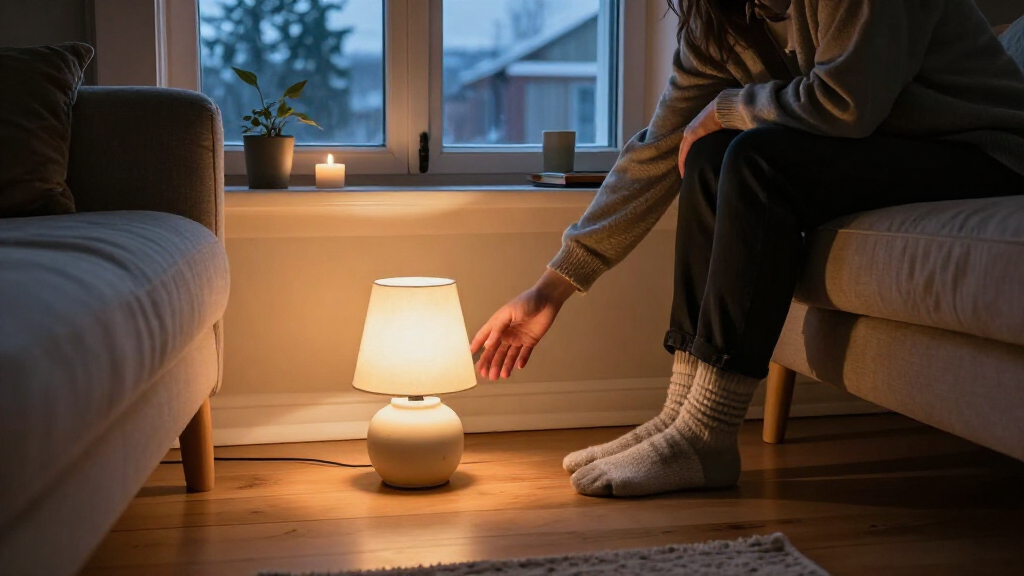
A Livingetc report shares Norwegian designer Gudbjørg Simonsen’s approach to lighting homes through long, dark winters. Her advice focuses on varied light, discreet task lighting and creating atmosphere rather than making every corner equally bright.
Norwegian designer Gudbjørg Simonsen has shared practical advice for lighting homes during dark winter months in a report by Livingetc, arguing that rooms should use varied, layered light rather than be uniformly bright. The guidance draws on Norway’s seasonal shifts and is relevant to households planning indoor lighting as daylight hours shorten.
Simonsen says her design work is shaped by Norway’s changing seasons, and that homes should respond to shifts in natural light instead of treating daylight as constant. She says designers should work with darkness rather than simply try to overcome it. In her view, light, shadow, color and materials can feel different across the year, allowing a home’s atmosphere to change with the season.
One of her main recommendations is to avoid evenly illuminating every part of a room. Simonsen says she wants variation, including brighter areas, soft transitions and shadow. She compares this to natural light, which is not uniformly distributed, and argues that a room can feel flat when every corner receives the same level of illumination.
She also recommends layering lighting according to purpose. Task lighting can support activities such as working at a surface, while other fixtures can guide movement through a room or highlight artwork. Simonsen says practical or technical lighting should meet those needs while remaining discreet where possible, so people experience the light without necessarily focusing on the fitting itself.
Designing for Dark Winter Evenings
The advice shifts the goal of winter lighting from making a space uniformly bright to supporting both practical tasks and atmosphere. That distinction may help readers plan lighting around how they actually use each room: a work surface needs adequate task light, while a seating area may benefit from softer pools of light and shadow.
Simonsen also describes lighting as a signal of comfort and human presence. She says a warmly lit window seen from outside can suggest that someone is home. That emotional dimension does not replace functional lighting, but it explains why fixture placement and light quality can shape how welcoming a home feels during dark evenings.
As an affiliate, we earn on qualifying purchases.
Norway’s Seasonal Light Shifts
The Livingetc report says Norway receives up to six hours of daylight per day in December, while its northernmost areas can have periods with no daylight. The article does not state the exact locations, dates or measurement method behind those figures. The contrast is offered as context for why Norwegian designers may pay close attention to seasonal changes in light.
Simonsen is based in Stavanger, according to the report. Her approach considers both the environment around a home and the lifestyle of the person living in it. She also draws on traditional Norwegian architecture. The source presents her comments as design guidance, not as a formal study of lighting’s health effects or as a set of technical standards.
“I don’t think we can design homes as though light remains constant throughout the year. Nor do I think the answer is to fight the darkness.”
— Gudbjørg Simonsen, Norwegian designer, as quoted by Livingetc
Limits of the Available Advice
The supplied report extract ends partway through its discussion of layered lighting. It does not include the full set of recommendations, product specifications, fixture positions, brightness levels or color-temperature guidance. Readers should not treat the excerpt as a complete lighting plan for every room.
The article offers Simonsen’s professional perspective, but does not cite research showing that a particular home-lighting scheme improves mood or health. It also gives no detailed breakdown of the daylight figures by region or date. The practical effects of any approach will depend on a home’s layout, natural light, activities and residents’ preferences.
Applying the Advice at Home
The report points readers toward a room-by-room approach: identify where focused light is needed for tasks, then add other sources to create softer areas and visual contrast. Rather than automatically brightening every shadowed corner, homeowners can test how different light sources affect the room at various times of day.
No further announcement, product launch or follow-up from Simonsen is included in the source material. The next step for readers is to adapt the broad principles to their own spaces, while checking that task areas remain adequately lit and that any electrical work is carried out safely by a qualified professional where required.
Key Questions
What is Gudbjørg Simonsen’s main winter-lighting advice?
She recommends varied, layered lighting rather than making every part of a room equally bright. Her approach combines practical task light with softer light and shadow.
Why does she advise against evenly lighting every corner?
Simonsen says uniform lighting can make a room feel flat. She favors brighter areas, gentle transitions and shadow, which she says more closely resemble natural light.
What does layered lighting mean in the report?
It means using different kinds of light for different purposes, including focused light for work surfaces, lighting that helps guide movement, and light that highlights art or contributes to atmosphere.
Does the article give specific brightness or bulb-temperature settings?
No. The supplied source extract gives general design principles but does not specify brightness levels, bulb color temperatures or a full room-by-room plan.
Source: rss
Halloween Picks
halloween
As an affiliate, we earn on qualifying purchases.