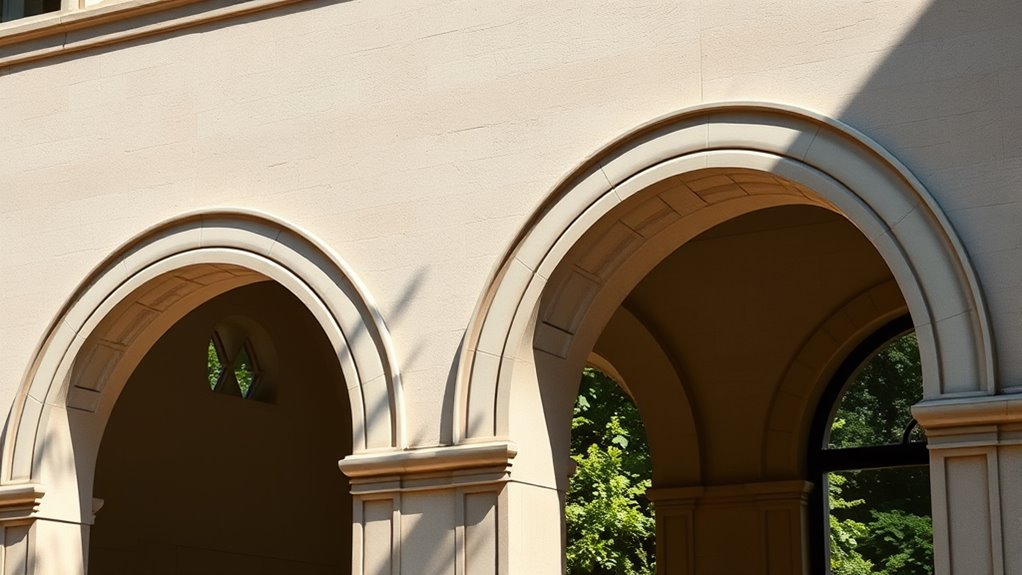

Curves and arches transform architecture by replacing rigid lines with flowing, organic forms that promote strength, flexibility, and aesthetic harmony. They challenge traditional geometries and evoke natural patterns, creating spaces that feel inviting and emotionally engaging. Modern materials and engineering innovations enable precise, sustainable designs that balance beauty with structural integrity. Embracing this approach guides you toward a future where architecture naturally integrates with human experience and environment—exploring deeper reveals even more transformative possibilities.
Key Takeaways
- Curves and arches introduce organic forms that soften architectural lines, creating inviting and harmonious spaces.
- They evoke natural patterns, promoting a sense of calmness and emotional warmth in design.
- Structural innovations using arches allow for expansive, elegant spans with less support, enhancing aesthetic fluidity.
- Incorporating curved elements breaks the rigidity of modernist architecture, fostering more dynamic and approachable environments.
- Modern materials and technology enable precise execution of soft, flowing forms, blending functionality with aesthetic softness.
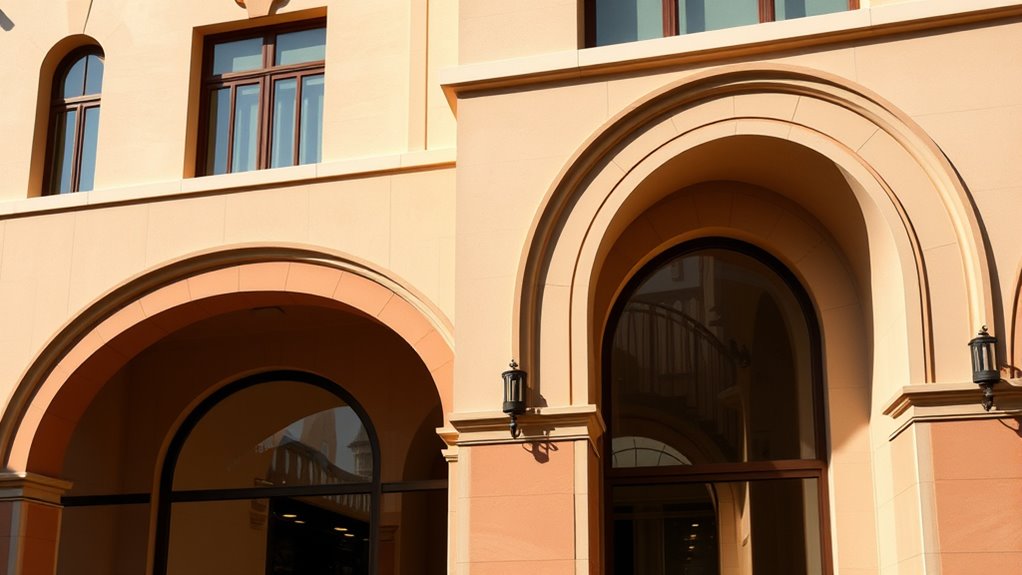
In contemporary architecture, the deliberate use of softened curves and arches signifies a shift towards designs that prioritize fluidity and organic forms over rigid geometry. This movement isn’t merely aesthetic; it reflects an evolving understanding of space, human experience, and structural innovation. By integrating curves and arches, architects challenge the traditional paradigm of straight lines and right angles, emphasizing a more dynamic interaction between built environment and natural forms. These elements serve as both visual anchors and structural solutions, offering a seamless changeover between interior and exterior, fostering a sense of openness and harmony.
Softened curves and arches foster fluid, harmonious architectural designs that blend natural forms with innovative structure.
You’ll notice that the intentional use of curvature acts as a visual counterpoint to the stiff, often impersonal nature of modernist structures. Instead of dominating the landscape with sharp, angular forms, curved surfaces introduce a softer, more inviting presence. This approach often results in spaces that feel more organic, more aligned with human physiology and psychological comfort. The arch, in particular, exemplifies this principle; its inherent strength allows for spans that are both expansive and elegant, reducing the need for excessive support structures. This not only enhances aesthetic appeal but also optimizes spatial efficiency.
From an engineering perspective, the integration of arches and curves demands precision and innovative material application. Modern materials like reinforced concrete and advanced composites enable architects to push the boundaries of traditional form, creating sweeping, uninterrupted curves that were previously unattainable. These materials also contribute to sustainability by reducing material waste and allowing for more flexible structural designs. The precise curvature and arching forms demand careful calculations and simulations, emphasizing the importance of technological integration in modern architectural practice.
Furthermore, these design choices influence how spaces are experienced. You might find that curved walls and arches generate a sense of movement and flow, guiding your eye and body through the environment intuitively. They can also evoke emotional responses—calmness, curiosity, or awe—by mimicking natural forms and patterns. This intentional emotional engagement underscores a broader shift toward architecture that is responsive not just to functional needs but also to psychological and aesthetic considerations.
Additionally, advances in projector technology have allowed architects and designers to visualize and simulate how these curved structures will appear and perform in real-world conditions, ensuring both aesthetic and structural integrity. Ultimately, the use of softened curves and arches reflects a deliberate move toward a more nuanced architectural language—one that balances structural integrity with visual fluidity, innovation with tradition. It invites you to reconsider how space is shaped and experienced, emphasizing that architecture is as much about emotional resonance as it is about physical form. This approach signals a future where fluid, organic structures become the standard, emphasizing harmony between built environments and human sensibilities.
Top picks for "curv arch soften"
Open Amazon search results for this keyword.
As an affiliate, we earn on qualifying purchases.
Frequently Asked Questions
How Do Curves Impact Building Energy Efficiency?
Curves improve building energy efficiency by reducing wind resistance and promoting natural airflow, which cuts down on cooling costs. They also optimize sunlight penetration, maximizing daylight while minimizing heat gain. Additionally, curved surfaces distribute thermal loads more evenly, decreasing temperature fluctuations. By integrating these design elements, you create a structure that’s more sustainable, lowers energy consumption, and enhances occupant comfort through innovative, aerodynamic, and thermally efficient architecture.
What Materials Are Best for Creating Durable Arches?
You should choose materials like reinforced concrete, steel, or stone for durable arches. Reinforced concrete offers strength and flexibility, making it ideal for complex shapes. Steel provides high tensile strength, ensuring longevity and resistance to stress. Stone, especially limestone or sandstone, offers natural durability and aesthetic appeal. Combining these materials can optimize structural integrity and longevity, enabling innovative designs while maintaining resilience in various environmental conditions.
How Do Curved Designs Influence Interior Acoustics?
You’ll find that curved designs enhance interior acoustics by directing sound waves more efficiently, reducing echoes and dead spots. The smooth, continuous surfaces diffuse sound evenly, creating a more balanced auditory environment. This innovative approach improves clarity for speech and music, making spaces feel more inviting and comfortable. By thoughtfully integrating curves, you optimize acoustic performance while adding a dynamic, aesthetic appeal that transforms the overall atmosphere.
Are Soft Arches More Cost-Effective Than Traditional Structures?
Soft arches tend to be more cost-effective than traditional structures, saving you up to 20% on construction costs due to reduced material needs and simplified fabrication. Their organic forms require less steel and concrete, lowering expenses while maintaining durability. By choosing soft arches, you optimize both budget and aesthetics, creating innovative spaces that appeal visually and functionally. This approach balances economic efficiency with architectural expression, making it a smart choice for modern projects.
How Do Cultural Influences Shape Curved Architectural Styles?
You see that cultural influences deeply shape curved architectural styles by reflecting regional values, beliefs, and aesthetics. You recognize that in some cultures, arches symbolize strength and spirituality, inspiring innovative designs that blend tradition with modernity. By analyzing these influences, you can identify how local histories, climate, and societal norms inform the use of curves, creating structures that resonate culturally while advancing architectural creativity and functionality.
Conclusion
You might think sharp angles define modernity, but it’s the gentle curves and arches that truly soften our built environment. Ironically, in seeking innovation, we rediscover timeless elegance that invites comfort rather than confrontation. These forms challenge your expectations, blending tradition with innovation. By embracing curves, architecture transforms from rigid to responsive, proving that sometimes, the most revolutionary design choices are those that evoke the most subtle emotional resonance—reminding us that softness can be the ultimate statement of strength.