For an LED light mask for acne, I’d start with the Nanoleaf FDA-Cleared LED Light Therapy Face Mask for its acne-focused treatment modes, then compare the MICEYLIVE Red Light and Blue Light Therapy Mask for its stated acne-treatment clearance and the NEWKEY 4D LED Mask for combined red and blue light. The main tradeoffs are acne-relevant blue light versus broader red-light modes, a structured fit versus cordless convenience, and targeted treatment versus added features such as under-eye cooling. Masks vary in their stated clearances, mode selections, and wear experience, so those details matter more than a long feature list. Light therapy is not a substitute for medical care, and results can vary by person and acne type. Continue reading for a ranked comparison and guidance on choosing a mask that fits your routine.

Get furniture and decor delivered free with Prime
- Fast, free delivery on millions of items
- Prime Video, Amazon Music and more included
- Member-only deals all year
Complete the kit


Key Takeaways
- Acne-focused blue-light modes are a useful point of separation: the Nanoleaf, MICEYLIVE, NEWKEY, and INIA models explicitly include blue light, while several picks emphasize red light or broader multi-color treatment.
- Stated FDA clearance is not uniform across this lineup: Nanoleaf, Aphrona, and MICEYLIVE identify clearance in their product names; compare the exact device and intended use rather than assuming every mask has the same status.
- More modes do not automatically mean a better acne choice: seven-color masks offer flexibility, but a buyer focused on breakouts may prefer clearly described acne-related light modes.
- Convenience features change the fit more than the acne rationale: cordless designs can suit flexible routines, while Shark CryoGlow adds under-eye cooling that may appeal to buyers wanting a broader facial-care experience.
- Premium features and high LED counts are not direct proof of better acne outcomes: the strongest comparisons are based on treatment details, fit, usability, and credible device information, not a single specification.
| Shark CryoGlow LED Face Mask with Red Light Therapy and Under-Eye Cooling |  | Best for Acne Care Plus Under-Eye Cooling | Model: FW312PL | Light types: Red, blue, and deep infrared LED | Treatments: Better Aging, Skin Clearing, Skin Sustain, and Under-Eye Revive | VIEW ON AMAZON | See Our Full Breakdown |
| NEWKEY 4D LED Red and Blue Light Therapy Mask |  | Best for a Simple, Scheduled Routine | LEDs: 150 LEDs with 450 light-emitting chips | Red wavelength: 630 nm | Blue wavelength: 465 nm | VIEW ON AMAZON | See Our Full Breakdown |
| iRestore Red Light Therapy LED Face Mask with 360 LEDs |  | Best for Three-Wavelength Flexibility | LED count: 360 | Red wavelength: 635 nm | Infrared wavelength: 830 nm | VIEW ON AMAZON | See Our Full Breakdown |
| Red Light Therapy Mask with Dual Near-Infrared Light |  | Best for Adjustable Sessions and Light Settings | LED count: 432 | LED wavelengths: 415 nm, 630 nm, 830 nm, and 850 nm | Light modes: 5 | VIEW ON AMAZON | See Our Full Breakdown |
| Nanoleaf FDA-Cleared LED Light Therapy Face Mask with 7 Treatment Modes |  | Best for Cordless, Multi-Mode Use | LED count: 432 | Light modes: 7 | Material: Medical-grade silicone | VIEW ON AMAZON | See Our Full Breakdown |
| Aphrona FDA Cleared LED Facial Mask Moonlight Pro 7‑Color Treatment Photon Mask |  | Best for Acne-Focused Specs | LED chips: 450 high-purity LEDs | Red wavelength: 630 nm ±5 nm | Blue wavelength: 415 nm ±5 nm | VIEW ON AMAZON | See Our Full Breakdown |
| Red Light Therapy LED Face Mask for Wrinkles, Acne, and Uneven Skin Texture |  | Best for Soft Silicone Fit | Material: Food-grade silicone | Coverage: Full face | Recommended session: 10–30 minutes | VIEW ON AMAZON | See Our Full Breakdown |
| INIA Red Light Therapy Mask for Face with Near-Infrared and Blue Light | 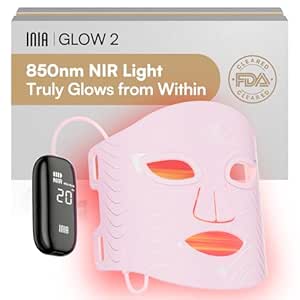 | Best Rechargeable Option with Stated Wavelengths | Red wavelengths: 620 nm and 630 nm | Blue wavelength: 460–470 nm | Near-infrared wavelength: 850 nm | VIEW ON AMAZON | See Our Full Breakdown |
| Rechargeable 7-Color LED Light Therapy Mask for Face |  | Best for Adjustable Intensity | Light colors: 7 | LED count: 70 | Intensity levels: 5 | VIEW ON AMAZON | See Our Full Breakdown |
| Cordless 7-Color LED Facial Therapy Mask |  | Best for Simple Cordless Sessions | Light colors: 7: red, blue, yellow, green, purple, cyan, and white | LED beads: 90 | Session length: 15 minutes | VIEW ON AMAZON | See Our Full Breakdown |
| Shark CryoGlow LED Face Mask with Under-Eye Cooling, FW312 |  | Best for Acne Routines With Under-Eye Cooling | Model: FW312 | Light types: Red, blue, and deep infrared LED | Treatment modes: Better Aging, Skin Clearing, Skin Sustain, Under-Eye Revive | VIEW ON AMAZON | See Our Full Breakdown |
| Wavytalk Glow Time Red Light Therapy LED Face Mask |  | Best for Specified Acne Wavelengths | Light modes: Anti-fine-line, anti-acne, rejuvenation | Acne wavelengths: 415nm blue and 630nm red | LED chips: 456 | VIEW ON AMAZON | See Our Full Breakdown |
| MICEYLIVE Red Light and Blue Light Therapy Mask for Face – FDA-Cleared Acne Treatment |  | Best for Buyers Prioritizing FDA Clearance | LED count: 432 | Wavelengths: 415nm blue, 630nm red, 850nm near-infrared, 590nm amber | Power density: 40mW/cm² | VIEW ON AMAZON | See Our Full Breakdown |
| Ulike Reglow LED Light Therapy Face Mask |  | Best for Short Daily Sessions | Treatment modes: Glow, Firm, Rejuvenate, Clear | Light types: Red, yellow, blue, infrared | Light beads: 272 | VIEW ON AMAZON | See Our Full Breakdown |
| INIA Red Light Therapy Face Mask with 4 Light Modes |  | Best for Timer Flexibility | Light modes: Red-L, Red-H, Blue, Red+Blue | Listed wavelengths: 620nm Red-L, 630nm Red-H, 460–470nm Blue, 460–630nm Red+Blue | Near-infrared wavelength: 850nm | VIEW ON AMAZON | See Our Full Breakdown |
More Details on Our Top Picks
Shark CryoGlow LED Face Mask with Red Light Therapy and Under-Eye Cooling
For shoppers who want an acne-focused mode without giving up other skincare functions, the Shark CryoGlow offers red, blue, and deep infrared light alongside adjustable under-eye cooling. Its Skin Clearing treatment gives it a more direct acne-care role than a mask focused mainly on aging, while the other programs cover maintenance and fine lines. The three cooling levels and clip-on pads are a distinctive extra; the iRestore mask, by comparison, offers three wavelengths but no under-eye cooling feature in the supplied details. Shark’s sessions range from four to 15 minutes depending on the treatment, so the routine can vary by goal. The tradeoff is that it combines several skincare aims rather than specializing in acne alone, and results may require consistent use over multiple weeks.
Pros:- Combines red, blue, and deep infrared LED
- Includes a dedicated Skin Clearing treatment
- Three adjustable under-eye cooling levels
- Treatment choices range from 4 to 15 minutes
Cons:- Multiple skincare programs may be more than acne-focused buyers need
- Some treatment results require regular use over multiple weeks
- Individual results may vary
Best for: Buyers who want a blue-light skin-clearing treatment plus separate options for skin maintenance and under-eye cooling.
Not ideal for: Shoppers seeking a mask dedicated only to acne, or anyone unwilling to follow a regular routine while waiting for results.
- Model:FW312PL
- Light types:Red, blue, and deep infrared LED
- Treatments:Better Aging, Skin Clearing, Skin Sustain, and Under-Eye Revive
- Treatment times:4, 6, 8, or 5–15 minutes, depending on treatment
- Under-eye cooling:3 adjustable chill levels
- Included accessories:Clip-on chill pads, remote, and USB-C charging cable
- Listed skin types:Dry, oily, normal, combination, and sensitive
Our verdict“Choose the Shark CryoGlow if you want acne-oriented blue light in a multi-treatment mask with added under-eye cooling.”
NEWKEY 4D LED Red and Blue Light Therapy Mask
The NEWKEY 4D keeps the routine straightforward: choose red or blue light, wear the contoured mask for a 10-minute session, and let the automatic shut-off end the treatment. That makes it an easy-to-follow option for buyers who prefer a fixed session over Shark CryoGlow’s several programs and varying treatment lengths. Its stated red wavelength is 630 nm and blue is 465 nm, with 150 LEDs and 450 light-emitting chips. The corded power supply can be a practical fit for a regular treatment spot, but it limits where a session can happen compared with the rechargeable Nanoleaf mask. The supplied product information also does not include independent verification of claimed results, so buyers should treat the specifications as product claims rather than a promise of acne improvement.
Pros:- Provides separate red and blue light modes
- 10-minute automatic shut-off supports a consistent session
- Corded power avoids relying on a built-in battery
- Contoured design is intended to cover the face
Cons:- The cord restricts movement and treatment location
- Supplied information does not include independent verification of results
- Offers fewer stated wavelengths than the iRestore mask
Best for: Buyers who want a fixed-length red-and-blue-light routine and plan to use the mask near a power outlet.
Not ideal for: People who need cordless use, want a rechargeable mask, or prefer product information with independent results data.
- LEDs:150 LEDs with 450 light-emitting chips
- Red wavelength:630 nm
- Blue wavelength:465 nm
- Irradiance:Up to 75 mW/cm²
- Treatment time:10 minutes with automatic shut-off
- Recommended use:Every other day, 3 times per week
- Power:Corded
- Design:4D facial contour with 5 mm light distance
Our verdict“Pick NEWKEY if you value a simple timed red-and-blue routine more than cordless convenience or broader wavelength options.”
iRestore Red Light Therapy LED Face Mask with 360 LEDs
The iRestore mask is a good fit for buyers who want acne-relevant blue light alongside red and infrared wavelengths for other skin goals. Its listed 415 nm blue light sits alongside 635 nm red and 830 nm infrared, giving it a broader stated wavelength mix than the two-light NEWKEY mask. Sessions are a manageable 10 minutes, though the recommended schedule of three to five times weekly calls for regular follow-through. A lightweight body and dual straps are intended to support a wearable fit during those sessions. Compared with the Shark CryoGlow, iRestore does not list separate treatment programs or under-eye cooling, so it is the simpler multi-wavelength choice rather than the more feature-heavy one. The supplied details describe intended benefits but provide no specific results data, and the routine still requires ongoing use.
Pros:- Includes 415 nm blue, 635 nm red, and 830 nm infrared wavelengths
- 10-minute sessions fit a short treatment routine
- Lightweight design with dual straps
- No messy gels or downtime are required, according to the product details
Cons:- Recommended use of 3–5 times weekly takes regular commitment
- Supplied information gives no specific results data
- Does not list the cooling feature or separate treatment programs offered by Shark CryoGlow
Best for: People who want a lightweight mask with blue light for blemishes and red and infrared options for broader skincare goals.
Not ideal for: Buyers who want built-in cooling, selectable treatment programs, or specific results data in the supplied product information.
- LED count:360
- Red wavelength:635 nm
- Infrared wavelength:830 nm
- Blue wavelength:415 nm
- Session duration:10 minutes
- Recommended frequency:3–5 times a week
- Design:Lightweight mask with dual straps
Our verdict“Choose iRestore if you want three listed wavelengths and a wearable 10-minute routine, without paying for extra features such as under-eye cooling.”
Red Light Therapy Mask with Dual Near-Infrared Light
This flexible silicone mask gives acne-focused shoppers several settings to work with: it lists 415 nm blue light alongside red and two near-infrared wavelengths, plus five modes and five brightness levels. That degree of adjustment is a stronger fit for people who want to tailor sessions than the simpler, fixed 10-minute NEWKEY mask. A built-in timer runs from five to 20 minutes, and the rechargeable 5000 mAh controller is described as lasting up to 450 minutes. Its coverage is specified for the forehead, cheeks, chin, and jawline, making the stated treatment area clear. The tradeoff is that more settings can mean more choices to manage, and the product’s claimed skincare improvements still depend on consistent use. The listing describes it as FDA 510(k)-cleared; that status alone does not establish a specific acne outcome.
Pros:- Includes 415 nm blue light along with red and two near-infrared wavelengths
- Five modes and five brightness levels allow setting choices
- Timer offers sessions from 5 to 20 minutes
- Rechargeable 5000 mAh controller is described as supporting up to 450 minutes
Cons:- The number of settings may feel less straightforward than NEWKEY’s fixed 10-minute routine
- Skincare improvements require consistent use
- FDA 510(k)-cleared status does not by itself guarantee an acne outcome
Best for: Buyers who want blue light plus adjustable modes, brightness, and session length in a rechargeable silicone mask.
Not ideal for: People who prefer a simple preset routine or expect adjustable settings to guarantee acne results.
- LED count:432
- LED wavelengths:415 nm, 630 nm, 830 nm, and 850 nm
- Light modes:5
- Brightness levels:5
- Timer:5–20 minutes
- Battery capacity:5000 mAh
- Claimed battery runtime:Up to 450 minutes
- Material and regulatory status:Flexible silicone; described as FDA 510(k)-cleared
Our verdict“Pick this mask if you want a rechargeable, highly adjustable routine and are comfortable choosing among multiple settings.”
Nanoleaf FDA-Cleared LED Light Therapy Face Mask with 7 Treatment Modes
The Nanoleaf mask pairs 432 LEDs with seven treatment modes in a flexible, rechargeable design, so it suits buyers who want varied settings without staying beside an outlet or managing an app. Its portable setup contrasts with the corded NEWKEY mask, while its medical-grade silicone construction is described as flexible for full-face coverage. The listed routine is five to 10 minutes, three to five times per week. For acne shoppers, the key limitation is that the supplied specifications do not identify individual wavelengths or explain which mode targets blemishes; by comparison, iRestore explicitly lists a 415 nm blue wavelength. Nanoleaf is described as FDA-cleared, but that claim does not replace clear acne-specific treatment details. A strap extender must be requested separately for larger fits, which may complicate sizing.
Pros:- Seven treatment modes provide multiple settings
- Rechargeable design does not require a wall outlet during use
- Medical-grade silicone is described as ultra-flexible
- No smartphone app is required
Cons:- Supplied specifications do not identify wavelengths or a specific acne mode
- Strap extender for larger fits must be requested separately
- No integrated app for additional controls
Best for: Buyers who want a portable, rechargeable mask with multiple modes and flexible silicone construction, and do not need app control.
Not ideal for: Shoppers who need explicit blue-light wavelength information, app-based controls, or a ready-to-use extender for a larger fit.
- LED count:432
- Light modes:7
- Material:Medical-grade silicone
- Battery:Built-in rechargeable
- Treatment duration:5–10 minutes per session
- Recommended frequency:3–5 times per week
- Result timeline stated in product data:Noticeable improvements in 2–6 weeks; full results in 8–10 weeks
- App and outlet requirements:No app or wall outlet required during use
Our verdict“Choose Nanoleaf for cordless convenience and mode variety, but prefer iRestore if confirmed blue-light wavelength details matter most.”
Aphrona FDA Cleared LED Facial Mask Moonlight Pro 7‑Color Treatment Photon Mask
For shoppers prioritizing clearly stated acne-treatment wavelengths, the Aphrona Moonlight Pro is the most evidence-conscious option in this group: it specifies 415 nm blue light alongside 630 nm red light, rather than leaving the wavelengths undisclosed as the Red Light Therapy LED Face Mask for Wrinkles, Acne, and Uneven Skin Texture does. Its 450 LEDs are intended to spread light across the face, while FDA 510(k) Class II clearance gives buyers more regulatory context than the product descriptions provide for several other masks here. The adjustable 5–50-minute timer offers flexibility, but longer sessions may make its bulky fit less comfortable. It also plugs into an AC adapter, so it is less convenient to travel with than the rechargeable INIA mask. The product calls for regular cleaning and serum use; buyers should follow its directions and not treat light therapy as a substitute for acne care advised by a clinician.
Pros:- Specifies 415 nm blue and 630 nm red light, making its acne-related light modes clearer than masks with undisclosed wavelengths.
- 450 LEDs are designed to distribute light across the treatment area.
- FDA 510(k) Class II clearance is stated in the product data.
- Adjustable 5–50-minute timer allows a range of session lengths.
Cons:- AC-adapter power limits cordless use and travel convenience.
- The mask may feel bulky during longer sessions.
- Requires regular cleaning and serum use according to the product description.
Best for: Buyers seeking a plug-in mask with specified red and blue wavelengths, high LED count, and FDA 510(k) clearance.
Not ideal for: Travelers or people who prefer a lightweight, cordless mask; this model uses an AC adapter and may feel bulky during longer sessions.
- LED chips:450 high-purity LEDs
- Red wavelength:630 nm ±5 nm
- Blue wavelength:415 nm ±5 nm
- Treatment duration:5–50 minutes; 15-minute default
- Color options:7
- FDA status:510(k) Class II medical device
- Power source:AC adapter
- Warranty:1 year
Our verdict“Choose the Aphrona if specified blue-light wavelength and stated FDA clearance matter more to you than a cordless design.”
Red Light Therapy LED Face Mask for Wrinkles, Acne, and Uneven Skin Texture
The clearest reason to choose this mask is its soft silicone construction and adjustable strap, which may suit buyers who find rigid masks uncomfortable. It also adds topical heating to LED light therapy, a feature not listed for the Aphrona Moonlight Pro or the cordless 7-Color LED Facial Therapy Mask. But for acne-focused shopping, comfort does not make up for a major information gap: the listing gives no wavelengths, LED count, or output figures, so it is hard to compare its light treatment with the Aphrona’s specified 415 nm blue light or INIA’s 460–470 nm blue mode. The suggested routine—10–30 minutes, four to six times weekly—also calls for frequent use. I’d pick it for a flexible, travel-friendly fit, not for shoppers who want detailed device specifications before buying.
Pros:- Soft food-grade silicone is designed for a flexible fit.
- Adjustable strap helps secure the mask.
- Combines LED therapy with topical heating.
- Compact design is described as suitable for home and travel.
Cons:- The listing does not state light wavelengths, LED count, or device output.
- The recommended routine involves sessions four to six times per week.
- Heating adds a feature, but the product data does not explain its settings or performance.
Best for: People who value a flexible silicone mask and adjustable fit for regular home or travel sessions, and are comfortable with limited technical detail.
Not ideal for: Acne-focused buyers who want stated blue-light wavelengths, LED count, or output data to compare treatment specifications.
- Material:Food-grade silicone
- Coverage:Full face
- Recommended session:10–30 minutes
- Recommended frequency:4–6 times weekly
- Treatment features:LED light therapy and topical heating
- Target concerns:Wrinkles, acne, and uneven skin texture
- Portability:Compact; described as suitable for home and travel
Our verdict“Pick this mask for a flexible silicone fit and heating feature, but choose the Aphrona or INIA if wavelength details are a priority.”
INIA Red Light Therapy Mask for Face with Near-Infrared and Blue Light
The INIA stands out among the cordless options because its listing names the light bands, including 460–470 nm blue light, red modes at 620 and 630 nm, and optional 850 nm near-infrared. That gives acne-focused shoppers more useful information than the Rechargeable 7-Color LED Light Therapy Mask, whose description lists colors but not wavelengths. Its rechargeable controller, three timer choices, and automatic shutoff also make sessions straightforward without a wall connection. Compared with the Aphrona Moonlight Pro, though, INIA lists 220 LEDs rather than 450 and does not provide FDA clearance in the supplied product data. The description says consistent use over four or more weeks is needed for results, so it suits buyers prepared for a routine rather than those seeking quick changes. The near-infrared mode adds flexibility, but blue-light details should remain the main acne-specific comparison point.
Pros:- Lists blue-light wavelengths of 460–470 nm, plus red and near-infrared wavelengths.
- Four light modes include a red-and-blue combination.
- Rechargeable 2600mAh controller avoids a required wall connection during use.
- 10-, 20-, and 30-minute timers include automatic shutoff.
Cons:- The description says results require consistent use over four or more weeks.
- Its 220 LEDs are fewer than the Aphrona Moonlight Pro’s stated 450.
- FDA clearance is not stated in the supplied product data.
Best for: Buyers who want a rechargeable mask with stated blue-light wavelengths, several light modes, and timed sessions.
Not ideal for: Shoppers who prioritize stated FDA clearance or a higher LED count; the Aphrona provides both a clearance claim and 450 LEDs in its product data.
- Red wavelengths:620 nm and 630 nm
- Blue wavelength:460–470 nm
- Near-infrared wavelength:850 nm
- Light modes:4
- LED chips:220
- Energy output:Up to 105 mW/cm²
- Controller battery:2600 mAh
- Timer settings:10, 20, or 30 minutes
- Recommended use:3–7 times per week
Our verdict“Choose INIA if you want a rechargeable mask with stated wavelengths and timer controls, and do not require the Aphrona’s stated FDA clearance.”
Rechargeable 7-Color LED Light Therapy Mask for Face
This mask’s main point of difference is five intensity levels, which give users more control over session settings than the fixed 15-minute routine listed for the Cordless 7-Color LED Facial Therapy Mask. Its soft silicone design and USB rechargeability also make it a portable choice, with a stated eight to twelve sessions per charge. For acne, however, buyers should distinguish color selection from wavelength data: the listing names seven colors but does not specify the wavelengths or light output. That leaves it less transparent than INIA, which identifies its blue and red bands, and less clearly acne-focused than the Aphrona with its stated 415 nm blue light. The mask has 70 LEDs and is described for sessions of 10–20 minutes, three to five times weekly. It may fit buyers seeking adjustable settings, but not those who need precise treatment specifications.
Pros:- Five intensity levels allow more setting options than a single fixed session format.
- Seven light colors offer multiple modes.
- Soft silicone construction is designed for a comfortable fit.
- Rechargeable design is rated for 8–12 sessions per charge.
Cons:- The listing does not specify wavelengths or energy output.
- The 70-LED count is lower than the Aphrona Moonlight Pro’s stated 450.
- The product description says benefits depend on consistent use over several weeks.
Best for: Portable-device shoppers who want multiple intensity settings and a soft silicone mask for short, regular sessions.
Not ideal for: Acne-focused buyers who need published wavelengths or output figures to compare the device’s light treatment.
- Light colors:7
- LED count:70
- Intensity levels:5
- Material:Soft silicone
- Session duration:10–20 minutes
- Sessions per charge:8–12
- Recommended use:3–5 times weekly
- Charging:Rechargeable; USB charging cable included
Our verdict“Choose this mask for adjustable intensity and USB portability, but favor INIA or Aphrona if wavelength transparency is more important.”
Cordless 7-Color LED Facial Therapy Mask
The Cordless 7-Color mask is the simplest pick here for buyers who want to avoid a plugged-in setup: it offers 15-minute sessions and up to 14 uses per charge. That makes it more straightforward than the Rechargeable 7-Color LED Light Therapy Mask, which adds five intensity levels and a 10–20-minute session range. The tradeoff is limited acne-treatment detail. Although this model lists red and blue among its seven colors, the product data does not provide their wavelengths, output, or evidence supporting its skin-benefit claims. The Aphrona Moonlight Pro is a more specification-led choice for acne, with stated 415 nm blue light and FDA 510(k) clearance; INIA also provides wavelength information while remaining rechargeable. This mask is best understood as a portable, simple-format option, not the strongest choice for buyers comparing acne-focused light parameters.
Pros:- Cordless design supports portable use.
- Fixed 15-minute sessions are simple to plan.
- Up to 14 uses per full charge are stated.
- Offers seven listed light colors, including red and blue.
Cons:- The listing does not state light wavelengths or output.
- The supplied product information does not substantiate its skin-benefit claims.
- Requires charging, and battery recharge time is not stated.
Best for: People who want a cordless mask with a fixed, short session and multiple color options for portable use.
Not ideal for: Buyers who want acne-specific wavelength or output data, or prefer a mask with stated FDA clearance.
- Light colors:7: red, blue, yellow, green, purple, cyan, and white
- LED beads:90
- Session length:15 minutes
- Battery life:Up to 14 uses per full charge
- Design:Cordless and portable
Our verdict“Pick this for uncomplicated cordless sessions, but choose Aphrona or INIA if you want published acne-relevant wavelength specifications.”
Shark CryoGlow LED Face Mask with Under-Eye Cooling, FW312
For shoppers prioritizing blemish care but wanting an added comfort feature, the Shark CryoGlow pairs blue LED treatment with red and deep infrared light and three adjustable cooling levels for the under-eye area. Its Skin Clearing mode gives it a clear acne-care role, while the other modes let one device serve broader skincare routines. Compared with the Wavytalk Glow Time, which lists specific acne wavelengths and several session lengths, Shark offers more explicit mode choices and integrated cooling rather than a detailed wavelength specification. That distinction may matter if cooling is part of your routine, but the supplied product data does not identify its LED wavelengths or acne-treatment session duration. I’d choose it for the combined treatment format, not for shoppers seeking published wavelength details. Like other at-home masks, it calls for regular use and individual results can vary.
Pros:- Includes a dedicated Skin Clearing treatment mode
- Combines red, blue, and deep infrared LED light
- Three adjustable chill levels add an under-eye cooling option
- Remote and USB-C charging cable are included
Cons:- Product data does not specify LED wavelengths or power density
- Regular use is needed, and results may vary between individuals
Best for: People seeking an acne-focused LED mode alongside adjustable under-eye cooling and additional skincare modes.
Not ideal for: Shoppers who want listed LED wavelengths or a clearly specified acne-session duration before choosing a mask.
- Model:FW312
- Light types:Red, blue, and deep infrared LED
- Treatment modes:Better Aging, Skin Clearing, Skin Sustain, Under-Eye Revive
- LED treatment duration:4–8 minutes
- Under-Eye Revive duration:5–15 minutes
- Under-eye cooling:3 adjustable chill levels
- Included accessories:Clip-on chill pads, remote, USB-C charging cable
Our verdict“Choose Shark if under-eye cooling and multiple treatment modes matter more to you than published wavelength specifications.”
Wavytalk Glow Time Red Light Therapy LED Face Mask
The Wavytalk Glow Time is a strong fit for buyers who want the acne mode spelled out: it combines 415nm blue light with 630nm red, while its other modes address fine lines and dull-looking skin. Its 456 LED chips and full-face design make it a more spec-forward choice than the Shark CryoGlow, whose supplied details describe its light colors but not exact wavelengths. Wavytalk also offers 10-, 15-, and 20-minute sessions, giving buyers more timing choices than the Ulike Reglow, which recommends an eight-minute daily treatment. The tradeoff is routine commitment: the maker recommends use three to five times weekly, and the required 5V/1A charger is not included. I’d favor it when wavelength disclosure and flexible session length matter more than built-in cooling or a shorter stated routine.
Pros:- Acne mode specifies 415nm blue and 630nm red light
- 456 LED chips provide full-face coverage
- Three session lengths offer timing flexibility
- Rechargeable battery and adjustable straps support regular use
Cons:- 5V/1A charger is required but not included
- Recommended use of three to five sessions weekly takes ongoing commitment
Best for: Buyers who want a clearly specified blue-and-red acne mode, full-face coverage, and several session-length options.
Not ideal for: People who want a charger included or prefer a short, once-daily treatment routine.
- Light modes:Anti-fine-line, anti-acne, rejuvenation
- Acne wavelengths:415nm blue and 630nm red
- LED chips:456
- Power density:40mW/cm²
- Session options:10, 15, or 20 minutes
- Battery capacity:2500mAh
- Charging:USB-C cable included; 5V/1A charger required, not included
- Recommended use:3–5 times per week
Our verdict“Pick Wavytalk if specific acne wavelengths and adjustable session lengths are higher priorities than included charging hardware.”
MICEYLIVE Red Light and Blue Light Therapy Mask for Face – FDA-Cleared Acne Treatment
The MICEYLIVE’s standout for acne-focused shoppers is its stated FDA clearance for acne and wrinkle treatment, paired with a defined 415nm blue-light option. It also lists red, amber, and near-infrared wavelengths, so the mask can serve routines beyond blemish care. Compared with the Wavytalk Glow Time, MICEYLIVE offers similar stated blue and red acne wavelengths and the same three session lengths, while its product description emphasizes a 180° face-covering silicone fit. Wavytalk, by contrast, lists 456 LED chips; MICEYLIVE lists 432, so buyers who prioritize the higher stated chip count may prefer that alternative. The recommended three-to-five sessions per week also asks for sustained use, and the product notes that results vary. I’d put this first for shoppers who value its clearance claim and wavelength detail over maximizing chip count.
Pros:- Product description states FDA clearance for acne and wrinkle treatment
- Lists 415nm blue light alongside red, amber, and near-infrared wavelengths
- Three modes cover acne, fine-line, and rejuvenation routines
- Medical-grade silicone and 180° coverage are specified
Cons:- 432 LED count is lower than Wavytalk’s stated 456 chips
- Recommended use of three to five times weekly requires a regular schedule
- Results may vary between users
Best for: Acne-care shoppers who prioritize a stated FDA clearance and want specified blue-light wavelengths in a multi-mode mask.
Not ideal for: Buyers focused on the highest stated LED chip count or those unlikely to keep up with several weekly sessions.
- LED count:432
- Wavelengths:415nm blue, 630nm red, 850nm near-infrared, 590nm amber
- Power density:40mW/cm²
- Coverage:180° full-face
- Material:Medical-grade silicone
- Therapy modes:Anti-Acne, Anti-Fine Line, Rejuvenation
- Session lengths:10, 15, or 20 minutes
- Recommended use:3–5 times per week
Our verdict“Choose MICEYLIVE if its stated FDA clearance and specified acne wavelength outweigh chip count and routine frequency for you.”
Ulike Reglow LED Light Therapy Face Mask
The Ulike Reglow suits people more likely to maintain a brief routine than a longer session several times a week: its stated schedule is eight minutes daily. The Clear mode uses blue light, supported by red, yellow, and infrared options across four modes. That makes it simpler to schedule than the INIA mask, whose timers run from 10 to 30 minutes, and shorter than Wavytalk’s listed 10-minute minimum. The tradeoff is less technical detail for acne comparison: Ulike does not provide wavelengths, power density, or an LED chip count in the supplied specs, while Wavytalk and MICEYLIVE do list acne wavelengths. Its protective silicone eye mask and adjustable straps are useful fit features, but the remote needs charging before use. I’d pick Ulike for the short daily format, not for buyers comparing light output by published measurements.
Pros:- Clear mode provides an acne-oriented treatment option
- Eight-minute daily treatment is shorter than the listed sessions for Wavytalk and INIA
- Four modes use red, yellow, blue, and infrared light
- Silicone eye mask and adjustable straps support a more secure fit
Cons:- Product data does not specify wavelengths, power density, or LED count
- Remote control must be charged before use
- Daily use still requires a consistent routine
Best for: People who prefer a brief daily mask routine and want a dedicated clear mode plus protective eye coverage.
Not ideal for: Shoppers who need published wavelengths, power density, or LED count to compare acne treatment specifications.
- Treatment modes:Glow, Firm, Rejuvenate, Clear
- Light types:Red, yellow, blue, infrared
- Light beads:272
- Coverage:360° full face
- Treatment time:8 minutes daily
- Eye protection:Silicone eye mask
Our verdict“Choose Ulike if an eight-minute daily session is easier for you to sustain than longer, less frequent treatments.”
INIA Red Light Therapy Face Mask with 4 Light Modes
The INIA gives acne-focused users a choice between a blue mode and a red-plus-blue mode, with an optional near-infrared wavelength listed separately. Its 10-, 20-, and 30-minute timers and automatic shutoff give more session control than the Ulike Reglow’s fixed eight-minute daily schedule, though that flexibility can mean longer appointments. Compared with Wavytalk Glow Time, INIA does not specify the same 415nm blue acne wavelength, and its 220-chip count is lower than Wavytalk’s 456. It does list energy output up to 105mW/cm², but that figure alone does not establish comparative acne results. The maker recommends use three to seven times weekly, so this is better for buyers who will keep to a recurring schedule than for occasional use. I’d choose it for timing options and automatic shutoff, not for the clearest wavelength comparison.
Pros:- Blue and red-plus-blue modes offer acne-oriented light choices
- Three timer settings allow sessions of 10, 20, or 30 minutes
- Automatic shutoff ends a session without manual timing
- Rechargeable 2600mAh controller
Cons:- 220 LED chips are fewer than Wavytalk’s stated 456
- Blue wavelength is listed as 460–470nm rather than the 415nm specified by Wavytalk
- Recommended use of three to seven times weekly requires frequent sessions
Best for: People who want multiple timer choices, automatic shutoff, and both blue and red-plus-blue treatment options.
Not ideal for: Buyers seeking a specified 415nm blue acne wavelength, a shorter fixed routine, or a higher stated LED count.
- Light modes:Red-L, Red-H, Blue, Red+Blue
- Listed wavelengths:620nm Red-L, 630nm Red-H, 460–470nm Blue, 460–630nm Red+Blue
- Near-infrared wavelength:850nm
- LED chips:220
- Energy output:Up to 105mW/cm²
- Controller battery:2600mAh rechargeable
- Timer settings:10, 20, or 30 minutes
- Recommended use:3 to 7 times a week
Our verdict“Pick INIA if timer flexibility and automatic shutoff matter more than a shorter routine or a specified 415nm acne wavelength.”

How We Picked
I ranked these masks for people specifically shopping for acne support, not for general anti-aging features alone. I gave greater weight to clearly stated blue-light availability, acne-related intended use, and verifiable device information such as a named clearance claim. I also considered whether the product description explains its treatment modes clearly enough for a buyer to distinguish acne-focused use from general red-light care.
After acne relevance, I compared practical factors that shape whether a mask can become part of a routine: fit and wearability, cord-free or rechargeable design, the range of modes, and added features such as cooling. A product with many colors did not automatically outrank one with a more direct acne focus. The list places the clearest acne-oriented options first, then separates broader-use, convenience-led, and premium-feature picks; product names alone do not establish clinical effectiveness, so I do not treat LED counts or marketing claims as proof of results.
Factors to Consider When Choosing Led Light Mask For Acne
Choosing an LED mask for acne takes more than comparing color counts. I’d first match the device’s stated treatment and intended use to your skin-care goals, then check whether the fit, schedule, and safety information work for your routine. These broader checks can help you avoid paying for features that do not address your main concern.
Prioritize the intended use over the number of colors
For acne, look for product information that clearly identifies an acne-related use and explains which light mode is intended for it. A seven-color menu may sound versatile, but color labels alone do not tell you whether a device is appropriate for breakouts. Check the manufacturer’s instructions and the exact device documentation rather than inferring treatment claims from the product title. If your main goal is acne support, broad red-light claims for skin appearance should not outweigh a clearly described acne mode. Buyers seeking several skin-care functions may value extra modes, but should treat them as added flexibility, not proof of stronger acne performance.
Check clearance and claims at the device level
Some masks in this roundup state that they are FDA-cleared, while others do not make that claim in their listed names. Clearance applies to a specific device and intended use; it does not mean every version from a brand has the same status or that results are guaranteed. Look up the exact model and confirm what the manufacturer says it is cleared to do. Be cautious when marketing language such as “acne removal” promises more than the supporting device information explains. If you have persistent, painful, or scarring acne, use a clinician’s guidance rather than relying on a home mask alone.
Choose a fit you can use consistently
A mask that presses uncomfortably, slips, or leaves areas uncovered can be difficult to use as directed. Before buying, check how it sits around the nose, cheeks, and eye area, and whether straps or supports can be adjusted. Cordless and rechargeable designs may remove a setup hassle, while a more structured mask may feel more secure to some users. Do not assume a flexible design fits every face shape well; product images and dimensions can help, but return terms also matter. A manageable fit is more useful than extra modes you rarely use.
Treat the recommended schedule as part of the purchase
Read the instructions for session length, frequency, cleaning, and any limits on consecutive use before choosing a device. A short session is not automatically better, and increasing exposure beyond the directions is not a reliable shortcut. Think about when you would realistically use the mask and whether that routine fits around cleansing and other treatments. If you use prescription acne products or have a photosensitivity concern, ask a qualified clinician whether light therapy is suitable for you. Following the device directions matters more than trying to create a more intensive schedule yourself.
Separate acne features from comfort extras
Under-eye cooling, near-infrared light, and multiple color modes can make a mask appealing for goals beyond breakouts, but they are separate considerations from acne suitability. Decide which added feature you would genuinely use before paying more for it. Cooling may be attractive to someone who also wants a soothing eye-area feature, while a simpler blue-and-red-light device may better match a focused acne routine. Near-infrared or red-light claims should not be treated as a replacement for a clearly stated acne treatment mode. Comparing the feature you need with the features you would only occasionally use helps keep the choice grounded.
Check upkeep, eye guidance, and return terms
Ask how the mask is cleaned, whether its materials can tolerate the recommended cleaning method, and what parts may need replacement. Follow the supplied eye-safety instructions, including any direction to keep eyes closed or use protective accessories. If the product page does not make safety guidance easy to find, consult the manufacturer before use rather than guessing. Also review the warranty and return policy, since fit and comfort are hard to judge from a listing. These practical details can matter more over time than a headline LED count.
Frequently Asked Questions
Should I choose a mask with blue light if acne is my main concern?
Blue light is a feature to look for when comparing masks marketed for acne, but its presence alone does not establish that a device will clear your skin. Check whether the exact model describes an acne-related intended use and provides clear instructions. In this roundup, several products explicitly name blue light, while others focus on red light or general multi-color modes. If you have inflammatory, painful, or persistent acne, ask a dermatologist whether an at-home light device belongs in your care plan. Keep using only treatments that are appropriate for your skin and follow the mask’s directions.
Does an FDA-cleared mask mean it will work better than a mask without that claim?
A clearance claim is relevant device information, but it is not a guarantee of results or a direct ranking of performance against every other mask. Check the exact model and the intended use associated with its clearance; do not rely on a broad brand claim or an older product listing. In this lineup, some product names explicitly state FDA clearance and others do not, so buyers should verify current documentation before deciding. Also compare fit, modes, instructions, and safety information. For medical advice about acne severity or treatment choices, a qualified clinician is a better source than a marketing label.
Can I use an LED mask alongside acne medication?
That depends on the medication, the mask, and your skin’s sensitivity, so I would not assume every combination is suitable. Some acne products can increase irritation or light sensitivity, and device instructions may list restrictions. Check the mask’s safety guidance and ask the prescribing clinician or pharmacist about your specific products before starting treatment. Avoid adding extra sessions to compensate for missed use, and stop if you develop unusual irritation or discomfort. A mask should not replace prescribed care unless your clinician advises a change.
Is a seven-color mask a better acne purchase than a mask with fewer modes?
Not necessarily. More colors can offer flexibility for people with several skin-care goals, but they do not automatically make the acne mode more appropriate or better supported. Compare the device’s acne-related intended use, instructions, fit, and safety details before counting modes. A simpler mask may be the more straightforward choice if you want a focused routine, while a multi-mode model may suit someone who values broader options. Avoid choosing by color count alone, since the number of settings does not establish effectiveness.
What should I do if acne does not improve with a light mask?
Do not extend sessions or increase frequency beyond the manufacturer’s instructions in an attempt to force a change. Review whether you are using the device as directed and whether the mask fits and covers the intended areas, but remember that home light therapy may not help every type of acne. Persistent breakouts, painful lesions, or scarring are good reasons to speak with a dermatologist. A clinician can check whether your current routine or medication needs adjustment and suggest options suited to your skin. Seek advice sooner if the device causes significant irritation or discomfort.
Conclusion
For the best overall acne-focused starting point, I’d choose the Nanoleaf FDA-Cleared LED Light Therapy Face Mask because its stated treatment modes and clearance claim give buyers clear details to verify. The MICEYLIVE Red Light and Blue Light Therapy Mask is a strong alternative for shoppers prioritizing a stated acne-treatment claim, while the NEWKEY 4D Mask suits those who want both red and blue light. For a best-value direction, compare simpler rechargeable or cordless models such as the Rechargeable 7-Color Mask and Cordless 7-Color Mask against the features you will actually use; I can’t establish value from specifications alone. Buyers seeking a premium feature set may prefer Shark CryoGlow for its under-eye cooling, while beginners may favor a mask with clear instructions and fewer choices over a crowded mode menu. If your specific priority is a multi-function mask, compare the seven-mode Nanoleaf or Aphrona; if you need clinical acne care, use a dermatologist’s advice to guide the purchase rather than relying on a mask alone.
Veterans Day Picks

Shark Matrix Plus 2-in-1 Robot Vacuum and Mop with 60-Day Self-Emptying Base
As an affiliate, we earn on qualifying purchases.