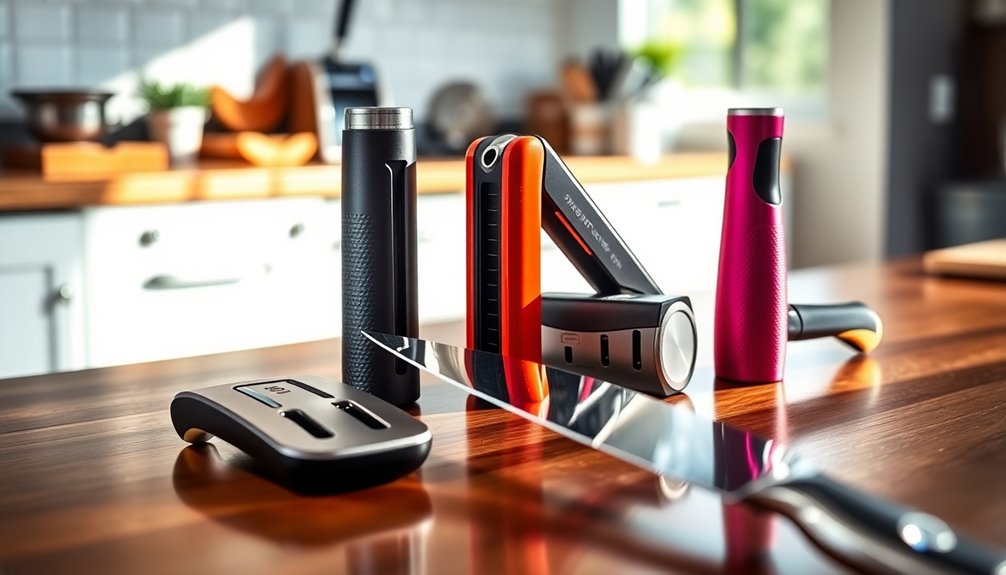

For most home cooks, I’d start with the Chef’sChoice 15XV EdgeSelect: its three-stage electric system is a practical pick for routine kitchen-knife sharpening, while the Work Sharp Precision Adjust Knife Sharpener Kit offers more hands-on angle control. For occasional touch-ups and travel, the Work Sharp Guided Field Sharpener is a compact alternative. The main tradeoff is convenience versus control: electric and pull-through sharpeners are quick, while guided and rolling systems give you more say over the edge but ask for slower setup and technique. Knife sharpeners also vary in their suitability for serrated blades, scissors, and different knife styles. Read on for how the 15 options compare and which one fits your knives and sharpening habits.
Complete the kit


Key Takeaways
- The roundup’s clearest split is convenience versus control: the amazon.com/dp/B0018RSEMU?tag=berkleyvallone-20&ascsubtag=dc-538034″ target=”_blank” rel=”nofollow sponsored noopener”>Chef’sChoice 15XV is designed for straightforward electric sharpening, while the Work Sharp Precision Adjust models give users more control over sharpening angles.
- Guided systems serve a different purpose from quick pull-through tools: the Precision Adjust Kit and Elite are better suited to deliberate edge work, but require more setup and attention than the AccuSharp or Amazon Basics 4-in-1.
- Compact does not mean kitchen-focused: the Work Sharp Guided Field Sharpener emphasizes portability and field touch-ups, making it a different choice from countertop electric models.
- Rolling sharpeners trade freehand skill for a guided motion: the TUMBLER, AIERLIAN, and BOGONI options use a rolling format, so buyers should compare their included discs and handling needs rather than assume the format fits every knife.
- Extra functions matter only when they match your tools: models such as the Croco Dial and Narcissus add support for serrated knives or scissors, while simpler sharpeners may be a better fit for buyers focused on standard kitchen blades.
| AccuSharp Knife Sharpener with Ergonomic Handle |  | Best for Fast Touch-Ups | Sharpening material: Diamond-honed tungsten carbide | Compatible knives: Chef’s, paring, serrated, filet knives, and cleavers | Sharpening time: Approximately 10 seconds | VIEW ON AMAZON | See Our Full Breakdown |
| Orange Ninja 4-Stage Manual Knife Sharpener |  | Best for Multi-Stage Manual Sharpening | Sharpening stages: 4 | Materials: ABS plastic, carbide, ceramic, and tungsten steel | Dimensions: 8.18 × 1.96 × 3.3 inches | VIEW ON AMAZON | See Our Full Breakdown |
| Work Sharp Precision Adjust Knife Sharpener Kit |  | Best for Angle Control | Angle range: 15–30 degrees | Angle adjustment: One-degree increments | Abrasives: 320-grit and 600-grit diamond; fine ceramic | VIEW ON AMAZON | See Our Full Breakdown |
| Chef’sChoice 15XV EdgeSelect Professional Electric Knife Sharpener, 3-Stage |  | Best Electric Pick | Sharpening stages: 3 | Abrasives: 100% diamond abrasives in stages one and two | Compatible blades: Straight-edge and serrated knives | VIEW ON AMAZON | See Our Full Breakdown |
| AIERLIAN Rolling Knife Sharpener Kit with Diamond and Ceramic Discs |  | Best Rolling Sharpener for Two Edge Angles | Abrasives: #400 diamond disc and #3000 ceramic disc | Sharpening angles: 15° and 20° | Base material: Natural wood | VIEW ON AMAZON | See Our Full Breakdown |
| Sharp Pebble Precision Adjust 3-Stage Knife Sharpener |  | Best for Adjustable Angles | Brand: Sharp Pebble | Type: Manual knife sharpener | Sharpening stages: 3 | VIEW ON AMAZON | See Our Full Breakdown |
| Work Sharp Guided Field Sharpener, Compact Travel Knife Sharpener Tool |  | Best Compact Field Sharpener | Brand: WORK SHARP | Model number: WSGFS221 | Angle range: 20–25° | VIEW ON AMAZON | See Our Full Breakdown |
| Croco Dial 5-in-1 Knife Sharpener for Straight and Serrated Knives |  | Best for Mixed Blade Types | Brand: Croco Dial | Sharpening system: 5-in-1 rotating sharpeners | Sharpening stages: 3 | VIEW ON AMAZON | See Our Full Breakdown |
| Narcissus QN-M866 2-Stage Electric Knife Sharpener with Scissors Slot and Dust Collection |  | Best Electric Kitchen Pick | Brand: Narcissus | Model number: QN-M866 | Power: 30 watts | VIEW ON AMAZON | See Our Full Breakdown |
| Amazon Basics 4-in-1 Kitchen Knife Sharpener with Nonslip Base and Safety Glove |  | Best for Straight-Edge Kitchen Basics | Knife sharpening stages: 3: coarse, medium, and fine | Scissor sharpening: Dedicated slot | Compatible blades: Straight-edge kitchen, pocket, and hunting knives | VIEW ON AMAZON | See Our Full Breakdown |
| TUMBLER Original Rolling Knife Sharpener with Wood Finish |  | Best Rolling Sharpener for Simple Angle Choice | VIEW ON AMAZON | See Our Full Breakdown | |||
| Work Sharp Ken Onion Elite Mk2 Electric Knife Sharpener | 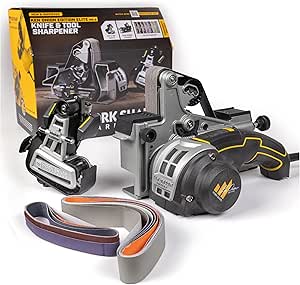 | Best for Versatile Powered Sharpening | VIEW ON AMAZON | See Our Full Breakdown | |||
| Work Sharp Precision Adjust Elite Knife Sharpener |  | Best Guided Manual System for Edge Control | VIEW ON AMAZON | See Our Full Breakdown | |||
| BOGONI Rolling Knife Sharpener with Diamond and Ceramic Discs |  | Best Rolling Pick for Sharpening and Polishing | VIEW ON AMAZON | See Our Full Breakdown | |||
| Kitchellence 3-Stage Kitchen Knife Sharpener with Cut-Resistant Glove |  | Best Simple Slot Sharpener for Everyday Kitchens | VIEW ON AMAZON | See Our Full Breakdown |
More Details on Our Top Picks
AccuSharp Knife Sharpener with Ergonomic Handle
The AccuSharp is the straightforward choice when a dull kitchen knife needs a quick edge without a multistage setup. Its diamond-honed tungsten carbide blades are designed to restore and hone a blade in about ten seconds, making it faster and simpler to operate than the four-slot Orange Ninja, which calls for several controlled pulls through its stages. The ambidextrous handle and full-length finger guard give the AccuSharp a practical safety advantage for quick handheld sharpening. It also works with straight and serrated knives, though it is not a flexible system for specialized edges or fine angle control. The tradeoff is that its sharpening blades eventually need replacement, and its rapid, simple approach offers less staged refinement than the Orange Ninja or the guided Work Sharp Precision Adjust.
Pros:- Restores and hones blades in approximately ten seconds
- Full-length finger guard and ambidextrous ergonomic handle
- Works with straight and serrated knives
- Reversible sharpening blades are designed for long service life
Cons:- Sharpening blades require periodic replacement
- Does not offer adjustable angles or multiple refinement stages
- Limited suitability for specialized blade types
Best for: Home cooks who want a compact, quick tool for occasional touch-ups on common straight-edge and serrated kitchen knives.
Not ideal for: Knife owners who need adjustable sharpening angles, fine control over edge refinement, or support for specialized blade types.
- Sharpening material:Diamond-honed tungsten carbide
- Compatible knives:Chef’s, paring, serrated, filet knives, and cleavers
- Sharpening time:Approximately 10 seconds
- Blade design:Reversible sharpening blades; double-beveled
- Handle:Ergonomic, ambidextrous design with full-length finger guard
- Maintenance:Dishwasher safe
- Blade service life:Designed for 5 to 10 years between replacements
- Color:White
Our verdict“Choose the AccuSharp for fast, uncomplicated touch-ups; choose the Work Sharp Precision Adjust when repeatable angle control matters more.”
Orange Ninja 4-Stage Manual Knife Sharpener
The Orange Ninja 4-Stage suits cooks who want separate slots for repair, sharpening, polishing, and serrated-blade work in one manual tool. That staged process gives it more room for edge refinement than the simpler AccuSharp, which prioritizes a fast pass over multiple steps. Its non-slip, ambidextrous handle also makes it usable from either hand, while the ABS body keeps the design suited to regular kitchen use. The tradeoff is pace: each knife needs several pulls, and the tool must be drawn through the slots rather than pushed back and forth. Unlike the Work Sharp Precision Adjust, it does not provide a stated adjustable angle or a clamp for securing a knife, so buyers seeking repeatable angle-specific sharpening should look elsewhere.
Pros:- Four slots cover repair, sharpening, polishing, and serrated-blade sharpening
- Non-slip handle accommodates left- and right-handed users
- Suitable for a range of kitchen and utility knives
- Compact manual design with an ABS plastic body
Cons:- Requires several manual strokes for sharpening
- Must be pulled through the slots rather than pushed back and forth
- Does not list adjustable sharpening angles or a knife clamp
Best for: Home cooks who want separate manual stages for repairing, sharpening, and polishing everyday straight and serrated knives.
Not ideal for: People who want a quick single-pass touch-up or precise angle adjustment and guided knife positioning.
- Sharpening stages:4
- Materials:ABS plastic, carbide, ceramic, and tungsten steel
- Dimensions:8.18 × 1.96 × 3.3 inches
- Weight:10.88 ounces
- Color:Black and orange
- Operation:Manual pull-through
- Included component:Four-stage manual knife sharpener
- Model:JVZ-2
Our verdict“Pick the Orange Ninja for staged manual sharpening in one tool, but choose the AccuSharp if speed matters more than refinement steps.”
Work Sharp Precision Adjust Knife Sharpener Kit
For buyers who care about setting and repeating a particular edge angle, the Work Sharp Precision Adjust is the most controlled option in this group. Its clamp holds the knife while the guided abrasive adjusts from 15 to 30 degrees in one-degree increments, a level of angle choice the Orange Ninja and AccuSharp do not offer. The kit pairs 320- and 600-grit diamond abrasives with a fine ceramic stone, letting the user move from more substantial sharpening to finer honing. That control comes at the cost of setup and hands-on effort: positioning the clamp and slide takes longer than using the Chef’sChoice electric model, and sharpening remains manual. I’d choose this for careful edge work, not for the fastest routine kitchen touch-up.
Pros:- Angle adjusts from 15 to 30 degrees in one-degree increments
- Knife clamp supports controlled, repeatable sharpening
- Includes coarse and fine diamond abrasives plus a fine ceramic stone
- Backed by a three-year warranty
Cons:- Manual sharpening requires time and physical effort
- Clamp and guided components take time to position
- Less convenient for quick routine touch-ups than the Chef’sChoice electric sharpener
Best for: Knife owners who want repeatable, adjustable angles and are willing to clamp and sharpen blades manually.
Not ideal for: Busy cooks who want electric convenience or a quick pull-through tool with minimal setup.
- Angle range:15–30 degrees
- Angle adjustment:One-degree increments
- Abrasives:320-grit and 600-grit diamond; fine ceramic
- Included components:Sharpening stones, adjustable chassis, benchtop base, knife clamp, sharpening slide rod, and user guide
- Warranty:3 years
- Model number:WSBCHPAJ
- Origin:Designed, engineered, and calibrated in Ashland, Oregon
Our verdict“Choose this kit for adjustable, guided edge work; choose the Chef’sChoice 15XV for quicker electric sharpening with less setup.”
Chef’sChoice 15XV EdgeSelect Professional Electric Knife Sharpener, 3-Stage
The Chef’sChoice 15XV is the convenience-led pick: it uses three electric stages to convert traditional 20-degree edges to a 15-degree Trizor XV edge, with diamond abrasives in the first two stages. Resharpening is listed at about ten seconds, making it a better fit for quick upkeep than the manually operated Work Sharp Precision Adjust, which offers more control but needs setup and repeated hand strokes. Flexible angle guides help keep the blade on course, and a dedicated polishing stage supports serrated knives. The main tradeoff is the edge conversion: this is not simply a tool for preserving a knife’s existing 20-degree geometry. First-time sharpening also takes about a minute, so I’d favor it for cooks comfortable with the 15-degree edge rather than owners seeking adjustable angles.
Pros:- Three-stage electric system sharpens and hones knives
- Diamond abrasives are used in stages one and two
- Flexible angle guides help control blade positioning
- Supports straight-edge and serrated knives
Cons:- Converts traditional 20-degree edges to a 15-degree edge
- First-time sharpening takes approximately one minute
- Does not offer the user-selected angle range of the Work Sharp Precision Adjust
Best for: Home cooks with straight-edge and serrated knives who want electric sharpening and are comfortable converting blades to a 15-degree edge.
Not ideal for: Knife owners who want to retain a 20-degree edge, set their own sharpening angle, or avoid an electric countertop unit.
- Sharpening stages:3
- Abrasives:100% diamond abrasives in stages one and two
- Compatible blades:Straight-edge and serrated knives
- Edge angle:15 degrees
- Sharpening time:Approximately 1 minute for first-time sharpening; 10 seconds for resharpening
- Dimensions:10 × 4.25 × 4.25 inches
- Warranty:3-year limited warranty
- Color:Gray
Our verdict“Choose the Chef’sChoice 15XV for quick electric sharpening if you want a 15-degree edge and do not need adjustable angle settings.”
AIERLIAN Rolling Knife Sharpener Kit with Diamond and Ceramic Discs
The AIERLIAN Rolling Knife Sharpener gives cooks a more deliberate, hands-on route than the AccuSharp: magnetic supports hold a knife at either 15° or 20° while diamond and ceramic discs sharpen and polish its edge. The included leather strop adds a final step for refining the edge and removing fine burrs. That makes this kit a better match for someone who wants to choose between two set angles and work through a sharpening routine, rather than make a quick pull-through pass. Its natural wood base and four N42 magnets provide the described support, but the angle choices are limited compared with the Work Sharp Precision Adjust’s one-degree adjustments. It also cannot sharpen serrated knives or scissors, so it is a focused choice for compatible straight-edge kitchen knives.
Pros:- Offers 15° and 20° sharpening angle options
- Pairs a #400 diamond disc with a #3000 ceramic disc
- Magnetic support uses four N42 magnets to hold the knife
- Includes a leather strop for edge refinement
Cons:- Not suitable for serrated knives or scissors
- Only offers two set sharpening angles
- Requires a deliberate rolling and finishing process rather than a quick pull-through
Best for: Home cooks with straight-edge kitchen knives who want a rolling system with two fixed angle choices and a polishing step.
Not ideal for: Owners of serrated knives or scissors, or anyone who wants fine-grained angle adjustment beyond 15° and 20°.
- Abrasives:#400 diamond disc and #3000 ceramic disc
- Sharpening angles:15° and 20°
- Base material:Natural wood
- Magnetic support:Four N42 magnets
- Included accessory:Leather strop
- Knife compatibility:Not suitable for serrated knives or scissors
Our verdict“Choose the AIERLIAN for hands-on sharpening of straight-edge kitchen knives at 15° or 20°, but skip it if you need serrated-blade support.”
Sharp Pebble Precision Adjust 3-Stage Knife Sharpener
The Sharp Pebble stands out for giving a handheld pull-through sharpener five angle choices: 12°, 15°, 18°, 21°, and 24°. That range lets buyers match the setting to different straight-edge kitchen, pocket, or hunting knives, rather than using one fixed angle. Its three-stage system adds more control than a basic single-slot sharpener, while the ergonomic ABS body is designed for a steady grip. Compared with the Amazon Basics 4-in-1, which adds a scissor slot and safety glove, this model prioritizes angle selection instead of extra accessories. The tradeoff is limited blade compatibility: it cannot sharpen serrated knives or scissors, and the supplied details do not specify the abrasive materials. It makes most sense for someone who wants adjustable settings without moving to a larger guided sharpening kit.
Pros:- Five selectable angles from 12° to 24°
- Three sharpening stages offer more than a single-slot touch-up
- Designed for straight-edge kitchen, pocket, and hunting knives
- Ergonomic ABS plastic body is made for handheld use
Cons:- Does not sharpen serrated knives or scissors
- Abrasive materials are not specified in the supplied product details
Best for: Home cooks and knife owners who want several angle settings for straight-edge kitchen, pocket, or hunting knives in a handheld format
Not ideal for: Owners of serrated knives or scissors, or buyers who want a sharpener with disclosed abrasive materials and broader blade compatibility
- Brand:Sharp Pebble
- Type:Manual knife sharpener
- Sharpening stages:3
- Adjustable angles:12°, 15°, 18°, 21°, 24°
- Material:ABS plastic
- Compatible blades:Straight-edge knives
- Not compatible with:Serrated knives or scissors
- Model number:4KS
Our verdict“Choose the Sharp Pebble if adjustable angles matter more to you than scissor sharpening or serrated-blade support.”
Work Sharp Guided Field Sharpener, Compact Travel Knife Sharpener Tool
This Work Sharp is the lineup’s most field-ready option: a self-contained compact system combines diamond plates, coarse and fine ceramic rods, a leather strop, and sharpening guides. Its five abrasive surfaces support more than a quick touch-up, while the 20–25° guides help keep the sharpening angle consistent without tools or setup. Compared with the angle-adjustable Sharp Pebble, it offers a broader mix of abrasive surfaces but a narrower stated angle range. It is also more involved than the simple Amazon Basics 4-in-1, which is aimed at convenient kitchen use rather than carrying a multi-surface kit outdoors. The tradeoff is that all those surfaces may be unnecessary for casual home sharpening, and the warranty excludes consumable abrasives. This is the better fit for hunters, campers, and knife owners who want maintenance options away from the kitchen.
Pros:- Compact, self-contained design requires no tools or assembly
- Five abrasive surfaces include diamond, ceramic, and leather strop options
- Guides support sharpening at a stated 20–25° angle
- Includes a three-year warranty, with workmanship coverage described as limited lifetime
Cons:- Multiple surfaces can be more involved than casual kitchen sharpening requires
- Warranty excludes consumable abrasives
- The stated angle range is less adjustable than the Sharp Pebble’s five settings
Best for: Hunters, campers, and outdoor knife owners who want a portable, self-contained sharpening and honing kit for field or home use
Not ideal for: Casual home users who want a simple pull-through sharpener, or buyers who expect warranty coverage for worn abrasive surfaces
- Brand:WORK SHARP
- Model number:WSGFS221
- Angle range:20–25°
- Abrasives:Diamond plates, coarse and fine ceramic rods, leather strop
- Abrasive surfaces:Five
- Guides:Sharpening guides included
- Setup:No tools or assembly required
- Warranty:Three-year warranty; limited lifetime workmanship coverage excludes abrasives
Our verdict“Pick this Work Sharp for portable, multi-surface knife maintenance; choose a simpler pull-through model for basic kitchen touch-ups.”
Croco Dial 5-in-1 Knife Sharpener for Straight and Serrated Knives
The Croco Dial earns its place through broad blade compatibility: its rotating tungsten carbide and ceramic sharpeners are described for straight knives, serrated knives, and scissors. That makes it a more flexible household choice than the Sharp Pebble or Amazon Basics 4-in-1, both of which exclude serrated knives. Its three-stage sequence is intended to restore, sharpen, and polish, and non-slip grip pads help steady the tool during use. The included pouch also gives it an advantage for storage or carrying. The tradeoff is that the supplied details do not state dimensions, weight, or sharpening angles, so buyers have less information about its footprint and control than they do with the guided Work Sharp field sharpener. Choose it when one tool needs to cover a varied household drawer, not when precise angle specifications are the priority.
Pros:- Compatible with straight-edge and serrated knives, plus scissors
- Three stages are designed for restoring, sharpening, and polishing
- Uses tungsten carbide and ceramic sharpening materials
- Non-slip grip pads and an included storage pouch add stability and convenient storage
Cons:- Sharpening angles are not provided in the supplied product details
- Dimensions and weight are not provided, making storage fit harder to judge
- The described multi-blade compatibility may matter less to buyers with only straight-edge knives
Best for: Households with a mix of straight-edge knives, serrated knives, and scissors that want one manual sharpener for several blade types
Not ideal for: Knife owners who need published angle settings, size details, or a guided system for more controlled edge work
- Brand:Croco Dial
- Sharpening system:5-in-1 rotating sharpeners
- Sharpening stages:3
- Sharpening materials:Tungsten carbide and ceramic
- Compatible blades:Straight-edge knives, serrated knives, and scissors
- Stability feature:Non-slip grip pads
- Included accessory:Storage pouch
Our verdict“Choose the Croco Dial if your household needs one sharpener for straight, serrated, and scissor blades rather than documented angle control.”
Narcissus QN-M866 2-Stage Electric Knife Sharpener with Scissors Slot and Dust Collection
The Narcissus is the batch’s clearest choice for buyers who want powered, quick pull-through sharpening rather than a handheld manual tool. Its two stages separate coarse sharpening from fine polishing, and a dedicated slot covers scissors—an accessory advantage over the Sharp Pebble and the Work Sharp Guided Field Sharpener, which are centered on knife edges. A magnetic dust collection box helps contain sharpening debris, while the 30-watt motor and 100–240V input suit kitchen use and international voltage ranges. That convenience comes with less manual control than the field Work Sharp’s guided abrasive surfaces, and the product information advises learning the technique before use. Buyers with high-end artisanal knives may prefer a more controlled approach. Choose this model for routine kitchen blades and scissors when speed matters more than portability or fine angle customization.
Pros:- Electric pull-through format supports quick sharpening and polishing
- Two stages separate coarse sharpening from fine polishing
- Dedicated slot sharpens scissors
- Magnetic dust collection box helps contain debris; input supports 100–240V
Cons:- Proper technique may require reading the instructions or watching a tutorial
- Electric sharpening may not suit owners of high-end artisanal knives
- Requires a power source, unlike the portable manual Work Sharp field sharpener
Best for: Busy home cooks who regularly maintain chef, slicing, or santoku knives and want electric sharpening plus a separate scissor slot
Not ideal for: Owners of high-end artisanal knives who want hands-on control, or people seeking a compact manual sharpener for outdoor use
- Brand:Narcissus
- Model number:QN-M866
- Power:30 watts
- Voltage:100–240V
- Stages:2: coarse sharpening and fine polishing
- Material:Stainless steel
- Included components:Adapter and knife sharpener
- Warranty and service:12-month replacement/refund; 24-month after-sales service
Our verdict“Choose the Narcissus for convenient powered maintenance of everyday kitchen knives and scissors, not for field carry or delicate artisanal edges.”
Amazon Basics 4-in-1 Kitchen Knife Sharpener with Nonslip Base and Safety Glove
The Amazon Basics sharpener focuses on practical kitchen upkeep: three knife stages move from coarse to medium to fine, while a separate slot is intended for scissors. Its nonslip silicone base helps keep the tool planted on the counter, and the included cut-resistant gloves add a safety accessory that the angle-adjustable Sharp Pebble does not list. Compared with the electric Narcissus, this is a manual option that does not depend on a motor or power connection; compared with the Croco Dial, however, it cannot handle serrated knives. Its stated blade range also includes straight-edge pocket and hunting knives, though the design is positioned for kitchen use. The tradeoff is straightforward: broad stage coverage and useful accessories, but limited blade types and no stated angle settings. It suits households that want a basic counter sharpener for conventional blades and scissors.
Pros:- Three knife stages cover coarse, medium, and fine sharpening
- Dedicated slot is included for scissors
- Nonslip silicone base supports counter stability
- Cut-resistant gloves are included
Cons:- Not suitable for serrated knives
- No adjustable angle settings are listed
- Counter-focused format is less suited to portable field maintenance than the Work Sharp Guided Field Sharpener
Best for: Home cooks who want a stable manual counter sharpener for straight-edge kitchen knives, with a scissor slot and included cut-resistant gloves
Not ideal for: Households that need to sharpen serrated knives, or knife owners seeking adjustable sharpening angles or field portability
- Knife sharpening stages:3: coarse, medium, and fine
- Scissor sharpening:Dedicated slot
- Compatible blades:Straight-edge kitchen, pocket, and hunting knives
- Serrated knives:Not suitable
- Base:Nonslip silicone
- Included accessory:Cut-resistant gloves
- Cleaning:Rinse or use soapy water
Our verdict“Choose this Amazon Basics model for straightforward straight-edge kitchen sharpening and scissor touch-ups, but skip it if serrated blades are in your drawer.”
TUMBLER Original Rolling Knife Sharpener with Wood Finish
The TUMBLER pairs a rolling diamond disc for sharpening with a stainless steel helix disc for honing, giving routine edge care two distinct steps. Its magnetic holder offers fixed 15° and 20° angles, so the user can choose between those settings without estimating an angle by hand. Compared with the BOGONI Rolling Knife Sharpener, this model uses a helix honing disc rather than a specified 3000-grit ceramic polishing disc, so the listed honing method differs even though both rely on rolling and magnetic positioning. The wood finish adds a countertop-friendly look, but the fixed settings limit its fit for knives designed around other angles. Buyers should also note that the product description does not spell out compatibility for every blade style. It suits straightforward maintenance better than broad repair work.
Pros:- Two fixed sharpening angles provide a simple choice without manual angle estimation.
- Magnetic holder helps keep the knife positioned during rolling.
- Diamond-plated sharpening disc is paired with a separate stainless steel helix honing disc.
- Designed for kitchen, utility, and specialty knives.
Cons:- Fixed angles do not accommodate knives that require a different edge angle.
- The description does not identify compatibility with every blade type.
- The listed details do not provide a grit rating or a specific sharpening method for different edge conditions.
Best for: Home cooks with kitchen, utility, or specialty knives suited to 15° or 20° edges who prefer a guided rolling setup.
Not ideal for: Knife owners whose blades need an angle outside 15° and 20°, or buyers seeking clearly stated compatibility across many blade types.
Our verdict“Choose the TUMBLER if your knives suit its two preset angles and you want a rolling sharpener with a separate honing disc.”
Work Sharp Ken Onion Elite Mk2 Electric Knife Sharpener
This is the lineup’s broadest powered option: its flexible abrasive belt and variable motor speed are intended for sharpening, honing, reprofiling, and repair. The angle range spans 10° to 35°, giving it more adjustment than the fixed-angle TUMBLER and BOGONI rolling sharpeners. Its stated uses also reach beyond kitchen knives to pocket and hunting blades, serrated knives, scissors, and garden tools. That versatility comes with a different level of control: a powered belt can remove more material than a manual tool used for light edge maintenance, so it may be excessive for someone who only wants occasional touch-ups. At 7 × 11.25 × 6.5 inches and 2.1 pounds, it is also a countertop machine rather than a compact drawer sharpener. The three-year warranty is a useful ownership detail, but does not change the learning and material-removal tradeoff.
Pros:- Adjustable 10°–35° sharpening angle accommodates a wide range of edge geometries.
- Variable motor speed offers more control than fixed-speed sharpening.
- Designed for kitchen, pocket, hunting, and serrated knives, plus scissors and garden tools.
- Flexible belt is described as sharpening and honing in one pass.
Cons:- Powered belt sharpening may remove more material than light honing tools.
- Larger and more involved than manual options such as the Kitchellence three-stage sharpener.
- The broad range of settings and uses may be unnecessary for buyers maintaining only standard kitchen knives.
Best for: Knife owners who regularly sharpen several blade types and want adjustable angles and motor speed for both maintenance and repair.
Not ideal for: Cooks seeking a small, simple tool for occasional touch-ups or users uncomfortable with powered belt sharpening and its potential to remove more material.
Our verdict“Pick the Ken Onion Elite Mk2 for varied blades and adjustable powered work, not for occasional, low-effort touch-ups.”
Work Sharp Precision Adjust Elite Knife Sharpener
The Precision Adjust Elite takes a more methodical route than the rolling TUMBLER: it uses a guided manual system with an adjustable 15°–30° range and a kit of abrasives for shaping and finishing. Coarse and fine diamond plates handle sharpening stages, while ceramic tools and a leather strop support finishing; the included serrated rod and curved-blade attachment extend its reach beyond straight kitchen edges. That makes it a better fit than the Kitchellence slot sharpener for owners who want to set an angle and work through specific stages, rather than rely on preset slots. The tradeoff is time and setup: the knife must be clamped, then sharpened manually, so this is not the quickest option for a routine kitchen touch-up. Its 14.5-inch length also calls for more storage room than a compact handheld tool.
Pros:- Adjustable 15°–30° angles support a range of kitchen, hunting, and pocket knives.
- Includes 320- and 600-grit diamond plates, a ceramic finishing rod, and a leather strop.
- Serrated rod and curved-blade attachment add capability beyond straight edges.
- Guided setup helps users maintain a consistent sharpening angle.
Cons:- Requires manual clamping and sharpening, making it slower than powered options.
- The 14.5-inch length takes more storage space than a handheld sharpener.
- The number of included components may be more involved than needed for basic kitchen edge upkeep.
Best for: Detail-oriented cooks and knife owners who want adjustable guided sharpening, multiple abrasive stages, and tools for serrated or curved blades.
Not ideal for: People who want a fast, simple slot sharpener or who do not want to clamp and manually sharpen each knife.
Our verdict“Choose the Precision Adjust Elite if you value guided angle control and blade-specific tools more than speed and simplicity.”
BOGONI Rolling Knife Sharpener with Diamond and Ceramic Discs
BOGONI makes its rolling process easy to understand by assigning a specific job to each disc: a 400-grit diamond disc reshapes the edge, while a 3000-grit ceramic disc polishes it. Its magnetic guides set the knife at 15° or 20°, and six built-in N52 magnets help hold the blade in position. Compared with the TUMBLER, which pairs diamond sharpening with a stainless steel helix honing disc, BOGONI states both abrasive grades and frames the second disc as a polishing step. That gives buyers clearer information about the two-stage process, though both models share the limitation of fixed angles. Natural wood construction gives it a different look from the Work Sharp Precision Adjust Elite, but this rolling format is less adjustable and less suited to a user seeking a broad range of edge angles.
Pros:- 400-grit diamond disc and 3000-grit ceramic disc provide distinct reshaping and polishing stages.
- Preset 15° and 20° guides support repeatable positioning.
- Six built-in N52 magnets help hold the knife in place.
- Natural wood construction and stated compatibility with most kitchen and outdoor knives.
Cons:- Limited to two preset sharpening angles.
- The product details do not specify compatible blade sizes or individual knife types.
- Offers less angle flexibility than the Work Sharp Precision Adjust Elite.
Best for: Home cooks and outdoor-knife owners who want a rolling system with separate, clearly specified reshaping and polishing discs at two preset angles.
Not ideal for: Owners of knives requiring angles other than 15° or 20°, or buyers who need detailed compatibility guidance for particular blade sizes and types.
Our verdict“Choose BOGONI if you want a rolling sharpener with clearly graded diamond and ceramic discs and your knives fit its preset angles.”
Kitchellence 3-Stage Kitchen Knife Sharpener with Cut-Resistant Glove
Kitchellence is the most direct option here for someone who wants a three-slot manual routine rather than a rolling system, clamp, or motor. Its stages are described as repairing and straightening blades, sharpening, then polishing the edge; an ergonomic handle and non-slip base support a stable countertop grip, and the included cut-resistant glove adds a safety accessory. Compared with the guided Work Sharp Precision Adjust Elite, this is simpler to operate but offers no stated angle adjustment or specialized attachments for curved and serrated blades. It is aimed at kitchen knives, not buyers who need control over edge geometry or a tool for many blade categories. The product data also omits the materials used in its sharpening components, so buyers have less detail about the abrasive surfaces than with the diamond-and-ceramic BOGONI roller.
Pros:- Three stages cover blade repair or straightening, sharpening, and polishing.
- Non-slip base supports stability during manual use.
- Ergonomic handle is designed for left- or right-handed use.
- Includes a cut-resistant glove.
Cons:- No adjustable sharpening angle is specified.
- The sharpening component materials and grit details are not provided.
- Less adaptable to specialized blades than the Work Sharp Precision Adjust Elite.
Best for: Home cooks who want a straightforward countertop sharpener for routine kitchen-knife upkeep and value a nonslip base and included glove.
Not ideal for: Knife enthusiasts who need adjustable angles, detailed abrasive specifications, or dedicated tools for serrated and curved blades.
Our verdict“Pick Kitchellence for uncomplicated kitchen-knife maintenance, but choose a guided system if angle control or specialty-blade tools matter.”

How We Picked
I compared the 15 knife sharpeners by the jobs they are built to do, rather than treating electric, manual, guided, rolling, and field models as interchangeable. The main criteria were sharpening control, ease of use, intended knife compatibility, useful features, portability, and the amount of setup or upkeep a buyer can expect. I also looked at how each design handles common needs such as routine kitchen touch-ups, angle consistency, serrated blades, scissors, and sharpening away from home.
The ranking favors options that make a clear, broadly useful case for their intended buyer, with control and practical usability weighed alongside convenience. That puts the Chef’sChoice 15XV in the overall lead for buyers who want an electric kitchen option, while the Work Sharp Precision Adjust Kit stands out for users who prefer guided angle control. More specialized products rank for narrower needs, such as travel, rolling sharpening, or added tool compatibility; they may suit those buyers better, but their narrower fit keeps them from being universal picks.
Factors to Consider When Choosing Knife Sharpeners
Before choosing a sharpener, I’d start with your knives and habits—not the number of stages or extra slots on the product. A tool that feels simple for standard kitchen knives may not suit a delicate edge, a serrated blade, or a knife you carry outdoors. These broader tradeoffs can help you narrow the options.
Match the sharpening style to your patience
Electric sharpeners reduce the work involved and can make routine kitchen maintenance more approachable, but they also give you less hands-on control over each pass. Pull-through models are similarly direct, though their fixed guides and abrasive layout may limit how much you can adjust the sharpening process. Guided systems take more setup, yet they can help users work at a chosen angle and make deliberate edge repairs. Rolling sharpeners simplify the motion, but still call for steady handling and a suitable surface. A common mistake is buying the fastest format when the real priority is controlling how much material comes off the blade.
Check blade compatibility before focusing on stages
Sharpeners are not automatically suitable for every blade just because the packaging lists several functions. Standard straight-edged kitchen knives are the broadest use case, while serrated edges, scissors, and unusual blade shapes need closer attention to the tool’s design. A slot intended for scissors does not tell you how well the sharpener handles every pair, and a serrated function may not suit every tooth pattern. Check the manufacturer’s compatibility details for your specific knives before buying. If your collection is mostly ordinary straight-edged kitchen knives, paying for functions you will rarely use may not improve your sharpening routine.
Think about edge condition, not only touch-up frequency
A knife that has gradually lost sharpness needs a different approach from one that is damaged or has a visibly uneven edge. Some sharpeners are better suited to basic maintenance, while guided systems may offer more control for users willing to work carefully on edge geometry. Do not assume a multi-stage sharpener will repair every kind of damage or that repeated quick passes are harmless. For a minor loss of bite, a conservative touch-up may be enough; for a badly damaged blade, professional service or a more controlled repair method may make better sense. Matching the tool to the condition of the blade helps avoid unnecessary sharpening.
Budget for control, setup, and upkeep—not just the tool
A lower-complexity sharpener can be a sensible choice if you want occasional maintenance with little setup, while more adjustable systems ask for time and practice in exchange for greater control. Consider what replacement or cleaning tasks the design may involve, and check the maker’s instructions before using abrasives or removable parts. Dust collection, a nonslip base, or a safety glove can improve the handling experience, but none replaces careful technique. Buyers sometimes pay for precision features they do not plan to use, or choose a bare-bones tool and later find it lacks the control they wanted. The right balance depends on how often you sharpen and how much process you want to manage.
Choose for where sharpening happens
A countertop electric unit makes the most sense when sharpening stays in the kitchen and access to power is convenient. A compact field sharpener is easier to pack for outdoor use, but its size and format may be less comfortable for a full set of kitchen knives. Rolling kits need a stable surface and enough room for their motion, which can matter in a small kitchen. Storage also affects whether a tool gets used: bulky equipment can become a nuisance if it has no dedicated place. Decide where you will sharpen before choosing a format, especially if you want one tool for both home and travel.
Frequently Asked Questions
Is an electric sharpener a good choice for my everyday kitchen knives?
It can be a good fit if you value speed and want a repeatable process for standard kitchen knives. A model such as the Chef’sChoice 15XV is aimed at that kind of routine use, while guided systems offer more control for buyers who want to manage the angle themselves. Check the maker’s guidance for your blade type and sharpening frequency before using any electric unit. If your knives have unusual edges or need careful repair, a more controlled method may suit them better. Convenience is useful, but it should not override compatibility.
Should I choose a guided sharpener or a rolling sharpener?
Choose a guided sharpener if angle control and deliberate edge work matter more to you than quick setup. A rolling sharpener uses a guided motion that may feel more intuitive, but it still requires steady handling and a suitable surface. Guided systems tend to involve more components and steps, while rolling kits depend on the included abrasive discs and the way they fit your needs. Neither format is automatically easier for every user. Think about whether you prefer adjusting and following a set process or keeping the movement simple.
Can one sharpener handle both straight and serrated knives?
Some models advertise support for both, but that does not mean one sharpening slot works equally well for every blade. Serrations vary, and sharpening them usually calls for a method suited to their individual shape rather than the same approach used on a straight edge. Check the product instructions for the serrated knives you own before using the feature. If most of your knives are straight-edged, a specialized serrated function may not be worth prioritizing. If serrated blades are a regular part of your kitchen, make compatibility a deciding factor.
Is a compact field sharpener enough for kitchen use?
A compact field model can handle maintenance when portability is your main concern, and it may also serve for occasional touch-ups at home. It is not automatically the most comfortable choice for sharpening several kitchen knives in one session. Countertop formats generally offer a more settled working position, while guided or rolling tools can provide a more deliberate process. Consider the number and size of the knives you sharpen, along with where you will store the tool. For a kitchen-first routine, a field sharpener may work as a supplement rather than a single all-purpose solution.
When should I choose a more adjustable sharpener instead of a simple pull-through?
More adjustability makes sense if you want control over sharpening angles, expect to work on different knives, or are willing to learn a slower process. A simple pull-through is easier to reach for when you need uncomplicated maintenance on compatible blades. The extra control of a guided system does not remove the need to follow instructions, and it can feel like unnecessary work for someone who sharpens only occasionally. Consider whether you will use its adjustments often enough to justify the added setup. If not, a simpler design may fit your routine better.
Conclusion
For an all-around kitchen choice, I’d pick the Chef’sChoice 15XV for buyers who want electric convenience. If value means a straightforward tool with broad everyday appeal, compare the Amazon Basics 4-in-1 and AccuSharp with your blade types and preferred handling; neither should be mistaken for a precision-guided system. Beginners who want guided angle control should look at the Work Sharp Precision Adjust Kit, while a more feature-focused buyer may prefer the Precision Adjust Elite. For a premium electric format, the Work Sharp Ken Onion Elite Mk2 is the specialist choice in this lineup. Outdoor users should favor the Guided Field Sharpener, and buyers interested in rolling systems can compare the TUMBLER, AIERLIAN, and BOGONI by their included discs and setup. Choose based on your knives, desired level of control, and where you plan to sharpen—not simply how many functions a sharpener lists.