The Saris M2 is my best overall pick among these indoor bike trainers because its smart electromagnetic resistance offers a more connected workout than basic magnetic stands. For direct smart-trainer features, the ThinkRider X2Max is a standout, while the Sportneer Fluid Bike Trainer suits riders who want progressive resistance without choosing a smart model. The main tradeoffs are smart control versus simplicity, fluid versus magnetic resistance, and workout features versus easy storage. Compatibility, tire setup, and noise also vary enough to affect daily use. Read on for a full breakdown of all 13 options and guidance on choosing the right fit.

Get furniture and decor delivered free with Prime
- Fast, free delivery on millions of items
- Prime Video, Amazon Music and more included
- Member-only deals all year
Complete the kit


Key Takeaways
- The Saris M2 and ThinkRider X2Max stand apart from basic stands by offering smart-trainer functionality, making them better suited to connected training than entry-level magnetic models.
- Fluid trainers emphasize progressive resistance: the two Sportneer and CXWXC fluid options are worth comparing if you want resistance that responds to pedaling rather than manually selected magnetic settings.
- Most of the lineup uses a wheel-on stand, so correct wheel size, axle fit, tire type, and roller contact matter; confirm compatibility before choosing based on resistance alone.
- Portability and riding stability can pull in opposite directions: foldable models such as the VEVOR and Alpcour are convenient to store, while Garmin’s Antares rollers demand more balance and rider attention.
- Basic magnetic trainers are the straightforward value-oriented group, but several similar stands differ little in their listed purpose, so frame fit, resistance controls, and included setup parts should guide the final choice.
| BalanceFrom Bike Trainer Stand – Steel Magnetic Bicycle Exercise Stand with Front Wheel Riser | 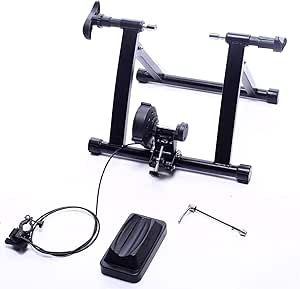 | Best for a Stable, Straightforward Ride | Resistance mechanism: Magnetic | Resistance settings: 8 | Wheel compatibility: 26–28 inches, including 700C | VIEW ON AMAZON | See Our Full Breakdown |
| Sportneer Magnetic Indoor Bike Trainer for 26–28-Inch and 700C Wheels |  | Best Value for a Practical Setup | Model: TY-JS007-C | Resistance mechanism: Magnetic | Resistance levels: 6 | VIEW ON AMAZON | See Our Full Breakdown |
| Garmin TacX Antares Indoor Retractable Bicycle Rollers 62 cm |  | Best for Balance and Riding Skills | Model: Antares T1000 | Roller diameter: 3.93–4.33 in (100–110 mm) | Wheel compatibility: 26–29 inches | VIEW ON AMAZON | See Our Full Breakdown |
| Saris M2 Smart Indoor Electromagnetic Bike Trainer |  | Best for Connected App Workouts | Model: M2 Smart Trainer | Resistance mechanism: Electronic | Accuracy: ±5% | VIEW ON AMAZON | See Our Full Breakdown |
| FDW Magnetic Bike Trainer Stand for Indoor Riding |  | Best Compact Folding Pick | Model: FDW-M8 | Resistance mechanism: Magnetic | Resistance settings: 5 | VIEW ON AMAZON | See Our Full Breakdown |
| FDW Magnetic Bike Trainer Stand with 5 Resistance Levels |  | Best for Simple, Compact Training | Resistance mechanism: Magnetic | Resistance levels: 5 | Listed wheel size: 26 inches | VIEW ON AMAZON | See Our Full Breakdown |
| Yaheetech Magnetic Bike Trainer Stand for Indoor Riding |  | Best for Quick-Release Bike Compatibility | Model: YT-165 | Resistance mechanism: Magnetic | Compatible wheel sizes: 26–28 inches and 700C | VIEW ON AMAZON | See Our Full Breakdown |
| CXWXC Fluid Bike Trainer Stand for 26–29-Inch or 700c Wheels |  | Best for App-Linked Training | Resistance mechanism: Fluid | Compatible wheel sizes: 26–29 inches and 700c | Connectivity: Bluetooth BLE 4.0 and ANT+ | VIEW ON AMAZON | See Our Full Breakdown |
| Sportneer Fluid Bike Trainer for 26-29″ and 700C Wheels – Auto Resistance, Noise-Reduction |  | Best for Smooth Fluid Resistance | Model: F1 | Wheel compatibility: 26–29 inches and 700C | Resistance mechanism: Fluid | VIEW ON AMAZON | See Our Full Breakdown |
| VEVOR Foldable Magnetic Bike Trainer with 6 Resistance Levels |  | Best Value for Broad Wheel Fit | Resistance mechanism: Magnetic | Resistance levels: 6 | Compatible wheel sizes: 26–29 inches and 700C | VIEW ON AMAZON | See Our Full Breakdown |
| Alpcour Bike Trainer Stand – Portable Foldable Magnetic Stainless Steel Indoor Trainer with Noise Reduction, 6 Resistance Settings and Carry Bag |  | Best for Portable Storage | Resistance mechanism: Magnetic | Resistance settings: 6 | Wheel compatibility: 26–28 inches and 700c; up to 29 inches | VIEW ON AMAZON | See Our Full Breakdown |
| ThinkRider X2Max Smart Bike Trainer |  | Best for Connected Training | Resistance mechanism: Electromagnetic | Power output: Up to 2000 W | Power accuracy: ±2% | VIEW ON AMAZON | See Our Full Breakdown |
| Magnetic Indoor Bike Trainer Stand |  | Best for Higher Load Capacity | Trainer type: Magnetic indoor bike trainer | Wheel compatibility: 26–29 inches, including 700c | Maximum load: 330 pounds | VIEW ON AMAZON | See Our Full Breakdown |
| indoor bike trainer | Resistance mechanism | Load capacity | Weight | Dimensions |
|---|---|---|---|---|
| BalanceFrom Bike Trainer Stand | Magnetic | 330 lb | 8 kg | 22 × 22 × 15.5 in |
| Sportneer Magnetic Indoor Bike | Magnetic | 300 lb | 19.3 lb | 22 × 22 × 15.5 in |
| Garmin TacX Antares Indoor Ret | — | — | 18.7 lb | — |
| Saris M2 Smart Indoor Electrom | Electronic | 300 lb | 20 lb | 22 × 20 × 9 in |
| FDW Magnetic Bike Trainer Stan | Magnetic | — | 17.6 lb | — |
| FDW Magnetic Bike Trainer Stan | Magnetic | 300 pounds | — | 19.6 × 17.7 × 21.6 inches |
| Yaheetech Magnetic Bike Traine | Magnetic | 265 pounds | 13.8 pounds | 23.8 × 21.5 × 14.8 inches |
| CXWXC Fluid Bike Trainer Stand | Fluid | 330 pounds | — | — |
| Sportneer Fluid Bike Trainer f | Fluid | 300 pounds | 24.3 pounds | 24 × 7.9 × 25.2 inches |
| VEVOR Foldable Magnetic Bike T | Magnetic | 330 pounds (150 kg) | 17.3 pounds | 23.23 × 21.85 × 16.14 inches |
| Alpcour Bike Trainer Stand | Magnetic | 250 pounds | 9.34 kg | 21.5 × 19 × 16.5 inches |
| ThinkRider X2Max Smart Bike Tr | Electromagnetic | 240 pounds | — | — |
| Magnetic Indoor Bike Trainer S | — | — | — | — |
More Details on Our Top Picks
BalanceFrom Bike Trainer Stand – Steel Magnetic Bicycle Exercise Stand with Front Wheel Riser
The BalanceFrom suits riders who want a firm-feeling wheel-on magnetic trainer without app setup or electronic controls. Its wide steel base and included front wheel riser help keep the bike supported, while the handlebar dial gives access to eight resistance levels—more adjustments than the Sportneer’s six. A quick-release clamp also makes taking the bike on and off less involved than setups that need repeated adjustments.
The tradeoff is weight: at 8 kg, this is a less convenient choice to move or store than its folding design might suggest. Like other wheel-on magnetic trainers, it can be noisy with knobby tires, so road tires are a better match for shared living spaces. Choose it over the FDW if you value more resistance settings and a wider stated load capacity; skip it if portability is your priority.
Pros:- Wide alloy-steel base and rubber feet support a steady setup.
- Eight magnetic resistance levels provide more adjustment steps than the Sportneer’s six.
- Quick-release clamp speeds up mounting and removing the bike.
- Includes a front wheel riser and supports a stated load of up to 330 pounds.
Cons:- At 8 kg, it is cumbersome to carry compared with lighter equipment.
- Rough or knobby tires can produce noticeable operating noise.
- Manual magnetic resistance does not provide app-connected workout control.
Best for: Road and mountain-bike owners seeking a stable, manually controlled trainer with several resistance steps for regular indoor workouts.
Not ideal for: Riders who need a lightweight, frequently moved trainer or who plan to use rough-tread tires in a noise-sensitive home.
- Resistance mechanism:Magnetic
- Resistance settings:8
- Wheel compatibility:26–28 inches, including 700C
- Bike compatibility:Road and mountain bikes
- Load capacity:330 lb
- Frame material:Alloy steel
- Weight:8 kg
- Dimensions:22 × 22 × 15.5 in
Our verdict“Choose the BalanceFrom for a stable, no-app trainer with eight resistance settings, but look elsewhere if easy carrying matters most.”
Sportneer Magnetic Indoor Bike Trainer for 26–28-Inch and 700C Wheels
The Sportneer is a sensible pick for riders who want the basics of a wheel-on magnetic trainer supplied in one package. It includes a handlebar resistance remote, front wheel block and quick-release skewer, so common setup pieces are already accounted for. Its six resistance levels offer less fine adjustment than the BalanceFrom’s eight, but the handlebar control lets a rider change effort without stopping to reach the trainer.
The wide base and adjustable anti-slip feet support indoor use, and the stand fits common road and mountain bike wheel sizes. Its main limitation is compatibility at the rear axle: bikes with thru axles need a separately chosen version and adapter. Tire tread also affects noise, so slick tires are the safer choice indoors. I’d favor this over the Garmin TacX Antares for controlled resistance workouts, but choose the rollers if you want an unpowered balance and handling challenge.
Pros:- Handlebar remote adjusts among six magnetic resistance levels.
- Includes a quick-release skewer and front wheel block.
- Adjustable anti-slip feet and a wide base support a stable setup.
- Fits common 26–28-inch and 700C road and mountain bike wheels.
Cons:- Thru-axle bikes require a separately selected version and adapter.
- Noise varies with tire tread and material; slick tires are recommended.
- Six resistance levels provide fewer adjustment steps than the BalanceFrom.
Best for: Road-bike owners who want a conventional trainer with a handlebar remote and included setup accessories for recurring indoor rides.
Not ideal for: Thru-axle bike owners who have not confirmed the correct stand version and adapter, or riders prioritizing quiet use with knobby tires.
- Model:TY-JS007-C
- Resistance mechanism:Magnetic
- Resistance levels:6
- Compatible wheel sizes:26–28 inches and 700C
- Rear axle width compatibility:4.92–6.57 inches
- Load capacity:300 lb
- Weight:19.3 lb
- Dimensions:22 × 22 × 15.5 in
- Included components:Trainer stand, resistance remote, front wheel block and skewer
Our verdict“Pick the Sportneer for a practical magnetic setup with included accessories, provided your rear axle is compatible and your tire choice suits indoor use.”
Garmin TacX Antares Indoor Retractable Bicycle Rollers 62 cm
The Garmin TacX Antares differs from the wheel-on stands here: free-rolling rollers ask the rider to balance the bike rather than clamp its rear wheel in place. That makes them a better fit for experienced cyclists who want to work on smooth pedaling and bike control, not simply hold a set effort. The tapered rollers help keep the wheels centered, and the system needs no power, unlike the app-connected Saris M2.
That freedom also raises the learning curve. Riders who want fixed support for a steady workout may find the BalanceFrom or Sportneer easier to manage, especially when starting or stopping. The Antares folds to a compact storage shape and fits 26–29-inch wheels, but at 18.7 pounds it is not especially light to carry. Choose it for balance practice and simple, unpowered operation; skip it if you want remote-controlled resistance or a securely held bike.
Pros:- Tapered rollers help guide wheels toward the center.
- Requires no power for operation.
- Fits bikes with 26–29-inch wheels.
- Folds down for more compact storage.
Cons:- Riding requires balance and control rather than a fixed bike mount.
- Does not provide the controlled resistance levels of the BalanceFrom or Sportneer.
- At 18.7 lb, it is relatively heavy to carry.
Best for: Experienced road cyclists seeking indoor balance practice and smooth-pedaling drills on an unpowered roller system.
Not ideal for: New indoor riders who want the bike held in place, or app-focused cyclists seeking electronic resistance control.
- Model:Antares T1000
- Roller diameter:3.93–4.33 in (100–110 mm)
- Wheel compatibility:26–29 inches
- Maximum footprint:53 × 18.5 in
- Folded dimensions:31.5 × 18.5 × 5.3 in
- Weight:18.7 lb
- Frame material:Metal
- Power requirement:No power required
Our verdict“Choose the Antares if balance and handling drills matter more than fixed-wheel stability or app-controlled resistance.”
Saris M2 Smart Indoor Electromagnetic Bike Trainer
The Saris M2 is the clearest choice here for riders who want app-connected training rather than a manually adjusted magnetic stand. ANT+ FE-C and Bluetooth connectivity support cycling apps such as Zwift, while electromagnetic resistance makes it suited to structured sessions. It remains a wheel-on trainer, so the rear wheel stays on the bike; compared with the Garmin TacX Antares rollers, the bike is held in place rather than balanced freely.
That convenience comes with limits. The listed accuracy is ±5%, and the stated noise level is 69 dB at 20 mph, so it is not a silent indoor option. Its electronic features also make it a more specialized choice than the simpler BalanceFrom, which suits riders who only need manual resistance. I’d choose the M2 for virtual rides and app-led workouts, but skip it if you want a basic trainer without connectivity or care most about low noise.
Pros:- ANT+ FE-C and Bluetooth connect with indoor cycling apps, including Zwift.
- Wheel-on design avoids removing the rear wheel.
- Electronic resistance supports app-led workouts.
- Includes a quick-release skewer and a one-month Rouvy subscription.
Cons:- Listed accuracy is ±5%.
- Produces a stated 69 dB at 20 mph.
- App connectivity offers little benefit to riders who prefer manual workouts.
Best for: Cyclists who plan to train with compatible apps such as Zwift and want electronic resistance while keeping the bike’s rear wheel installed.
Not ideal for: Riders seeking a quiet, basic manual trainer, or those who need tighter stated accuracy than ±5%.
- Model:M2 Smart Trainer
- Resistance mechanism:Electronic
- Accuracy:±5%
- Connectivity:ANT+ FE-C and Bluetooth
- Noise level:69 dB at 20 mph
- Wheel size:29 inches
- Load capacity:300 lb
- Weight:20 lb
- Dimensions:22 × 20 × 9 in
Our verdict“Choose the Saris M2 for app-connected indoor sessions without removing the rear wheel, but not if noise or basic simplicity is your priority.”
FDW Magnetic Bike Trainer Stand for Indoor Riding
The FDW makes sense for riders who need a foldable magnetic stand that can be put away between workouts. It supports road and mountain bikes and offers five resistance settings, giving casual riders a basic way to vary effort without the Saris M2’s app connections or electronic resistance. The stated noise figure—below 60 dB at the first setting—may appeal to indoor riders, though that figure applies only to the lowest resistance level.
Compared with the BalanceFrom, the FDW has fewer resistance steps and a lower stated load limit, but it is described as folding for storage and transport. Noise may rise at higher resistance, and the 90-day warranty is shorter than the Sportneer’s one-year coverage. This is a practical pick for occasional rides where storage matters more than fine control or connected training; it is not a standalone exercise bike, since you need your own bicycle.
Pros:- Foldable design helps with storage and transport.
- Five magnetic resistance settings provide basic effort adjustment.
- Fits road and mountain bikes within its stated wheel-size range.
- Supports a stated maximum weight of 300 pounds.
Cons:- Noise may increase above the first resistance setting.
- Five settings offer fewer adjustments than the BalanceFrom’s eight.
- The stated 90-day warranty is shorter than the Sportneer’s one year.
Best for: Apartment or home cyclists who have their own compatible bike and need a folding trainer to store after occasional workouts.
Not ideal for: Riders wanting app-based training, many resistance adjustments, or a longer stated warranty.
- Model:FDW-M8
- Resistance mechanism:Magnetic
- Resistance settings:5
- Compatible wheel sizes:66 cm to 700C (69 cm)
- Bike compatibility:Road and mountain bikes
- Maximum supported weight:300 lb
- Material:Carbon steel
- Weight:17.6 lb
- Warranty:90 days
Our verdict“Choose the FDW if folding storage and simple resistance matter more than extensive adjustment, app features or longer warranty coverage.”
FDW Magnetic Bike Trainer Stand with 5 Resistance Levels
The FDW suits riders who want a straightforward magnetic trainer they can fold away after a session. Its five resistance levels provide basic effort changes without app connectivity or a more involved setup. Compared with the VEVOR Foldable Magnetic Bike Trainer, it has one fewer level and a lower stated weight capacity, but its compact foldable design and roughly 15-minute assembly make it a practical option for occasional indoor rides. The listing specifies a 26-inch wheel, so buyers should verify fit rather than assume it accommodates the broader range supported by the VEVOR or Yaheetech Magnetic Bike Trainer Stand. Noise is stated as below 60 decibels at the first level, though it may rise with resistance. Its short 90-day warranty is another tradeoff.
Pros:- Five magnetic resistance levels offer basic control over workout effort.
- Folds for storage or carrying between rides.
- Carbon steel frame has a stated 300-pound load capacity.
- Assembly is described as taking about 15 minutes.
Cons:- Listed wheel compatibility is limited to 26 inches.
- Noise may increase at higher resistance levels.
- The 90-day warranty is relatively short.
Best for: Riders with a compatible 26-inch-wheel bicycle who want a foldable, uncomplicated trainer for occasional indoor sessions.
Not ideal for: Owners of 700C, larger-wheel, or thru-axle bikes, and riders seeking app-linked training or a long warranty.
- Resistance mechanism:Magnetic
- Resistance levels:5
- Listed wheel size:26 inches
- Load capacity:300 pounds
- Frame material:Carbon steel
- Dimensions:19.6 × 17.7 × 21.6 inches
- Warranty:90 days
- Assembly time:About 15 minutes
Our verdict“Choose the FDW for simple, foldable training on a compatible 26-inch bike, but pick the VEVOR if you need broader wheel fit and another resistance level.”
Yaheetech Magnetic Bike Trainer Stand for Indoor Riding
The Yaheetech is a sensible pick for riders whose bikes use a rear quick-release axle and fall within its stated 26–28-inch or 700C wheel range. Its magnetic resistance keeps the design simple, while adjustable non-slip feet help level the stand on uneven floors. Shock-absorbing mounting fittings may also help limit vibration, a useful distinction from the more basic FDW Magnetic Bike Trainer Stand with 5 Resistance Levels. That said, the FDW lists a 300-pound capacity, compared with 265 pounds for this model. The Yaheetech also lacks app connectivity like the CXWXC Fluid Bike Trainer, and it requires a quick-release axle; thru-axle adapters are not included. Wheel friction can be noisy, so slick tires and carpet may suit it better than knobby tires on a hard floor.
Pros:- Fits several common wheel sizes, including 700C.
- Adjustable non-slip feet help stabilize the stand on uneven floors.
- Shock-absorbing mounting fittings can help reduce vibration.
- Relatively light at 13.8 pounds.
Cons:- Requires a rear quick-release axle; thru-axle adapters are not included.
- Wheel-to-trainer friction can create noise.
- Stated load capacity is 265 pounds, lower than the FDW and VEVOR models here.
Best for: Road-bike owners with 26–28-inch or 700C wheels and a rear quick-release axle who want a basic, levelable magnetic stand.
Not ideal for: Riders with thru-axle bikes who do not want to source an adapter, or those seeking app-connected workouts or a higher load capacity.
- Model:YT-165
- Resistance mechanism:Magnetic
- Compatible wheel sizes:26–28 inches and 700C
- Bike compatibility:Bikes with rear quick-release axles
- Load capacity:265 pounds
- Weight:13.8 pounds
- Material:Alloy steel
- Dimensions:23.8 × 21.5 × 14.8 inches
Our verdict“Choose the Yaheetech if your bike has a compatible quick-release axle and you value adjustable stability over app features or a higher load limit.”
CXWXC Fluid Bike Trainer Stand for 26–29-Inch or 700c Wheels
The CXWXC stands apart from the magnetic options in this group because it pairs fluid resistance with Bluetooth BLE 4.0 and ANT+ connectivity for apps including Zwift, Kinomap, Meilan, and TrainerRoad. That makes it a better fit for riders who want structured or app-guided sessions than the Yaheetech Magnetic Bike Trainer Stand, which offers a simpler, non-connected setup. Its wheel-on design keeps the rear wheel on the bike, and the included quick-release skewer helps with setup; however, thru-axle adapters are sold separately. The foldable iron frame has a stated 330-pound capacity, the highest listed among these five models, but tire choice affects noise: knobby tread can sound louder. Unlike the Sportneer F1, the supplied information does not give a trainer weight or resistance-setting count, so buyers should focus on connectivity and fit rather than assuming specific controls.
Pros:- Connects via Bluetooth BLE 4.0 and ANT+ to several named training apps.
- Fits a broad range of common wheel sizes.
- Foldable wheel-on design stores more easily than a fixed indoor bike.
- Stated 330-pound load capacity.
Cons:- Thru-axle adapter is sold separately.
- Knobby tire tread can increase operating noise.
- App compatibility does not by itself establish the specific resistance controls or training data available.
Best for: App-oriented cyclists with a compatible 26–29-inch or 700C bike who want a foldable wheel-on trainer for connected indoor sessions.
Not ideal for: Riders with thru-axle bikes who need an adapter included, or cyclists using knobby tires who need a quieter setup.
- Resistance mechanism:Fluid
- Compatible wheel sizes:26–29 inches and 700c
- Connectivity:Bluetooth BLE 4.0 and ANT+
- Compatible apps:Zwift, Kinomap, Meilan, TrainerRoad
- Load capacity:330 pounds
- Material:Iron
- Design:Foldable, wheel-on
- Included components:Bike trainer and quick-release skewer
Our verdict“Pick the CXWXC for connected app sessions and broad wheel fit, provided your bike’s axle works with the included skewer or you obtain the separate adapter.”
Sportneer Fluid Bike Trainer for 26-29″ and 700C Wheels – Auto Resistance, Noise-Reduction
The Sportneer F1 is the strongest fit here for riders who prioritize a fluid-resistance feel and a broad stated wheel range without needing app connectivity. Its fluid mechanism is presented as quiet and smooth, while a dual locking system and heavy-duty frame address stability. Compared with the app-connected CXWXC Fluid Bike Trainer, the Sportneer does not list Bluetooth, ANT+, or compatible apps; the CXWXC is the clearer choice for digital training. The F1 does list eight resistance settings, though that count may not satisfy cyclists seeking finer control. Its 24.3-pound weight can make carrying and repositioning less convenient than the 13.8-pound Yaheetech magnetic stand. The foldable design helps with storage, but buyers should weigh that portability benefit against the heft of the unit.
Pros:- Fluid resistance is described as smooth and quiet.
- Fits 26–29-inch and 700C wheels.
- Dual locking system supports a stable bike connection.
- Folds for storage and transport.
Cons:- At 24.3 pounds, it is heavier to move than the Yaheetech stand.
- No Bluetooth, ANT+, or training-app compatibility is listed.
- Eight resistance settings may offer limited adjustment for advanced training.
Best for: Road cyclists with 26–29-inch or 700C wheels who want a foldable fluid trainer and prioritize smooth, quiet riding over app connectivity.
Not ideal for: Riders who need app-linked workouts, frequent easy carrying, or more resistance adjustment than the listed eight settings provide.
- Model:F1
- Wheel compatibility:26–29 inches and 700C
- Resistance mechanism:Fluid
- Resistance settings:8
- Load capacity:300 pounds
- Frame material:Alloy steel
- Weight:24.3 pounds
- Dimensions:24 × 7.9 × 25.2 inches
Our verdict“Choose the Sportneer F1 for a stable, foldable fluid ride, but favor the CXWXC if app connectivity matters more than simple operation.”
VEVOR Foldable Magnetic Bike Trainer with 6 Resistance Levels
The VEVOR earns this spot through a practical combination of six magnetic resistance levels, broad wheel compatibility, and useful included setup pieces. It fits 26–29-inch and 700C wheels, while the front wheel riser block helps level the bike and the extended quick-release lever supports mounting. Compared with the FDW Magnetic Bike Trainer Stand with 5 Resistance Levels, it adds another resistance step, supports a higher stated load, and covers more wheel sizes. It is not the connected choice: the CXWXC Fluid Bike Trainer is better suited to riders who want app-linked sessions. VEVOR’s foldable carbon steel frame supports up to 330 pounds, but the trainer still requires a compatible bicycle, and its 17.3-pound weight may be less convenient to carry than the lighter Yaheetech. No warranty duration is supplied in the product data.
Pros:- Six resistance levels provide more adjustment than the five-level FDW.
- Fits 26–29-inch and 700C wheels.
- Includes a front wheel riser block and extended quick-release lever.
- Foldable carbon steel frame has a stated 330-pound capacity.
Cons:- Requires a compatible bicycle and axle setup.
- At 17.3 pounds, it is heavier than the Yaheetech stand.
- Product data does not specify warranty coverage or app connectivity.
Best for: Road-bike owners seeking a foldable magnetic trainer for 26–29-inch or 700C wheels, with useful setup accessories and a higher stated load capacity.
Not ideal for: Cyclists who want app connectivity, a trainer that works without their own bike, or a clearly specified warranty.
- Resistance mechanism:Magnetic
- Resistance levels:6
- Compatible wheel sizes:26–29 inches and 700C
- Load capacity:330 pounds (150 kg)
- Frame material:Q235 carbon steel
- Weight:17.3 pounds
- Dimensions:23.23 × 21.85 × 16.14 inches
- Included components:Bike trainer, extended quick-release lever, front wheel riser block, user manual
Our verdict“Choose the VEVOR for broad wheel fit, six magnetic levels, and included setup accessories; choose the CXWXC instead for app-connected training.”
Alpcour Bike Trainer Stand – Portable Foldable Magnetic Stainless Steel Indoor Trainer with Noise Reduction, 6 Resistance Settings and Carry Bag
The Alpcour stands out among basic magnetic trainers for riders who need to pack their setup away or take it on the road. Its folding frame and included carry bag make storage more manageable than a fixed indoor station, while six handlebar-controlled resistance levels let riders change effort without stopping. Compared with the ThinkRider X2Max, this is a simpler wheel-on trainer: it does not offer app connectivity or simulated climbs, but it avoids the need to buy a cassette or build a connected training setup. The stainless steel frame and stated 250-pound capacity support a stable-feeling setup, though its 9.34 kg weight makes carrying it less effortless than the folding design suggests. It fits common wheel sizes up to 29 inches, not larger wheels.
Pros:- Folds flat and includes a carry bag for storage and transport.
- Six resistance levels can be adjusted from the handlebars.
- Stainless steel frame and anti-slip pads support a stable setup.
- Tool-free assembly and quick-release lever simplify setup.
Cons:- At 9.34 kg, it may feel cumbersome to carry regularly.
- No ANT+ or BLE connectivity or cycling software support is specified.
- Wheel compatibility tops out at 29 inches.
Best for: Riders with a compatible road or mountain bike who want a foldable trainer they can store between sessions or transport with its carry bag.
Not ideal for: Cyclists seeking interactive app workouts, electronically controlled resistance, or a lightweight trainer for frequent carrying.
- Resistance mechanism:Magnetic
- Resistance settings:6
- Wheel compatibility:26–28 inches and 700c; up to 29 inches
- Load capacity:250 pounds
- Weight:9.34 kg
- Dimensions:21.5 × 19 × 16.5 inches
- Frame material:Stainless steel
- Model:APC-BTSMBK
Our verdict“Choose the Alpcour if you want a foldable, manually controlled trainer with a carry bag and do not need the smart features of the ThinkRider X2Max.”
ThinkRider X2Max Smart Bike Trainer
The ThinkRider X2Max is the clear choice here for riders who want structured, software-connected indoor sessions rather than only adjustable resistance. Its ANT+ and BLE connectivity, stated ±2% power accuracy, and support for gradients up to 18% give compatible training apps more data and control than the manual Alpcour or Magnetic Indoor Bike Trainer Stand can provide. The claimed up to 2000 W output also gives harder efforts room to scale, while a stated 58 dB at 30 km/h is a tradeoff for a trainer designed around electronic resistance. This is not a complete out-of-box setup: the cassette is not included, so buyers need to account for that component and installation. At 35.2 pounds, it is also less appealing for riders who need to move a trainer often.
Pros:- ANT+ and BLE connectivity supports compatible cycling software such as Zwift.
- Power accuracy is specified at ±2%.
- Simulates gradients up to 18% for app-guided climbing workouts.
- Up to 2000 W output suits demanding training efforts.
Cons:- Cassette is not included and must be sourced separately.
- Listed noise level is about 58 dB at 30 km/h.
- At 35.2 pounds, it is less convenient to move than a foldable manual stand.
Best for: Indoor cyclists who use Zwift or compatible training software and want electronic resistance, power data, and simulated climbs.
Not ideal for: Casual riders who want a low-complexity wheel-on trainer, or buyers unwilling to source and install a separate cassette.
- Resistance mechanism:Electromagnetic
- Power output:Up to 2000 W
- Power accuracy:±2%
- Simulated gradient:Up to 18%
- Connectivity:ANT+ and BLE
- Noise level:About 58 dB at 30 km/h
- Load capacity:240 pounds
- Cassette:Not included
- Warranty:1 year
Our verdict“Pick the ThinkRider X2Max for app-based workouts and electronic resistance, provided you are prepared to supply a cassette and accept its stated noise level.”
Magnetic Indoor Bike Trainer Stand
This Magnetic Indoor Bike Trainer Stand is a straightforward pick for riders who prioritize a higher stated load limit over smart functions or a bundled carry setup. Its 330-pound maximum load exceeds the Alpcour’s 250-pound capacity and the ThinkRider X2Max’s 240-pound limit, making that spec its main point of distinction in this group. Like the Alpcour, it uses six handlebar-adjustable magnetic resistance levels and folds for storage, but the listed details do not specify a bag or frame material. Setup is tool-free, a useful advantage for riders who want to get a compatible bike mounted with little fuss. The key compromise is potential tire noise: the product notes that mountain bike tires may be loud, so it is less suited to quiet shared spaces unless paired with smooth tires or a carpet.
Pros:- 330-pound maximum load is higher than the listed capacity of the Alpcour and ThinkRider X2Max.
- Six resistance levels adjust from the handlebar control.
- Folding design helps with storage and transport.
- Tool-free installation makes setup simpler.
Cons:- Mountain bike tires may create substantial noise and vibration.
- No smart connectivity or power accuracy data is specified.
- No carry bag or frame material is listed.
Best for: Riders seeking a basic folding magnetic trainer with a higher stated load capacity and a compatible 26–29-inch or 700c bike.
Not ideal for: People training in noise-sensitive rooms with knobby mountain-bike tires, or cyclists who want connected workouts and electronic resistance like the ThinkRider X2Max.
- Trainer type:Magnetic indoor bike trainer
- Wheel compatibility:26–29 inches, including 700c
- Maximum load:330 pounds
- Resistance levels:6
- Resistance adjustment:Handlebar-mounted control
- Storage:Folding design
- Installation:Tool-free
Our verdict“Choose this stand if its 330-pound load rating matters more than smart features, and plan for tire noise if you ride a mountain bike indoors.”

How We Picked
I ranked these indoor bike trainers by how well their stated design serves distinct home-riding needs, not by treating every stand as interchangeable. The main criteria were resistance type and control, compatibility with common wheel sizes, smart-training capability, setup demands, storage and portability, and features that can affect regular use, such as noise reduction or a front-wheel riser.
The Saris M2 ranks first as a strong middle ground between ordinary wheel-on stands and a more specialized connected setup. The ThinkRider X2Max earns a premium-oriented place for buyers prioritizing smart training, while fluid and magnetic models serve different preferences for resistance feel and simplicity. Foldability, rollers, and listed fit ranges create distinct use cases, but the product details provided do not establish equivalent performance measurements across models. I treat unspecified compatibility, noise, and training metrics as items for buyers to verify rather than assume.
| indoor bike trainer | Resistance mechanism |
|---|---|
| BalanceFrom Bike Trainer Stand | Magnetic |
| Sportneer Magnetic Indoor Bike | Magnetic |
| Garmin TacX Antares Indoor Ret | — |
| Saris M2 Smart Indoor Electrom | Electronic |
| FDW Magnetic Bike Trainer Stan | Magnetic |
| FDW Magnetic Bike Trainer Stan | Magnetic |
| Yaheetech Magnetic Bike Traine | Magnetic |
| CXWXC Fluid Bike Trainer Stand | Fluid |
| Sportneer Fluid Bike Trainer f | Fluid |
| VEVOR Foldable Magnetic Bike T | Magnetic |
| Alpcour Bike Trainer Stand | Magnetic |
| ThinkRider X2Max Smart Bike Tr | Electromagnetic |
| Magnetic Indoor Bike Trainer S | — |
Factors to Consider When Choosing Indoor Bike Trainers
The right trainer depends on how you ride indoors, what equipment you already own, and how much setup friction you will tolerate. Before choosing a resistance style, check the bike fit and the space around it; those practical details can matter more than a long feature list.
Match the Trainer to Your Bike and Wheel Setup
Start by checking the trainer’s stated wheel range against your bike, then confirm how it attaches to the rear axle or quick-release system. A listed wheel-size range does not automatically confirm compatibility with every axle standard, tire width, or frame shape. Wheel-on trainers also press a roller against the tire, so tire condition and correct roller adjustment affect setup and wear. A front-wheel riser can help level the bike, but it does not solve rear-end fit issues. Before ordering, compare the manufacturer’s fit guidance with your exact bike details and check whether any required skewer or adapter is included. This is a more useful first filter than choosing by resistance type alone.
Choose Resistance for the Workouts You Actually Do
Magnetic resistance models commonly give riders discrete settings, which can suit steady workouts and simple interval changes. Fluid designs typically increase resistance as pedaling speed rises, offering a more continuous feel without the same style of manual setting changes. Smart trainers add a different benefit: compatible training software can control or respond to resistance, depending on the model and setup. Avoid assuming that a smart label means every app, connection type, or workout feature is supported; check those details before buying. If you mostly want a simple indoor spin, extra connectivity may add cost and setup without improving your routine. Riders following structured, app-led sessions have more reason to prioritize smart compatibility.
Think About Sound Beyond the Trainer Listing
Noise comes from the trainer, the tire, the bike, and the floor, so a noise-reduction claim does not guarantee a quiet room. Wheel-on designs can transmit vibration through the frame and floor, especially on hard surfaces. A trainer mat may help limit vibration and protect flooring, though it will not change the trainer’s resistance mechanism. Tire choice and tire pressure can also affect the sound produced at the roller. If you share walls or ride early, check product guidance for compatible tires and look for practical noise details rather than relying on broad labels. A direct-drive setup may suit some noise-sensitive riders, but that is a different style of trainer from most options in this lineup.
Balance Foldability Against Stability and Setup
A foldable stand can make a big difference when the trainer must be put away after each ride. Yet folded dimensions alone do not tell you how stable the stand will feel during hard efforts, or how quickly the bike can be mounted and removed. Consider where the trainer will sit while in use, whether the floor is level, and how much room you need to move around it. Rollers are a distinct case: they allow the bike to move freely, but ask for balance and control rather than holding the rear wheel in a frame. Riders who want a predictable, hands-free warm-up should usually favor a stand. Those who value handling practice may accept the learning curve of rollers.
Decide Whether Smart Features Earn Their Place
Smart training can make indoor sessions more engaging, but the trainer is only one part of that setup. You may also need a compatible phone, tablet, computer, or cycling computer, plus a suitable app and a way to connect them. Check whether the model reports the data you care about and whether resistance control works with your preferred platform. Do not infer accuracy, maximum resistance, or connectivity from a product name if those details are not clearly specified. If you do not plan to use structured workouts or virtual riding, a simpler magnetic or fluid unit may be easier to live with. Paying for connectivity makes more sense when it supports a routine you will actually follow.
Account for Tire Wear, Maintenance, and Storage
Most wheel-on trainers require occasional attention to tire pressure, roller contact, and secure mounting. Excessive roller pressure can add avoidable tire wear, while too little contact may cause slipping during harder efforts. A dedicated trainer tire can be useful for frequent indoor riding, but check compatibility and whether your bike’s wheels make swapping convenient. Foldable frames and carry bags help with storage, though they do not remove the need to inspect fasteners and contact points. Think about where the trainer will live between rides and whether you want to leave the bike mounted. A small amount of setup discipline can make an affordable stand more pleasant to use regularly.
Frequently Asked Questions
Can I use a mountain bike with these wheel-on indoor trainers?
Some models list compatibility with wheel sizes commonly used on mountain bikes, but wheel diameter alone does not confirm a fit. Check the trainer’s stated range against your actual wheel and tire, then verify axle compatibility and frame clearance. Knobby tires may create more noise and a rougher feel on a roller than a smoother tire. If you ride indoors often, check whether a smoother compatible tire is practical for your bike. Confirm fit details with the manufacturer before buying, particularly if your bike has a nonstandard axle.
Do I need a smart trainer to use indoor cycling apps?
Not always: some apps can display ride data from a separate sensor while a basic trainer provides resistance manually. A smart trainer can add automatic resistance control or connected workout features, but the exact functions depend on the trainer and app. Before paying for smart features, check that the model supports your preferred platform and connection method. Also account for the device you will use to run the app and any sensors the setup requires. If you mainly want uncomplicated indoor exercise, a non-smart stand may meet your needs with less configuration.
Are fluid trainers quieter than magnetic trainers?
Resistance type alone does not settle how loud a trainer will be in your home. Tire tread, roller contact, floor construction, bike condition, and pedaling speed all affect the sound you hear. Fluid models are often chosen for progressive resistance, but that does not guarantee a quieter ride than every magnetic option. Look for model-specific noise information and consider a mat to limit vibration reaching the floor. If quiet operation is a deciding factor, plan to check compatible tire recommendations and your room’s acoustics as well.
Should I choose rollers or a trainer stand as a beginner?
A stand holds the rear wheel in place, which lets many new indoor riders focus on pedaling and workout intensity without balancing the bike. Rollers allow more bike movement and can help riders work on smooth pedaling, but they require attention and may take practice. The Garmin TacX Antares is the lineup’s roller option, while the magnetic and fluid models use a stand format. Think about whether you want a stable platform for routine workouts or a more involved riding feel. Beginners who feel uncertain about balance will generally find a stand easier to start with.
What should I check before buying a foldable trainer for a small apartment?
Check the trainer’s folded footprint, but also measure the space needed to ride safely with the bike mounted. Consider where you can place a mat, how close the setup will be to shared walls, and whether you can store the bike separately from the stand. Confirm that the folding mechanism and any carry bag suit your storage routine; portability features do not say much about noise or ride feel. You may also want a setup that is simple to mount and remove if you cannot leave the bike in place. A compact stand helps most when the entire bike-and-trainer arrangement fits your room and storage plan.
Conclusion
For most buyers seeking a capable wheel-on setup with connected training, I’d start with the Saris M2 as best overall. The ThinkRider X2Max is my best premium choice for riders whose priority is a smart-trainer setup, while the FDW, Yaheetech, BalanceFrom, and basic magnetic stands make the most sense for straightforward indoor riding and value-focused shopping. For beginners who want the rear wheel held in place, I’d choose a stand over the balance-demanding Garmin Antares rollers. Riders who prefer progressive resistance should compare the Sportneer Fluid and CXWXC Fluid options; anyone short on storage should look closely at the foldable VEVOR and Alpcour. Before deciding, verify bike fit, app compatibility if needed, and the space and noise your home setup can accommodate.
Halloween Picks
halloween
As an affiliate, we earn on qualifying purchases.