
Get furniture and decor delivered free with Prime
- Fast, free delivery on millions of items
- Prime Video, Amazon Music and more included
- Member-only deals all year
A window that carries the whole room
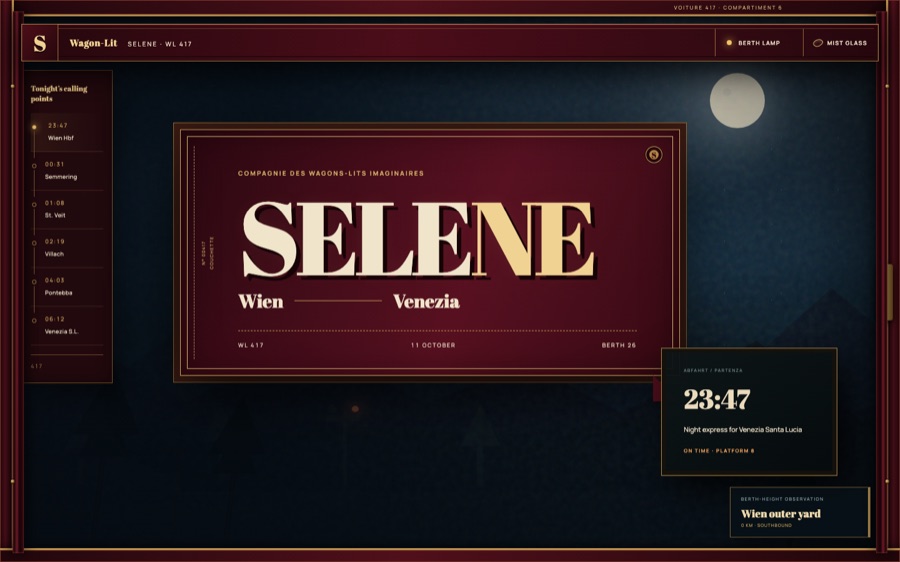
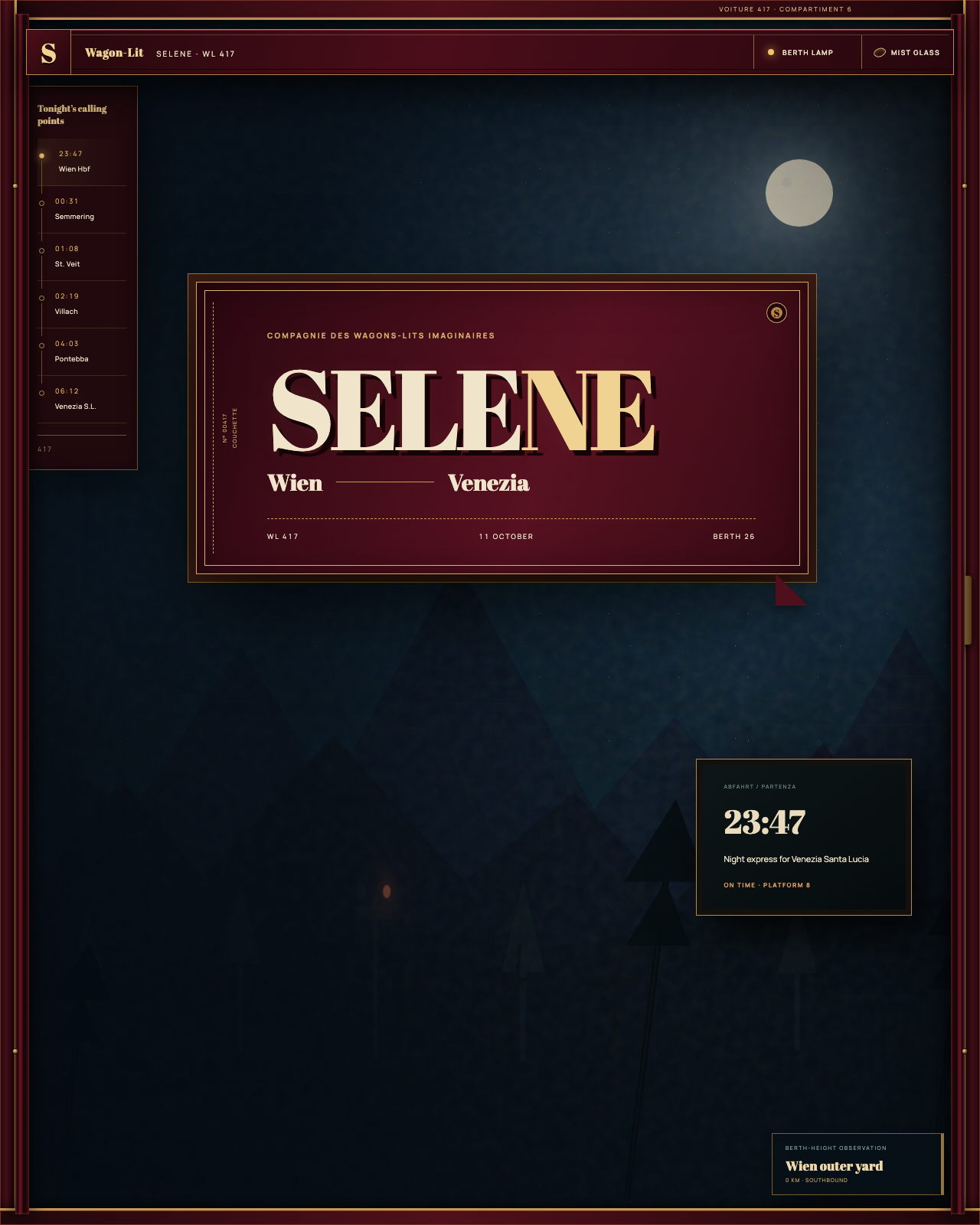
Room 158/175, “Wagon-Lit SELENE — Wien to Venezia by Night,” is an AI-built exhibition piece: an imagined sleeper-car interior for the fictional night express SELENE, not a real railway or company. Its signature move is to make the browser feel like a window in a moving compartment. Instead of decorating the page with train pictures, the design keeps one landscape in view while notices, timetables and other reading matter appear to belong inside the carriage.
The effect is closer to sitting in a berth than browsing a collection of furniture. As the route travels from Wien toward Venezia, the light and scenery shift around the reader. The room’s identity comes from that persistent view: the interface becomes the glass, and the journey becomes its changing interior backdrop.
Products Worth Considering

Hisense 40-Inch QD4SR Series Hi-QLED FHD Roku Smart TV

Levoit Vital 100S-P Air Purifier with Washable Pre-Filter

TCL 85-Inch QM64L QD-Mini LED 4K Smart Fire TV
As an affiliate, we earn on qualifying purchases.
How the illusion is furnished
The palette divides the imagined compartment into three material zones. Deep bordeaux gives the carriage its lacquered weight; warm brass supplies the hardware accent; and dark blue-black defines the distance beyond the glass. Linen cream lifts the text from those darker surfaces. Abril Fatface lends the larger headings a theatrical, poster-like presence, while Manrope keeps route information, controls and longer notes clear and practical.
The landscape is built from code rather than supplied as a collection of image assets. A fixed exterior combines inline SVG scenery with CSS-drawn details, including moonlight, wires, signals, water and foreground shapes. These layers move at different rates, giving the view a sense of depth without replacing it as the page scrolls. A single normalized journey value coordinates the movement, while scene changes adjust the look of the glass as the train passes through different environments.
That glass is the most tactile interaction. In a tunnel, a dark reflection brings carriage details back into the window; in other stretches, the same surface responds to the platform, water or dawn. A mist control lets visitors clear a path through condensation to uncover a small hidden note. The interaction suits the room’s premise: the reader does not just look at a landscape but briefly acts on the pane between the compartment and the outside world.
The content follows the same material logic. A ticket-like opening, linen-inspired reading surfaces and a route menu with a printer’s-rule detail make the information feel like objects from the fictional journey, not generic cards dropped into a template. A berth illustration uses clickable, keyboard-accessible hotspots to reveal its parts. The result is interior design expressed through interface decisions: materials shape the reading experience, and each control has a role within the room’s fiction.
Motion has boundaries, too. The moving scenery is composed from lightweight transforms, and ambient animation pauses when the page is out of view. Reduced-motion preferences turn the journey into a still composition and remove several animated effects. The route remains usable on small screens, with touch-friendly stops, keyboard support and a drawer that can be closed with Escape.
Want this? Paste this into your AI coding agent
Build a single-page showcase website from this art-direction brief. Work like an elite creative frontend engineer; commit totally to the direction.
BRIEF (room 158 of 175, “wagonlit”):
WAGON-LIT — night express SELENE, Wien→Venezia (fictional line, golden-age sleeper register). Aesthetic: bordeaux lacquer, brass, linen; the world passing at berth height. Palette: sleeper bordeaux, brass, window-night blue, linen cream. Fonts: abril-fatface (poster display), manrope (body). SIGNATURE: THE WINDOW — the page is your berth window: a continuous parallax nightscape (SVG layers) passes behind the content for your ENTIRE visit — lonely signal lights, sodium-lit platforms, a slice of lake with a moon path, tunnel blackouts that briefly mirror the “compartment” (your reading) in the glass. The timetable is the nav (23:47 Wien Hbf … 02:19 Villach, invented halts included); border-crossing stamps interleave as section dividers (passport thunk). Compartment anatomy (the ladder, the wool blanket’s tartan, the attendant’s triple knock), dining-car last-seating menu, the 06:12 arrival across the lagoon as finale. Unforgettable: reading a whole site through a train window.STACK: pure HTML/CSS/JS, no build step, no frameworks, no CDNs or external requests of any kind; self-hosted fonts only; every visual is code (CSS/SVG/canvas/WebGL) — no image assets required.
QUALITY BAR: flawless at 390px, 834px and 1440px with zero horizontal overflow; tap targets >= 44px; semantic landmarks, focus-visible styles, body-text contrast >= 4.5:1; prefers-reduced-motion pauses or simplifies heavy animation; rAF loops pause when the tab is hidden; hold 60fps (cap particle counts, avoid layout thrash); rich invented content everywhere — real-sounding names, numbers and program notes, never lorem ipsum; orchestrate one beautiful staggered load moment plus scroll and hover surprises. FORBIDDEN: Inter/Roboto/Arial/system-ui, purple-gradient-on-white, and cookie-cutter hero+cards+footer layouts.
PROCESS: iterate in three documented passes — (1) build plus builder self-critique, (2) merciless external critique finding and fixing at least ten real problems, (3) art-director elevation from good to unforgettable. Screenshot at all three widths every pass and fix everything you can see.
— Original brief by Claude Fable 5 (art director), executed by the FABLE/175 pipeline.
— This room lives at https://fable-25-830.netlify.app/sites/wagonlit/
This is the verbatim art-direction brief that produced the room — exposed by the exhibition itself via the “Prompt” link in the room’s footer.
From brief to finished compartment
The making-of guide describes a three-pass pipeline: build the room, critique it mercilessly, then have an art director certify the result. Its reproduction notes also show how the brief can steer an AI frontend agent: establish the viewport as a persistent physical object, define the journey and its scene changes, then require responsive layouts, accessible controls and reduced-motion behavior. AI built the site; that is central to the story, not a detail to hide. The guide frames the work as a designed exhibition room rather than a real-world rail service.
The full build notes live in the room’s design guide.
Take a seat by the window
Visit the live Wagon-Lit SELENE room and follow its imagined night route from Wien to Venezia. For more design experiments, browse all 175 rooms at the hub.
Visit the live room → · Browse all 175 rooms
Previously in Wing VII
- Room 155: Luciole — The Synchronous Fireflies of Vallon Creux
- Room 152: Mothlight — A Porch-Light Census
- Room 154: Nightmarket — Mercado de Medianoche
FABLE / 175 is a finished exhibition of 175 fundamentally different websites, each built end-to-end by an AI. This article is part of our series walking through it room by room.