TL;DR

Get furniture and decor delivered free with Prime
- Fast, free delivery on millions of items
- Prime Video, Amazon Music and more included
- Member-only deals all year
A House Beautiful report says several designers are moving away from five textile patterns they consider overused or dated as 2027 approaches. The list includes abstract brushstrokes, mass-market block prints, faux tapestry, ikat and oversized watercolor florals; these are designers’ preferences, not a measured industry-wide trend.
A House Beautiful report on decorating trends ahead of 2027 identifies five textile patterns that interviewed designers say they are ready to use less: abstract brushstrokes, mass-market block prints, faux tapestry, ikat and oversized watercolor florals. The list reflects the designers’ opinions about prints they find overused or dated, rather than survey data showing a broad shift across the industry.
The designers’ objections differ by pattern. Sara Swabb, founder of Storie Collective, said high-contrast abstract brushstroke prints can feel forced when individual marks compete for attention. She favors subtler color changes and the irregularities of hand-painted designs, which she said can add depth and work with other fabrics.
For block prints, the distinction is between hand-stamped fabric and mass-produced versions. Sonia Chauhan, founder of Studio Sonia, described traditional block printing as a process in which a person repeatedly stamps fabric with a hand-carved block. She values the small variations left by that process and said mass-produced prints do not capture the same signs of human handiwork.
Adnan Anwar said he prefers actual tapestry on walls over fabric printed to imitate tapestry, especially for large upholstery projects. Meghan Jay said ikat can be difficult to combine with other patterns and colors, while she and Eve Jean said oversized, watercolor-style florals feel less appealing to them. Jay pointed instead to smaller botanical designs with clearer detail.
How Print Choices Shape a Room
The report offers guidance for readers choosing fabric, upholstery or curtains, but it does not establish that these patterns are broadly disappearing from homes or retailers. Its significance is more limited and practical: the designers describe how scale, contrast, saturation and production method affect whether a print feels balanced to them.
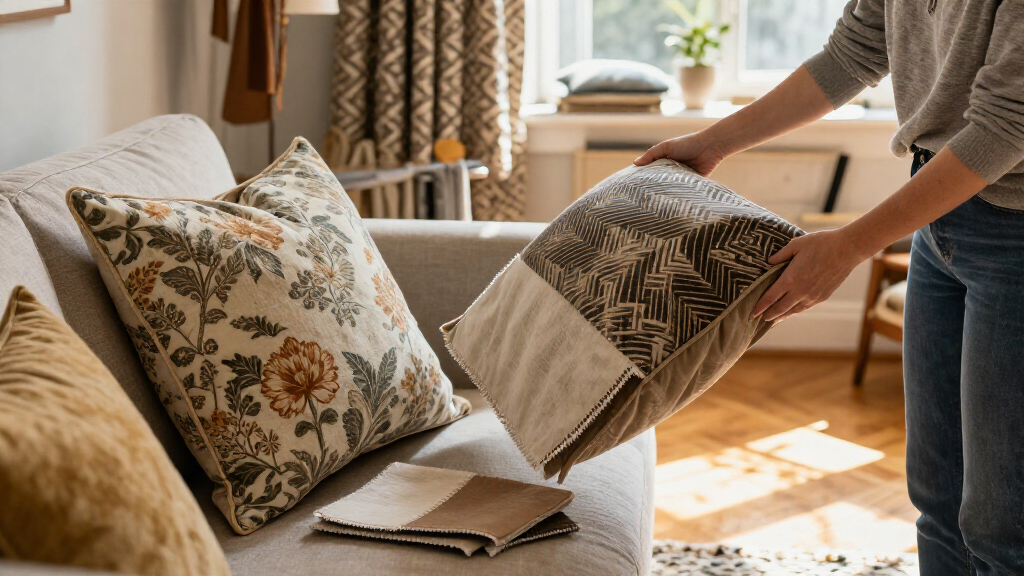
That distinction may matter to shoppers deciding whether to replace existing furnishings. The comments are not a recommendation to discard a particular pattern; they suggest that a print’s execution can shape how it reads. A hand-stamped block print, for example, is not treated as equivalent to a mass-produced imitation, and a single tapestry-print cushion is different from covering an entire sofa in the pattern.
As an affiliate, we earn on qualifying purchases.
The Five Prints in Question
The report frames the comments around the approach of 2027, when designers and retailers often discuss colors and styles expected to gain attention. It describes the five patterns as having reached near-ubiquitous status, but provides no sales figures or other data to establish how common they are. That description should be read as the publication’s framing, not a quantified finding.
The alternatives suggested by the designers are specific rather than universal rules: Swabb favors nuanced, hand-painted-looking textiles; Chauhan prefers genuine hand block printing; Anwar favors actual tapestry remnants over imitation upholstery fabric; and Jay prefers smaller, more defined botanical prints to oversized watercolor florals. The report does not say that every designer shares these preferences.
““They can feel a little forced when the contrast is stark, and every mark competes for attention.””
— Sara Swabb, founder of Storie Collective
How Broad the Shift Is
The report presents individual designers’ views, not a representative survey of designers, retailers or consumers. It does not provide market research, sales trends, polling or a defined timeframe for how the patterns’ popularity has changed. It is therefore unclear whether these preferences signal a wider change or remain personal design judgments.
The source also does not identify particular products or brands that are being discontinued, nor does it say that the patterns are no longer available. Its comments focus on how the designers would use the prints in their own work, and some leave room for selective use—for example, Anwar said tapestry print could work on a pillow.
What Shoppers Can Watch
The report does not announce a formal industry forecast or name a future milestone. Readers can treat its suggestions as a set of design preferences while comparing fabrics in person or reviewing how a pattern works with the colors and textures already in a room. The designers’ comments favor attention to print scale, detail and material origin, rather than a blanket rule to avoid the five patterns.
Whether the preferences become more widespread as 2027 approaches remains to be seen. Evidence such as retailer collections, sales data or broader designer surveys would be needed to show that the patterns are losing popularity across the market.
Key Questions
Which five textile patterns do the designers say they are moving away from?
The report names abstract brushstrokes, mass-market block prints, faux tapestry, ikat and oversized watercolor florals. The comments reflect the interviewed designers’ preferences.
Are these patterns going out of production?
The report does not say that any pattern is being discontinued. It describes designers’ views on prints they find overused or dated.
Do the designers object to all block prints?
No. Sonia Chauhan distinguishes hand-stamped block printing from mass-produced versions and says she values the imperfections created by a person making the fabric.
What floral patterns does Meghan Jay prefer?
Jay said she is drawn to smaller-scale botanical prints with more definition and detail, rather than oversized, washed-out watercolor florals.
Source: rss
Halloween Picks
halloween
As an affiliate, we earn on qualifying purchases.