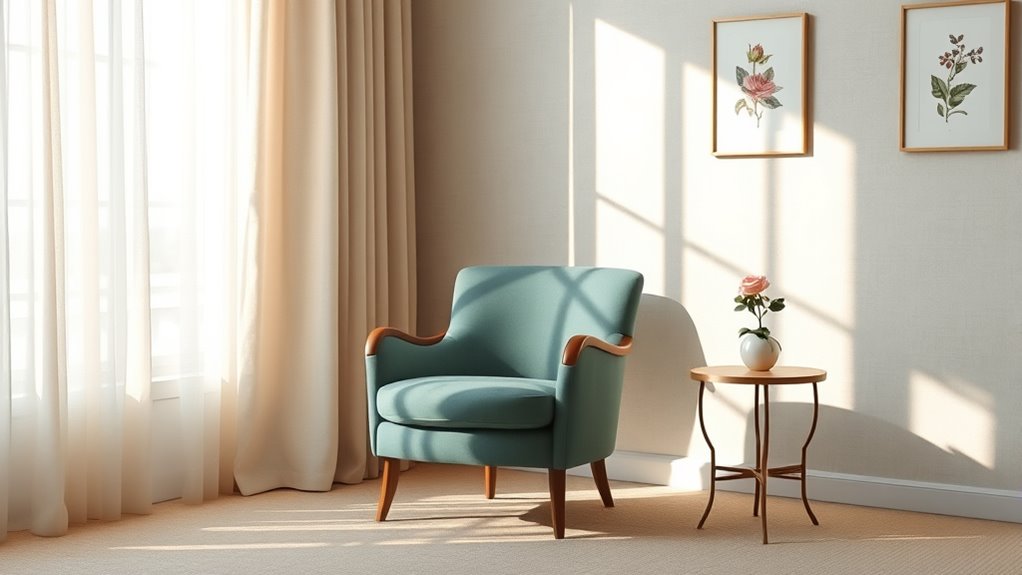

To create focal points that don’t shout, focus on subtle elegance and harmonious placement. Use delicate contrast in textures, tones, and materials to gently guide the eye, avoiding loud colors or jarring elements. Position key features thoughtfully, employing asymmetry or the rule of thirds for a natural flow. Enhance with refined details, soft lighting, and restraint, ensuring each element whispers rather than shouts. Continuing will reveal how to craft spaces that invite quiet admiration and effortless beauty.
Key Takeaways
- Use subtle contrast in textures, tones, and materials to naturally guide attention without overwhelming the space.
- Position focal elements where the eye naturally falls, employing asymmetrical or off-center placement for intrigue.
- Incorporate delicate details and craftsmanship that invite curiosity without loud embellishments.
- Focus on lighting techniques like soft glow and shadow play to highlight focal points gently.
- Limit the number of focal features, maintaining simplicity and restraint for an understated, elegant environment.

Have you ever wondered how to direct attention effortlessly within a space or composition? The secret lies in crafting focal points that draw the eye naturally, without shouting for notice. It’s about creating subtle yet compelling visual cues that guide viewers smoothly, allowing their gaze to wander and settle with intention. The art of these understated focal points involves a delicate balance—where contrast, placement, and detail converge to produce a refined harmony rather than chaos.
Begin by understanding that a focal point should feel organic within its environment, not a stark interruption. You can achieve this by employing contrast in a gentle, sophisticated manner. Instead of loud colors or jarring elements, consider variations in texture, tone, or material that subtly stand apart. For instance, a smooth marble surface can be accented by a single, intricately carved object or a splash of soft, warm lighting. These contrasts won’t shout but will quietly command attention, inviting viewers to explore the space at their own pace. Incorporating visual hierarchy principles ensures that each element contributes meaningfully without overwhelming the senses.
Achieve subtle contrast with textures and lighting to create organic, inviting focal points that draw attention quietly.
Placement is equally essential. You want to position your focal point where the eye naturally falls, often guided by the rule of thirds or asymmetrical balance. Imagine a well-placed sculpture or an elegant arrangement of flowers slightly off-center; it creates a sense of movement and intrigue. The goal is to craft a visual “pause,” a spot where the gaze lingers momentarily before continuing. Think of it as a whisper rather than a shout—an invitation for the viewer to pause and appreciate the detail.
Incorporating subtle details enhances the appeal of your focal point. Fine craftsmanship, delicate ornamentation, or a nuanced play of light and shadow can elevate the element without overwhelming the overall composition. A soft glow can cast gentle highlights, emphasizing form and texture without overpowering the senses. When executed with finesse, these details serve as quiet accents that deepen the aesthetic experience, encouraging a viewer’s curiosity and engagement.
Finally, remember that simplicity often magnifies sophistication. Overloading a space with competing focal points dilutes their power. Instead, focus on one or two carefully curated features that embody your vision. These should be crafted with intention, allowing their understated elegance to speak volumes. When you approach focal points with this mindful restraint, you create environments that feel both inviting and refined—spaces that communicate beauty through subtlety and grace, rather than noise and excess.
Top picks for "creat focal point"
Open Amazon search results for this keyword.
As an affiliate, we earn on qualifying purchases.
Frequently Asked Questions
How Do Color Choices Influence Subtle Focal Points?
Color choices influence subtle focal points by guiding your eye with nuanced contrasts and harmonious palettes. You can use softer shades or analogous hues to draw attention gently, avoiding abrupt shifts that shout. Incorporate variations in tone and saturation to create depth, allowing your focal points to emerge naturally without overwhelming. Thoughtful color selection fosters an elegant balance, subtly capturing interest and inviting closer inspection without shouting for attention.
Can Minimalism Still Feature Effective Focal Points?
A minimalist space can indeed feature effective focal points. Think of a single, carefully chosen object—perhaps a striking sculpture or a bold piece of art—that symbolizes your intent or mood. Through subtle contrast, texture, or placement, this object draws the eye without overwhelming the senses. Your restraint enhances its significance, turning simplicity into sophistication. The key lies in deliberate selection, allowing the focal point to quietly command attention through understated elegance.
What Role Does Texture Play in Understated Focal Design?
Texture plays a subtle yet essential role in understated focal design, adding depth and interest without overwhelming the space. You can achieve this by selecting materials with tactile appeal, like soft fabrics or textured wall finishes, which draw the eye gently. By balancing smooth surfaces with intricate textures, you create a nuanced focal point that invites touch and visual exploration, all while maintaining a refined, minimalist aesthetic.
How Can Lighting Enhance Discreet Focal Points?
You can enhance discreet focal points through thoughtful lighting that subtly highlights texture and form. Use soft, directed illumination to cast gentle shadows, emphasizing delicate details without overwhelming the space. Incorporate dimmable fixtures or concealed lighting to create a sophisticated ambiance, guiding the eye naturally. By carefully balancing brightness and contrast, you draw attention to the focal point elegantly, ensuring it remains engaging yet unobtrusive in your refined design.
Are There Cultural Considerations for Subtle Focal Points?
Yes, cultural considerations shape how subtle focal points are perceived. You should respect local symbolism, colors, and aesthetics to guarantee your design feels harmonious and appropriate. What’s elegant in one culture might be understated or even misunderstood in another. Carefully research cultural nuances, using refined lighting and materials that honor tradition without overwhelming. This thoughtful approach creates a discreet focal point that resonates deeply and elegantly within its cultural context.
Conclusion
Ironically, the quiet allure of a subtle focal point commands more attention than the loudest display. By embracing restraint and delicate details, you craft spaces that speak softly but resonate deeply. It’s in the understated, the refined, where true elegance lives—silent yet so compelling. So, resist the urge to shout; let your focal points whisper, inviting viewers to lean in and discover the beauty in restraint. After all, sometimes less truly is more.