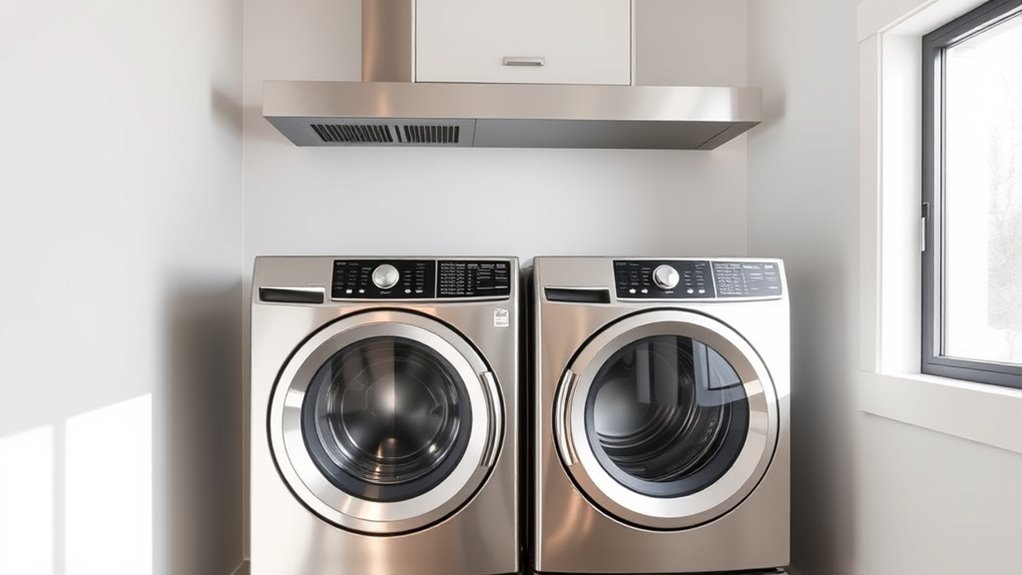

To optimize your laundry room, select washers with capacities of 3.0 to 5.0 cu ft, balancing space and load size, while matching your dryer’s capacity to prevent bottlenecks. Make certain proper venting—using rigid metal ducts for vented dryers and short, straight pathways—to avoid lint buildup and fire hazards. Place appliances on level surfaces near dedicated electrical outlets and accessible plumbing, allowing for safe operation and maintenance. Mastering these details will help prevent issues and improve efficiency throughout your laundry routine.

Get furniture and decor delivered free — and shop member deals
- Fast, free delivery on millions of items
- Access to Prime Big Deal Days deals on October 6–7
- Prime Video, Amazon Music and more included
Key Takeaways
- Match washer and dryer capacities to prevent longer cycles, energy waste, and appliance strain.
- Ensure proper venting with rigid metal ducts and minimal elbows for safety and optimal airflow.
- Place appliances on level surfaces, with enough space for maintenance and proper clearance around vents and electrical outlets.
- Use dedicated 240V outlets for dryers, and secure plumbing hoses with accessible shut-off valves to prevent leaks.
- Consider ventless dryers if venting is challenging, noting they may have longer cycles and higher energy costs.

A well-equipped laundry room relies on a combination of essential appliances that streamline the washing and drying processes. The core appliances—washer and dryer—must be selected based on capacity, venting requirements, and ideal placement to maximize efficiency and safety. Understanding these factors is vital for designing a functional space that minimizes energy consumption and maintenance issues. When choosing a washer, capacity is a primary consideration; larger capacities, such as 4.5 to 5.0 cubic feet, accommodate bulky items like bedding and towels, reducing cycle frequency. Conversely, smaller models around 3.0 cubic feet suit compact spaces and lighter loads, but may require more frequent operation. It’s essential to match the washer’s capacity with your typical laundry volume to prevent overloading, which can strain the motor, impair cleaning performance, and cause premature wear. For dryers, capacity should be comparable to the washer to prevent bottlenecks; a mismatch can lead to longer cycle times or increased energy use. Front-loading washers generally have higher capacities and energy efficiency compared to top-loaders, which may be advantageous in space-constrained environments. Proper ventilation is especially important for vented dryers, as it helps prevent lint buildup and reduces fire hazards; using rigid metal ducts is recommended for optimal airflow and safety. Venting is another vital element influencing appliance performance and safety. Proper venting ensures that moist air and lint are expelled outside, preventing humidity buildup and reducing fire risks. For vented dryers, rigid metal ducts are recommended over flexible plastic or foil hoses, as they resist lint accumulation and allow for better airflow. The vent path should be as straight and short as possible, with a maximum length of about 25 feet, accounting for elbows and transitions that incrementally reduce airflow. Adequate ventilation prevents overheating and enhances drying efficiency, saving energy and prolonging appliance lifespan. For ventless dryers, such as condensing or heat pump models, venting is not required, but these units often have longer drying cycles and higher upfront costs. Proper placement of appliances takes into account venting and electrical considerations. Washers and dryers should be positioned with sufficient clearance for maintenance and airflow — at least a few inches on the sides and back. The dryer must be near a dedicated electrical outlet rated for its power requirements, typically a 240V outlet, and should be grounded properly to avoid electrical hazards. Plumbing connections for washers require secure, leak-free hoses attached to cold and hot water supplies, with valves easily accessible for shut-off. Adequate space allows for unobstructed access to these connections, simplifying repairs and preventing water damage. Additionally, placing appliances on level surfaces prevents vibrations and excessive noise during operation. Overall, meticulous attention to capacity, venting, and placement guarantees your laundry appliances operate efficiently, safely, and with minimal downtime, making your laundry room a truly functional space.
washer and dryer capacity matching
As an affiliate, we earn on qualifying purchases.
As an affiliate, we earn on qualifying purchases.
Frequently Asked Questions
How Do I Choose the Right Capacity for My Household?
You should select a washer and dryer with capacity matching your household size and laundry habits. For small families or singles, 4.0 to 4.5 cubic feet washers suffice. Larger families benefit from 4.5 to 5.0 cubic feet or more, accommodating bulky items like bedding. Consider your laundry frequency and load sizes; oversizing wastes energy, while undersizing leads to overloading and inefficiency. Choose appliances that balance capacity with energy efficiency.
What Are the Best Venting Options for Small Laundry Spaces?
You should opt for a rigid metal vent pipe, as it offers ideal airflow and minimizes fire risk in small laundry spaces. guarantee the duct has a smooth interior to prevent lint buildup and reduce resistance. Use a vent cap with a damper to prevent backdrafts, and keep the duct length as short and straight as possible for maximum efficiency. Proper sealing and regular cleaning are essential for safe operation.
Can Appliances Be Installed in Closets or Tight Areas?
Yes, appliances can be installed in closets or tight spaces, but it requires careful planning. You must guarantee proper ventilation, adequate clearance, and access for maintenance. Install venting kits designed for confined areas and consider space for airflow to prevent overheating. Proper insulation and sealing are essential to avoid moisture buildup. With precise measurements and adherence to manufacturer guidelines, you can optimize small spaces for safe, efficient appliance operation.
How Often Should I Service or Clean My Laundry Appliances?
You should service your laundry appliances every 6 to 12 months to guarantee peak performance. Regularly clean the lint filter after each load, check hoses for leaks or wear every few months, and run a cleaning cycle with specialized cleaner quarterly. Inspect vents for blockages annually, and ensure seals and gaskets remain intact. Proper maintenance prevents breakdowns, improves efficiency, and extends the lifespan of your washer and dryer.
Are There Energy-Efficient Appliance Options for Laundry Rooms?
Yes, there are energy-efficient laundry appliances available. Look for models with ENERGY STAR certification, as they meet strict efficiency standards, reducing water and electricity consumption. Front-loading washers typically use less water and energy than top-loading models. Additionally, high-efficiency dryers with moisture sensors prevent over-drying, saving energy. Consider appliances with advanced cycle options and inverter motors, which optimize performance and reduce energy use, ensuring your laundry routine is both eco-friendly and cost-effective.
Conclusion
By carefully selecting appliances with appropriate capacity, guaranteeing proper venting, and thoughtful placement, you set the stage for a laundry room that functions like a well-orchestrated symphony. Just as Da Vinci’s precision brought masterpieces to life, attention to these technical details ensures efficiency and longevity. Neglecting these factors risks chaos, akin to a dissonant orchestra. Master your laundry space with deliberate choices, turning routine chores into a seamless, harmonious process.
Halloween Picks
halloween
As an affiliate, we earn on qualifying purchases.