TL;DR
Interior designers Phoebe Hollond and Natasha Lyon describe using split artworks that cover a television when not in use and pull apart to reveal the screen. The approach offers a decorative alternative to a visible black TV, though the source does not provide costs, installation details or evidence of wider adoption.
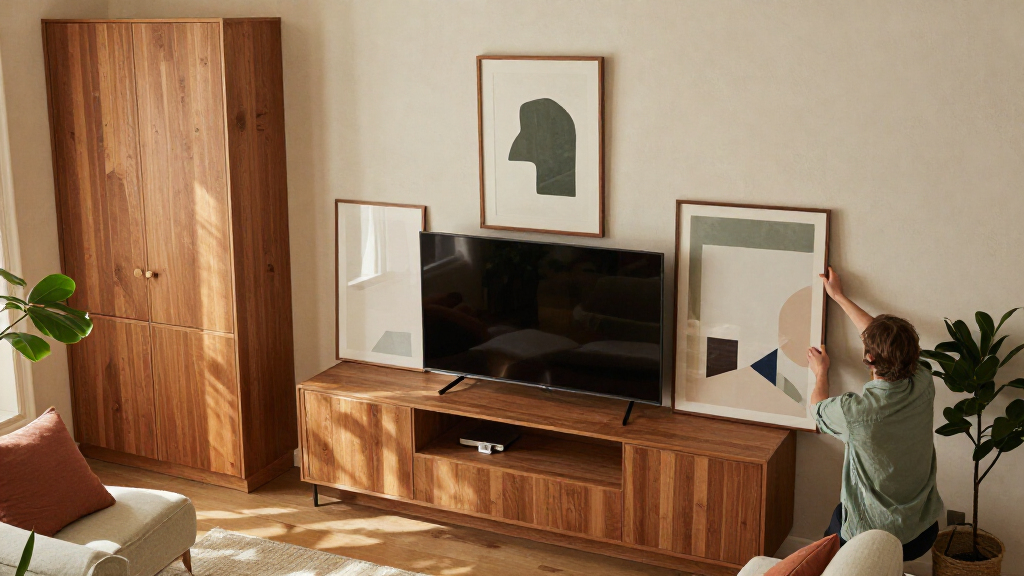
Interior designers Phoebe Hollond and Natasha Lyon are using split-canvas artworks to cover wall-mounted televisions, letting homeowners display a piece of art when the screen is off and pull the panels apart to watch. The bespoke approach addresses a common living-room design problem: a large, dark screen can dominate a carefully arranged space.

Get furniture and decor delivered free with Prime
- Fast, free delivery on millions of items
- Prime Video, Amazon Music and more included
- Member-only deals all year
The artworks are made as two or more movable panels positioned in front of a television. When closed, the panels meet to form a single image or composition; when opened, they expose the screen. The source describes the idea through examples from designers’ projects, rather than a standardized product available from a named retailer.
Hollond, of Studio Hollond, says she has used artwork to disguise TVs and has also created furniture with an automated lift mechanism that raises and lowers a screen. Lyon has worked on several approaches, including a bi-fold cabinet, sliding artwork mounted on a media unit and tapestry wall hangings. These alternatives show that the split-panel design is one option among several, with the choice depending on the room and the installation.
The artwork can be selected or commissioned around a homeowner’s interests. Hollond used a celestial map depicting fixed stars relative to the ecliptic for 1730. Lyon collaborated with Parisian artist Andrea Mongenie on eight bespoke artworks for a project. The source does not specify the projects’ budgets, hardware, or the time needed to make or install the covers.
How Split Artworks Hide a TV and Shape the Room
Custom panels cover the screen when it is off, then move apart for viewing. The approach makes the artwork part of the room’s design while keeping the television available.
How the cover works
Two or more panels sit in front of the television, meeting to form an image and moving aside to reveal the screen.
Select or commission an image that suits the room and the homeowner’s interests.
Close the movable panels to make the artwork the visible feature.
Pull the panels apart when the television is needed.
A bespoke design choice
The examples come from individual designer projects, with artwork tailored to each brief.
A celestial map
Hollond used a map of fixed stars relative to the ecliptic for 1730.
Artist collaboration
Lyon collaborated with Parisian artist Andrea Mongenie on eight bespoke artworks for a project.
Other ways to conceal a TV
The designers describe several approaches; the right fit depends on the room and installation.
| Approach | How it conceals the screen |
|---|---|
| Split artwork | Panels move aside to reveal the television |
| Bi-fold cabinet | Cabinet doors cover the screen |
| Sliding artwork | Artwork moves across the screen |
| Tapestry hangings | Textiles make the screen less visible |
| Automated lift furniture | A mechanism raises and lowers the screen |
What homeowners should clarify
The source gives no project specifications, so practical details need to be discussed with a designer or maker.
- Cost, dimensions and materials
- How the panels move and mount
- Fit with the television and surrounding furniture
- Access to cables and screen ventilation
Turning a Screen Into a Design Feature
The practical appeal is straightforward: the television remains available, but it is less visually prominent when not being watched. For people who want a more composed living room without removing a screen, a movable artwork offers a way to change the room’s appearance without giving up the device.
The design also gives the wall above or around the television a decorative purpose. Rather than treating the screen as the room’s focal point, a homeowner can use a custom image to reflect personal interests and color choices. That benefit is an aesthetic judgment, not a guarantee that the arrangement will suit every home: the panels still need space to open and must work with the television’s position and surrounding furniture.
Lyon links the idea to a wish to reduce the screen’s presence in everyday life. She says she considers mental health alongside functionality in her work and wanted to create a way to shut out visual and sound distractions. A cover can hide a screen when it is off, but the source does not establish that this changes viewing habits or produces measurable wellbeing benefits.
Products Worth Considering

Levoit Vital Pet Pro Smart Air Purifier for Large Rooms

Sonos Roam 2 Portable Waterproof Bluetooth Speaker, White

eufy Security 5-Piece Home Alarm Kit
As an affiliate, we earn on qualifying purchases.
Other Ways to Conceal a Television
Designers have long used cabinetry, artwork and textiles to make televisions less noticeable. The projects described here place split artwork in that broader set of solutions. Compared with a fixed picture, a multi-panel cover is designed to move aside; compared with a cabinet or lift, it makes the disguise itself part of the wall’s decoration.
Hollond says she has previously used automated lift furniture, while Lyon lists a bi-fold cabinet, sliding artwork and tapestry hangings as other options she has designed. The source presents these as examples from their work, not as a survey of the interior-design industry. It does not establish how common split artworks are or whether demand is growing.
The artwork choices in the examples are specific to their projects: Hollond’s celestial map reflects her interest in astrology, while Lyon’s work involved collaboration with an artist. That personal approach distinguishes the installations from a generic screen cover, but it may also mean the design and fabrication process varies from project to project.
“TVs on the whole are ugly; they are not something you should have on your walls, so why not put them in a TV box and hide them with a piece of art.”
— Phoebe Hollond, Studio Hollond
Costs, Hardware and Fit Are Unspecified
The source does not give pricing, dimensions, materials or installation instructions for the projects. It is also unclear whether the panels move manually or use a particular track or mechanism in each case, beyond Hollond’s separate example of automated lift furniture. Readers would need to confirm those details with a designer or maker before planning a similar installation.
No independent evaluation is provided of durability, ease of use, access to cables, ventilation or compatibility with different screen sizes. The source also does not establish how widely designers are adopting the approach, or whether the projects described are available as ready-made products. Claims about reducing distraction or supporting wellbeing are the designers’ stated intentions, not measured outcomes in the material supplied.
Project Details Depend on the Home
No product launch, release date or broader industry announcement is identified, so there is no confirmed next milestone. The examples point instead to a project-by-project design process: selecting the artwork, deciding how the panels open and making sure the arrangement fits the television and room.
Anyone considering the approach would need to ask a designer or fabricator about measurements, mounting, panel movement, access to the screen and the total cost. Until those details are published for a specific installation or product, the split artwork is best understood as a bespoke design solution rather than a defined retail offering.
Key Questions
How does a split artwork hide a television?
Two or more panels sit in front of the screen and join to display a larger artwork. The panels move apart when the television is needed.
Is the artwork a standard product?
The source describes custom projects by interior designers and does not identify a standard product or retailer. Availability and pricing are not provided.
What other ways have the designers concealed TVs?
The designers cite bi-fold cabinets, sliding artwork, tapestry hangings and furniture with an automated lift as alternatives or related approaches.
Does hiding a TV improve wellbeing?
Lyon says reducing the screen’s visual presence and distractions informed her design. The source provides no measured evidence that the approach improves wellbeing or changes viewing habits.
Source: livingetc.com