
TL;DR
Interior designers interviewed by House Beautiful describe growing interest in cook’s tables as a more flexible, visually lighter alternative to built-in kitchen islands. The source does not establish that cook’s tables will replace islands in 2027; their fit depends on room size, circulation needs and how much storage a household requires.
Freestanding cook’s tables are gaining attention as an alternative to built-in kitchen islands, according to a House Beautiful report featuring interior designers. The tables can offer a lighter, movable work and gathering surface, but the report does not show that they will replace islands in 2027 or that the shift is universal.

Get furniture and decor delivered free with Prime
- Fast, free delivery on millions of items
- Prime Video, Amazon Music and more included
- Member-only deals all year
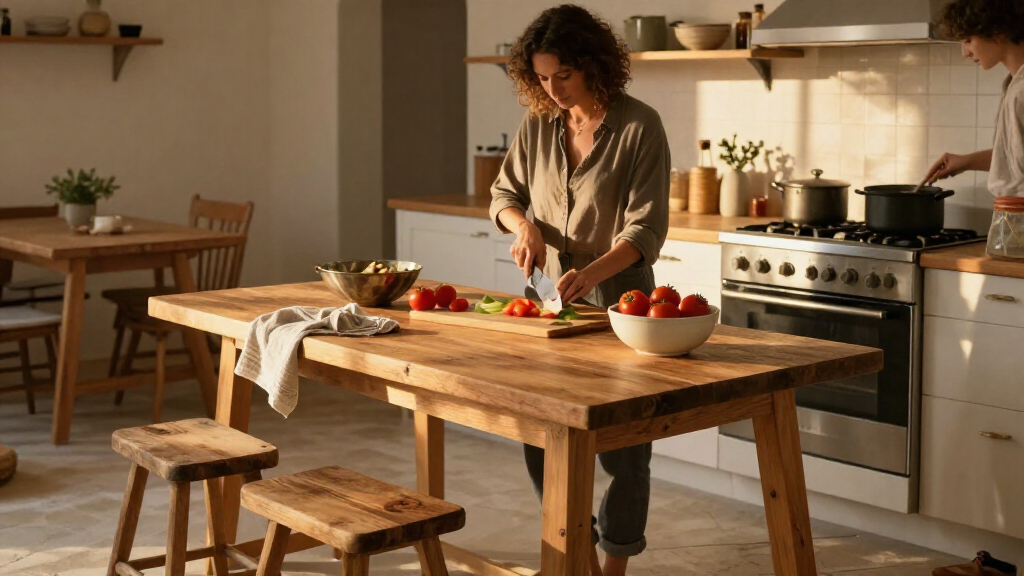
Designers say a cook’s table can serve as a food-preparation surface, dining spot and informal gathering place without the fixed cabinetry and bulky base of a conventional island. Its freestanding design may leave a kitchen feeling more open, particularly where a large island would occupy much of the available floor area. Some tables can be moved, especially when fitted with casters.
The appeal is also visual. Many examples are made of wood and have furniture-like details, such as turned legs or curved shapes. Vintage and antique tables can add signs of age and character, while custom-made pieces can be selected to fit a room. Designers quoted in the report describe the style as more relaxed and approachable than a standard built-in island.
Size and circulation remain practical constraints. Becky Ducsik of The Phinery recommends leaving four to five feet of clearance around a cook’s table to allow comfortable movement. That spacing may not be possible in every kitchen. For a tighter layout, Ducsik suggests a table-like peninsula attached to the end of cabinetry as an alternative way to create a communal surface.
Could Cook’s Tables Replace Islands?What the 2027 trend says
Designers describe growing interest in freestanding cook’s tables, but the report does not establish that they will replace kitchen islands in 2027.
A different fit for the room
The choice affects movement, storage and how the kitchen is used.
- Freestanding and potentially movable
- Can offer a lighter work and gathering surface
- Usually has less integrated storage
- Fixed central work surface
- Can include substantial cabinetry and appliances
- May feel bulky in a compact room
Why designers are drawn to them
Furniture-like details can bring warmth and character to kitchens used for cooking and gathering.
An adaptable surface
Some tables can be moved, especially when fitted with casters.
A furniture feel
Wood, turned legs and vintage or custom designs can make the kitchen feel more relaxed.
Check the layout first
Choose for the room’s circulation, working height and storage needs.
Becky Ducsik recommends four to five feet around the table where possible.
Some vintage tables sit below standard counter height and may need modification.
Consider whether the kitchen can do without the cabinetry or appliances an island provides.
A Different Fit for Kitchen Layouts
The choice matters because a kitchen’s central work surface affects movement, storage and everyday use. A built-in island can provide substantial cabinetry and a fixed place for appliances; a cook’s table offers less integrated storage but can be easier to reposition and may take up less visual space. The trade-off is not simply between two looks: it involves how people cook, gather and move through the room.
For households with limited floor area, a smaller freestanding table may make the kitchen more usable than an island that crowds circulation. In larger kitchens, designers say a carefully chosen table can act as a focal point when storage and appliances are arranged along the perimeter. The report presents these as design options, not proof of a broad market shift or a forecast that islands are on their way out.
The furniture approach also changes how a kitchen feels. Designers cited in the report connect the interest in more communal spaces with the importance homeowners place on gathering at home. A table can support that use without making the kitchen’s center feel dominated by built-in cabinetry.
Products Worth Considering

Dyson V8 Cordless Vacuum

Arlo Pro Wireless Security Camera, 2K HDR, 6th Gen, 4-Camera System

Hisense 40-Inch QD4SR Series Hi-QLED Full HD Smart Roku TV
As an affiliate, we earn on qualifying purchases.
Why Designers Favor Furniture-Like Pieces
Kitchen islands have long been used as central work areas, often combining preparation space, storage, appliances and seating. The report describes a growing interest among some designers and homeowners in smaller, freestanding pieces that feel less permanent and visually imposing. It links that preference to a wider move away from ultra-sleek, minimal interiors toward materials and objects with warmth and character.
Several designers frame the cook’s table as a response to how kitchens are used for more than cooking. Becky Ducsik says the pandemic placed greater value on home spaces designed for connection. Cynthia Lananh describes the table as a way to combine practical use with personality. These are attributed views from designers, rather than survey findings or evidence that all homeowners share the preference.
The report also notes that a cook’s table can work in either a small or large room, but for different reasons. In a compact or galley kitchen, its narrower profile may help preserve openness. In a larger room, a vintage or custom piece can serve as a centerpiece if storage and appliances are handled elsewhere.
““A traditional island can dominate a kitchen.””
— Amy Sklar, interior designer
No Evidence of a 2027 Switch
The central uncertainty is whether this design interest will become a broad replacement for kitchen islands. The source offers designer observations and recommendations, but no sales figures, homeowner survey, construction data or forecast supporting a 2027 tipping point. “Could replace” is therefore a possibility raised by the trend framing, not a confirmed outcome.
It is also unclear how well the option suits households that rely on island storage, built-in appliances or a fixed counter-height work surface. The report does not compare costs or quantify how much space different table designs save. Vintage pieces may also vary in height and condition; designer Amy Sklar notes that some sit below standard counter height and may need casters or leg extensions to work for food preparation.
Measure the Room Before Choosing
For homeowners weighing the options, the immediate next step is to assess clearance, working height and storage needs, rather than assume a cook’s table will suit every kitchen. The designers recommend choosing a piece proportional to the room and preserving enough space to move around it. Ducsik’s suggested four-to-five-foot clearance is a design guideline from the report, not a guarantee that every layout can accommodate that distance.
Material and shape are further choices. Cynthia Lananh recommends durable woods such as oak, maple or walnut; reclaimed wood can add a more rustic look, while metal or butcher-block tops offer different appearances and uses. Curved corners may soften a room, while rectangular tables can provide more seating or preparation area. The report offers no specific 2027 forecast or scheduled follow-up data, so whether the trend expands will depend on future homeowner choices and design-market evidence.
Key Questions
Are cook’s tables expected to replace kitchen islands in 2027?
That has not been established. The report describes growing interest among some designers and homeowners but provides no market data or forecast showing that cook’s tables will broadly replace islands by 2027.
What is a cook’s table?
A cook’s table is a freestanding table used in a kitchen, often for food preparation, dining or gathering. Unlike a built-in island, it is not fixed to cabinetry and may be movable, particularly if fitted with casters.
Can a cook’s table work in a small kitchen?
It may suit a smaller kitchen because it can be narrower and visually lighter than a built-in island. The room still needs enough space for safe, comfortable circulation; the report’s designer Becky Ducsik recommends four to five feet of clearance around the table where possible.
What should homeowners check before buying one?
Check the table’s size, height, material and clearance. Some vintage tables sit lower than standard counters and may need modification for preparation work. Also consider whether the kitchen can do without the storage or appliances a built-in island might provide.
Source: housebeautiful.com