TL;DR
House Beautiful’s report presents an IKEA-designed children’s room organized around how a child uses the space, with reachable storage, play areas and a hideaway nook. The video highlights specific IKEA products, but the source does not provide prices, availability details or evidence about how children or families have used the design.
House Beautiful has presented an IKEA children’s-room design built around a child’s point of view, using reachable storage, floor-based play zones and a tucked-away reading or play nook. The report, led by Associate Shopping Editor Janae McKenzie, frames the room as an effort to balance imaginative play with the everyday need to keep belongings organized.

Get furniture and decor delivered free with Prime
- Fast, free delivery on millions of items
- Prime Video, Amazon Music and more included
- Member-only deals all year
The report’s central idea is to arrange furniture and storage at a child’s height. It says that when children can reach places for toys and clothes, routine tasks may become easier for them to manage independently. The examples shown include IKEA’s house-shaped VITBJÖRN storage unit for toys and a cactus-shaped clothes stand. The source describes these as design choices that can encourage children to take ownership of their space; it does not report measured results or family experiences.
For play, the design uses rugs to mark out areas on the floor, where children often spend time. House Beautiful names the nature-inspired GREJSIMOJS rug as a setting for imaginative “wilderness” play and the cityscape-style HUSSPARV rug as a surface that can suggest a city. These are presented as ways to give play a defined area without adding walls or separate rooms.
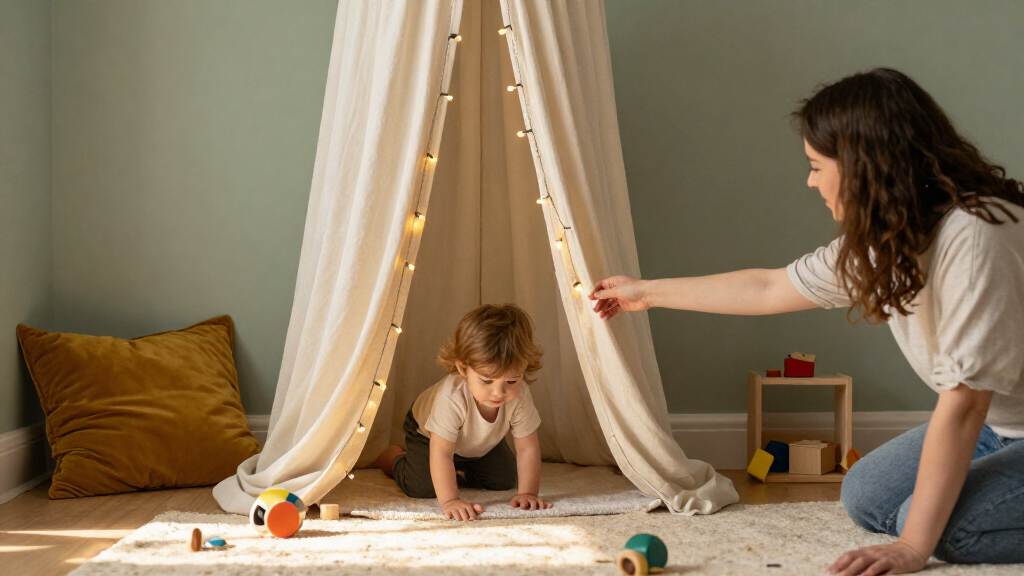
A KURA reversible bed forms the basis of a small retreat. According to the report, raising the bed can create a nook for reading or playing, and an optional coordinating screen can make the corner feel more enclosed or be removed to open up the play area. The source says the screen can also hide clutter, but provides no detail on dimensions, assembly, safety guidance or which configurations are available for purchase.
A Room Built for Everyday Independence
The design illustrates a practical question for families: how to make a child’s room inviting for play while still supporting daily routines. Child-height storage places toys and clothes within reach, while rugs and a nook give activities a clearer place in the room. The concept makes children’s access and use of the floor central to the layout rather than treating the bedroom only as a place to sleep.
That approach may be useful to readers planning a shared or compact room, because the features shown serve more than one purpose: a bed can also help define a retreat, and a rug can distinguish a play area. Still, the report is a product-focused design presentation, not an evaluation of the products’ long-term durability, affordability or effects on children’s behavior. Those practical questions are not answered in the supplied material.
Products Worth Considering

Ring Alarm 5-Piece Home Security Kit

Levoit Vital 200S-P Smart Air Purifier for Large Rooms (Up to 1875 sq ft)

Shark Rocket Pet Plus Corded Stick Vacuum, Bordeaux/Silver, HV322
As an affiliate, we earn on qualifying purchases.
The Design Choices in the Video
House Beautiful introduces the video as a demonstration of how IKEA products can help create a room that works for both children and adults. Its organizing principle is to think at a child’s level: place useful items where children can reach them, and recognize that the floor can function as an important play space.
The products named in the report each serve a particular role in that concept: VITBJÖRN storage and the cactus-shaped stand address tidying, GREJSIMOJS and HUSSPARV rugs suggest different play settings, and the KURA bed with its coordinating screen provides the hideaway option. The source does not describe this as a completed customer installation or give a project location. It presents the room through a video and accompanying product descriptions.
“Think at their level.”
— House Beautiful
Details the Report Does Not Provide
The supplied report does not state when the video was published, the cost of the featured items, or whether each product is currently available in every market. It also gives no room dimensions, installation instructions, or information about how the furniture and screen should be configured for a particular child or space.
The suggested benefits are presented as design aims rather than verified outcomes. The report says accessible storage can encourage children to put belongings away, but it does not include research, interviews with families or follow-up evidence. Readers should treat the claims about independence and organization as the report’s rationale for the design, not as a guarantee that the products will produce those results.
How Readers Can Explore the Setup
House Beautiful directs readers to watch the video and use its “Shop the Room” feature to view the IKEA items shown. The source does not announce a future event or product launch, so no further milestone is specified. Anyone considering the layout would need to check current product listings and suitability for their room independently, since the report does not supply pricing, measurements or detailed setup guidance.
Key Questions
What is the room design meant to do?
It aims to combine imaginative play and practical organization by giving children reachable storage, defined floor-play areas and a small retreat.
Which IKEA products does the report feature?
The report names the VITBJÖRN storage unit, a cactus-shaped clothes stand, GREJSIMOJS and HUSSPARV rugs, and the KURA reversible bed with a coordinating screen.
How does the design create a hideaway?
According to House Beautiful, raising the KURA reversible bed can create a nook for reading or play. A coordinating screen can make the space feel more enclosed and can be removed to reopen the play area.
Does the report give prices or prove the design improves organization?
No. The supplied source gives no prices or measured results. It presents easier tidying and greater independence as potential benefits of child-height storage, not as outcomes demonstrated by research.
Source: housebeautiful.com