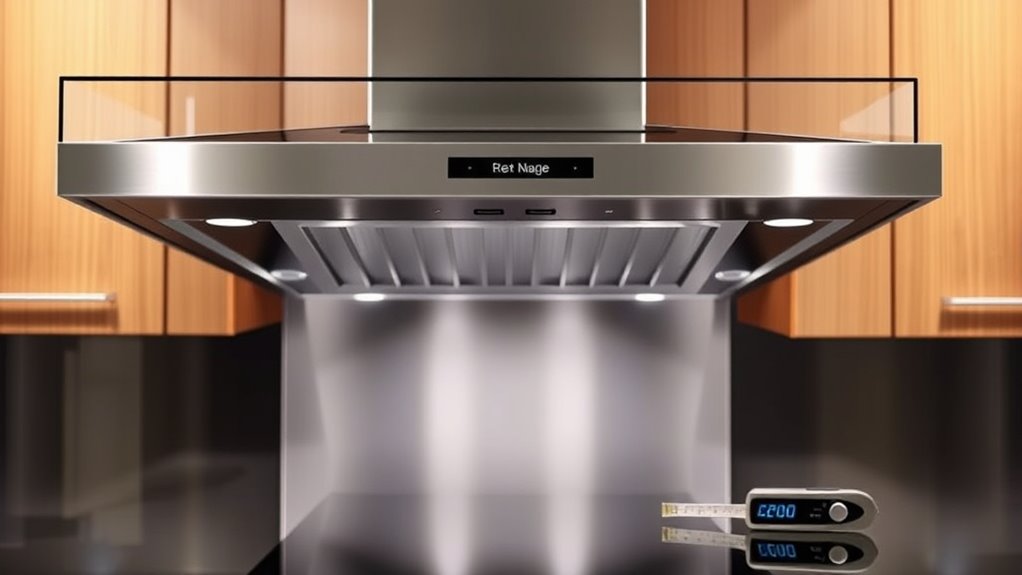

To calculate your range hood CFM, first measure your kitchen’s volume by multiplying length, width, and ceiling height in cubic feet. Then, determine the needed air exchanges per hour, typically 15, which gives you the base CFM by multiplying volume by 15 and dividing by 60. Adjust this number upward by 20-25% to account for system inefficiencies and duct losses. Considering your cooking habits and duct setup ensures maximum performance—more details follow.
Key Takeaways
- Measure your kitchen’s volume (length x width x height) in cubic feet for accurate ventilation needs.
- Calculate basic CFM by multiplying kitchen volume by 15 air exchanges per hour, then divide by 60.
- Increase the raw CFM estimate by 20-25% to account for duct losses, filters, and system inefficiencies.
- Consider your cooking habits; high-heat or frying require higher CFM for effective smoke and odor removal.
- Ensure duct design minimizes resistance; longer runs and elbows may necessitate higher CFM to maintain airflow.
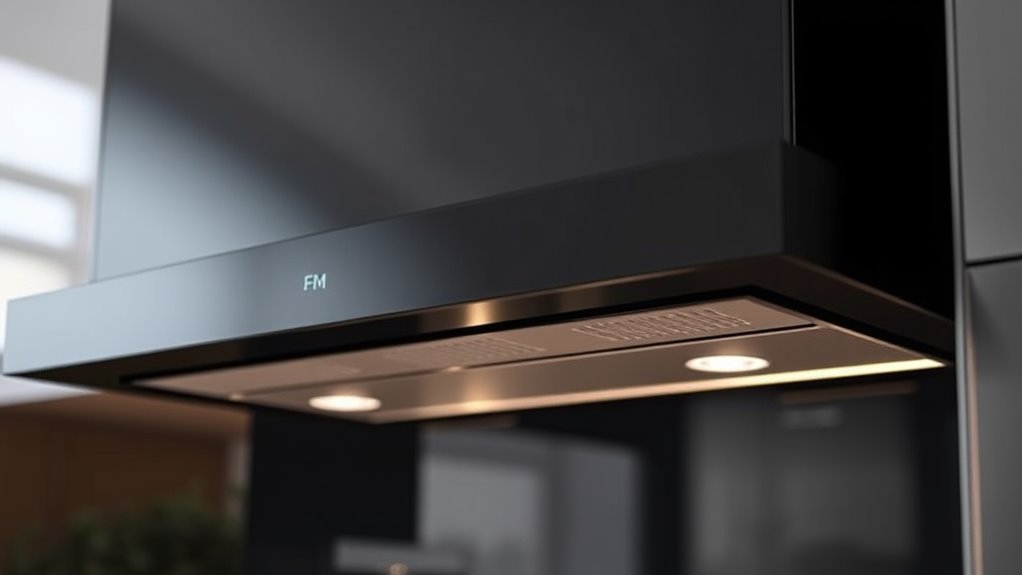
Have you ever wondered how to determine the appropriate CFM (Cubic Feet per Minute) for your range hood? The correct calculation hinges on understanding the volume of your kitchen and the frequency of air exchanges needed to maintain proper ventilation. To start, you must measure the total volume of your kitchen, which is the product of its length, width, and ceiling height, all expressed in feet. For example, if your kitchen measures 12 feet by 15 feet with an 8-foot ceiling, the volume equals 12 x 15 x 8, totaling 1,440 cubic feet.
Next, you need to consider the recommended air exchange rate, which varies based on the type of cooking you do and local building codes. For typical residential kitchens, a standard recommendation is to exchange the air volume 15 times per hour. To convert this to a per-minute rate, divide the hourly exchange rate by 60. So, for 15 exchanges per hour, you multiply the kitchen volume by 15 and then divide by 60 to obtain the required CFM: (1,440 x 15) / 60, which equals 360 CFM. This figure represents the minimum airflow needed to effectively replace all air in the kitchen every four minutes.
However, this calculation assumes a perfectly sealed environment and ignores factors like duct losses, filter resistance, and hood placement. To account for these, you should adjust the raw CFM value upward by approximately 20-25%. For example, multiplying 360 CFM by 1.25 results in roughly 450 CFM, providing a buffer to compensate for real-world inefficiencies. Additionally, if you engage in high-heat cooking, frying, or use multiple burners simultaneously, increasing the ventilation capacity is prudent. In such cases, selecting a hood with a higher CFM rating ensures adequate removal of smoke, grease, and odors.
It’s also important to consider duct design, as longer duct runs and multiple elbows increase resistance, reducing effective airflow. You may need to select a range hood with a higher CFM rating than the basic calculation suggests to compensate for these losses. Always review manufacturer specifications and installation instructions, ensuring the selected hood can deliver the calculated airflow despite duct restrictions. Proper duct design considerations and understanding system inefficiencies are crucial for optimal performance. In sum, precise calculation involves measuring your kitchen’s volume, applying appropriate air exchange rates, adjusting for system inefficiencies, and considering your cooking habits and duct configuration. This comprehensive approach guarantees optimal ventilation performance tailored to your specific environment.
As an affiliate, we earn on qualifying purchases.
Frequently Asked Questions
How Often Should I Clean My Range Hood Filter?
You should clean your range hood filter every 1 to 3 months, depending on usage. If you cook frequently or use oils heavily, cleaning once a month is advisable. Remove the filter and soak it in warm, soapy water or degreaser to break down grease and debris. Regular cleaning maintains ideal airflow and prevents grease buildup, ensuring your range hood functions efficiently and prolongs its lifespan.
Can a Higher CFM Cause Excessive Noise?
Studies show that noise levels increase by approximately 3 decibels for every 100 CFM increase. A higher CFM can cause excessive noise, especially if your range hood’s motor struggles with the airflow demands. This noise results from the motor working harder to maintain airflow, which can lead to discomfort and reduced effectiveness. To balance ventilation and noise, select a CFM rating suited to your kitchen size and cooking style.
Is CFM More Important Than Hood Size?
CFM is more vital than hood size because it determines the hood’s airflow capacity, directly impacting ventilation efficiency. A higher CFM ensures better removal of smoke, odors, and airborne particles, regardless of hood dimensions. While larger hoods can accommodate higher CFM, selecting the right CFM for your cooking volume is essential. Prioritize CFM to optimize performance, especially if you frequently cook with high heat or produce strong odors.
How Does Duct Length Affect CFM Efficiency?
Duct length dramatically impacts CFM efficiency—longer ducts cause significant air resistance, reducing your hood’s suction power like trying to breathe through a clogged straw. Every additional foot of ductwork can slash your hood’s airflow by up to 10%, forcing your vent to work harder and less effectively. To maximize performance, keep duct runs as short and straight as possible, using smooth, rigid materials to minimize resistance and guarantee ideal airflow.
What Safety Precautions Are Needed for High-Cfm Hoods?
You should guarantee proper installation of high-CFM hoods by securing adequate ductwork support to prevent vibrations and noise. Use fire-resistant materials and maintain clearance from combustible surfaces. Regularly inspect and clean filters to prevent fire hazards. Install a backdraft damper to minimize airflow reversal, and verify electrical connections meet safety standards. Always follow manufacturer guidelines and local building codes to ensure safe operation and maximize the hood’s efficiency.
Conclusion
By accurately calculating your range hood’s CFM, you guarantee ideal ventilation and air quality. While some might think higher CFM is always better, oversizing can lead to unnecessary noise and energy use. Instead, focus on precise calculations based on your kitchen’s volume and cooking habits. This approach guarantees effective removal of fumes without excess, balancing performance and efficiency. Properly selected CFM not only improves air quality but also prolongs the lifespan of your ventilation system.