
In new construction, layering your lighting involves combining ambient, task, accent, and decorative fixtures to achieve a balanced, functional environment. Ambient lighting provides overall brightness, while task lighting focuses on specific work areas. Accent lighting highlights architectural features or artwork, and decorative fixtures add aesthetic appeal. Precise planning guarantees proper fixture placement, beam angles, and control systems for seamless operation. Continuing with this approach, you’ll gain insights into creating efficient, cohesive lighting schemes that elevate your space’s design and functionality.
Key Takeaways
- Layered lighting combines ambient, task, accent, and decorative lighting to create balanced and functional spaces.
- Proper planning ensures each layer complements the others, enhancing both aesthetics and efficiency.
- Ambient lighting provides overall brightness, serving as the foundation for other layers.
- Task lighting focuses on specific work areas to improve visibility and reduce glare.
- Accent and decorative lighting highlight features and add visual interest, completing a cohesive lighting design.
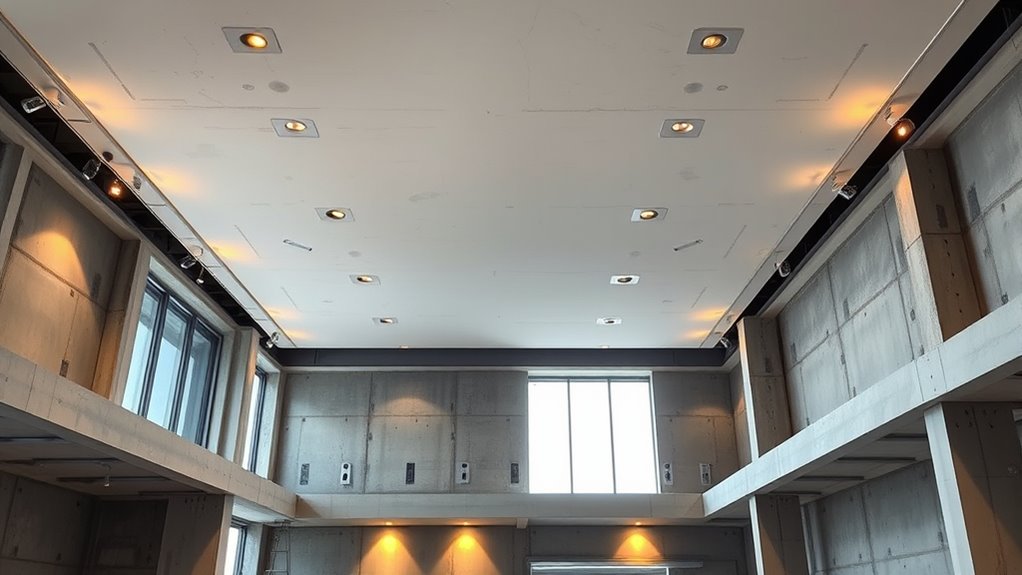
Have you considered how layered lighting can enhance both functionality and aesthetics in new construction projects? This approach involves deploying multiple lighting types—ambient, task, accent, and decorative—to achieve a balanced, efficient, and visually appealing environment. Each layer serves a specific purpose, and understanding their technical functions is essential for ideal integration. Ambient lighting provides general illumination, typically achieved through ceiling-mounted fixtures, recessed cans, or LED panels. It establishes the foundational brightness level, ensuring uniform light distribution across the space. When selecting fixtures, consider lumen output, color temperature, and beam spread to match the room’s size and purpose, avoiding over- or under-lighting.
Layered lighting with ambient, task, accent, and decorative layers boosts functionality and aesthetics in new spaces.
Task lighting is focused and directional, designed to illuminate specific work areas with precision. Examples include under-cabinet lights in kitchens, pendant fixtures over islands, or adjustable reading lamps. The key technical consideration here is luminaire placement and control. You must evaluate the ideal mounting height, wattage, and beam angle to prevent glare and shadows, ensuring sufficient light intensity for detailed tasks. Compatibility with dimming systems enhances flexibility, allowing users to adjust brightness according to activity or time of day.
Accent lighting emphasizes architectural features, artwork, or textured surfaces. This layer adds depth and visual interest, often achieved through spotlights, track lighting, or wall washers. When designing this layer, precise aiming and beam control are critical to avoid spill light and maintain focus on targeted elements. Selecting fixtures with adjustable trims or lenses enables fine-tuning of light spread, optimizing highlight effects while minimizing energy consumption. Proper placement also involves calculating the appropriate beam angle and distance to create desired contrast without overpowering the space.
Decorative lighting acts as a visual focal point, contributing to the overall aesthetic and mood. Chandeliers, sconces, or decorative pendants are common options. Although primarily aesthetic, these fixtures require technical consideration for wiring, voltage compatibility, and integration with control systems. Incorporating smart lighting controls allows seamless operation and scene setting, which can be particularly valuable in multi-functional spaces. Additionally, selecting fixtures with appropriate color rendering indices (CRI) ensures that colors are accurately represented, enhancing the visual impact of decorative elements.
In designing layered lighting, you must also consider electrical load balancing, wiring pathways, and control systems integration. Proper planning ensures each layer functions harmoniously, avoiding conflicts or overlaps that can cause glare, uneven lighting, or energy inefficiency. Understanding the energetic alignment of lighting layers helps in creating a space that supports both aesthetic and functional goals. By meticulously selecting fixtures, aiming, and controlling each layer, you create a cohesive lighting scheme that maximizes both utility and visual appeal in your new construction project.
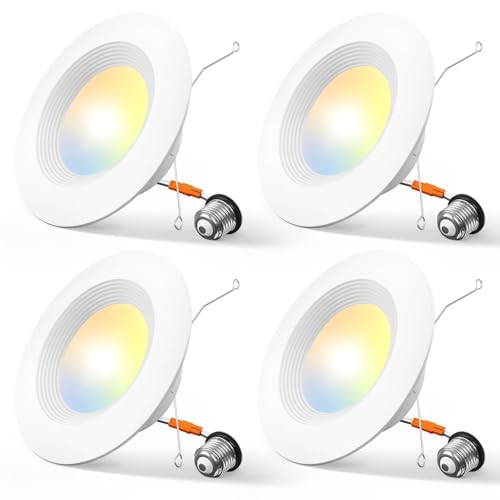
Amico 4 Pack 5/6 inch 5CCT LED Recessed Lighting, Dimmable, 12.5W=100W, 950LM, 2700K/3000K/4000K/5000K/6000K Selectable, Retrofit Can Lights with Baffle Trim, IC Rated – ETL & FCC, White
Eye protection: The brightness of the can lights can be smoothly adjusted from 10% to 100%, so you…
As an affiliate, we earn on qualifying purchases.
As an affiliate, we earn on qualifying purchases.
Frequently Asked Questions
How Do Lighting Layers Impact Energy Efficiency?
Lighting layers substantially boost energy efficiency by enabling you to control different light zones independently, reducing unnecessary energy use. By layering ambient, task, and accent lighting, you optimize illumination levels according to activity, minimizing wastage. You can dim or turn off specific layers when not needed, leading to lower power consumption. This targeted approach not only conserves energy but also enhances occupant comfort and prolongs fixture lifespan.
What Are the Best Practices for Integrating Natural Light?
You should maximize natural light by strategically positioning windows and skylights to enhance daylight penetration while minimizing glare. Incorporate light shelves and reflective surfaces to direct sunlight deeper into spaces, reducing reliance on artificial lighting. Use shading devices like louvers or adjustable blinds to control heat gain and glare during peak hours. Employ daylight sensors linked to your lighting controls for automatic dimming, ensuring energy efficiency without sacrificing occupant comfort.
How Can Smart Lighting Control Enhance Layered Lighting?
Think of smart lighting control as the conductor of your layered lighting symphony. It dynamically adjusts each layer—ambient, task, accent—based on occupancy, daylight, and time. You’ll gain precise control over brightness and color temperature, creating seamless shifts that enhance ambiance and energy efficiency. This automation reduces manual adjustments, guarantees consistent lighting quality, and optimizes energy use, turning your space into a well-orchestrated environment that adapts effortlessly to your needs.
What Are Common Mistakes to Avoid When Designing Lighting Layers?
You should avoid neglecting proper zone zoning, which can cause uneven lighting or glare. Don’t overlook the importance of appropriate fixture placement, as this impacts both function and aesthetics. Make certain you don’t ignore dimming capabilities, which are essential for layered control. Be cautious about overusing high-CRI lighting, which can distort color accuracy. Finally, avoid underestimating the power load, risking system overload or insufficient illumination.
How Do Lighting Layers Influence Overall Interior Design Aesthetics?
Lighting layers crucially influence your interior design aesthetics by creating depth, mood, and visual interest. You actively shape the space’s ambiance through a strategic mix of ambient, task, and accent lighting, which highlights architectural features and enhances functionality. Proper layering ensures balanced illumination, reduces shadows, and complements your color palette and furnishings. This meticulous approach results in a cohesive, inviting environment that reflects your design intent and elevates overall aesthetic appeal.

MCGOR 10inch Under Cabinet Lighting, 2 Pack Rechargeable Motion Sensor Light Indoor, 5 Levels Dimmable Magnetic Closet Lights, Wireless Under Counter Lights for Kitchen, Stairs
Upgraded Motion Sensor Under Cabinet Lights: Setting the under cabinet lights on motion sensor mode, they auto-on when…
As an affiliate, we earn on qualifying purchases.
As an affiliate, we earn on qualifying purchases.
Conclusion
By meticulously designing lighting layers in new construction, you create an environment so perfectly illuminated that every task, mood, and detail is enhanced beyond imagination. When you master layering techniques—ambient, task, accent—you don’t just light a space; you revolutionize it. Your attention to technical precision guarantees energy efficiency, visual clarity, and architectural harmony. In the end, this approach transforms ordinary rooms into breathtakingly functional masterpieces, elevating your construction project from standard to extraordinary—an illumination revolution that leaves no detail in the dark.

AUQUEE 8 Light Track Lighting Fixtures Ceiling, Matte Black Kichen Track Lighting Fixtures, Rotatable Light Heads, Adjustable Modern LED Track Lights for Kitchen/Hallway, No GU10 Bulb
Black 8 Light track lighting fixures ceiling with Long Size: The 55.3'' length allows this kitchen track lighting…
As an affiliate, we earn on qualifying purchases.
As an affiliate, we earn on qualifying purchases.

garini 6 Feet Industrial Black Light Fixture Chain, Adjustable Metal Pendant Chandelier Chain Extension with Detachable Link, Maximum Load is 66 Pounds
Design: Replace damaged old-fashioned links to make your lights still looks good or can ues it to hang…
As an affiliate, we earn on qualifying purchases.
As an affiliate, we earn on qualifying purchases.